
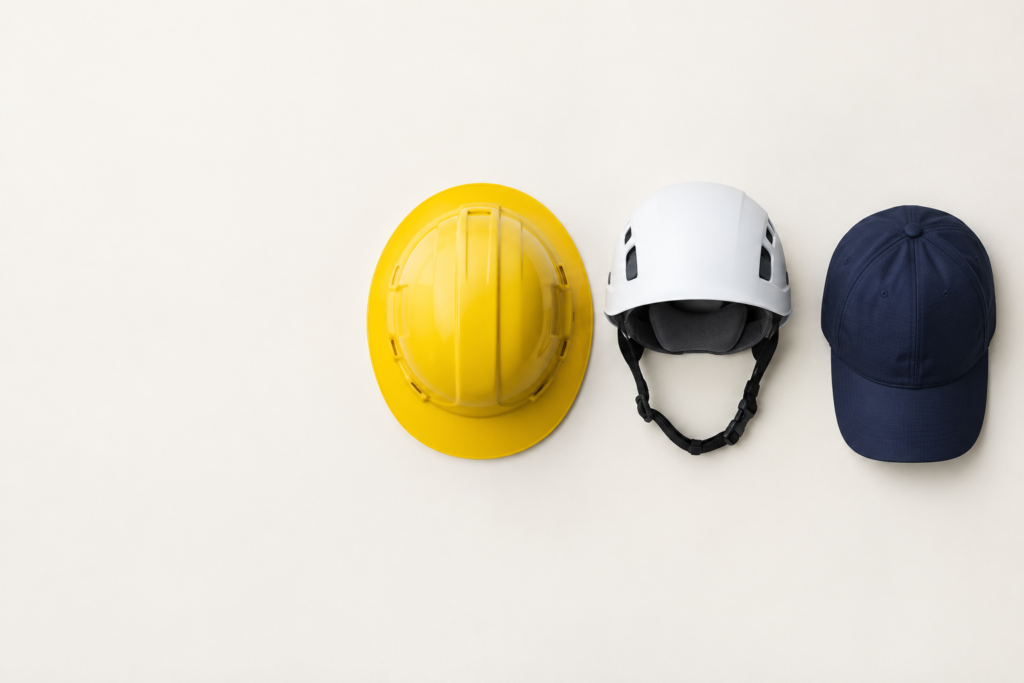
You’ve been told to wear head protection on a new job, and the supply room has three different-looking options on the shelf. Choosing correctly takes about a minute once you know which hazard you’re facing and how to read the label inside the shell. This guide covers both.
We built it from OSHA’s regulatory text and its 2024 head protection bulletin, ISEA’s announcements for the standards behind every certified product, and NIOSH injury research. Each source is named where its claim appears.
Head protection is PPE that guards the head against impact, penetration, and electrical hazards. It mainly means hard hats and safety helmets certified to ANSI/ISEA Z89.1, plus lighter bump caps certified to ANSI/ISEA 100-2024. OSHA requires Z89.1-compliant protective helmets under 29 CFR 1910.135 and 1926.100 wherever falling objects, impact, or exposed electrical conductors threaten the head.
What You Need to Know
- Pick by hazard, not by style. Anything that can fall, fly, or swing into your head calls for Z89.1 headgear. Bump caps cover only minor bumps against fixed objects and never substitute for a hard hat.
- “Hard hat” and “safety helmet” are style names, not protection levels. The Type and Class printed on the label tell you what the headgear was actually tested for.
- OSHA’s rules still name the 1997, 2003, and 2009 editions of Z89.1. The new Z89.1-2026 edition adds optional Type I+ and Type II+ markings but doesn’t change what OSHA requires.
- Electrical work needs Class E or Class G, and no vented shells. OSHA’s 2024 bulletin specifically rules out vented headgear for electrical work.
- Retire any head protection after an impact, even if you can’t see any damage.
Why Does Head Protection Matter?
Head injuries are among the deadliest on the job. According to NIOSH’s 2016 analysis of 2003–2010 federal fatality data, 2,210 U.S. construction workers died from traumatic brain injuries in that period, about a quarter of all construction deaths. The right headgear, worn correctly, is the last barrier between a hazard and that outcome.
The cause behind those deaths surprises most people. According to the same NIOSH research, falls (especially from roofs, ladders, and scaffolds) led to more than half of fatal work-related brain injuries. The danger isn’t only something dropping on you: it’s you hitting the ground, and that is where headgear that stays on your head matters.
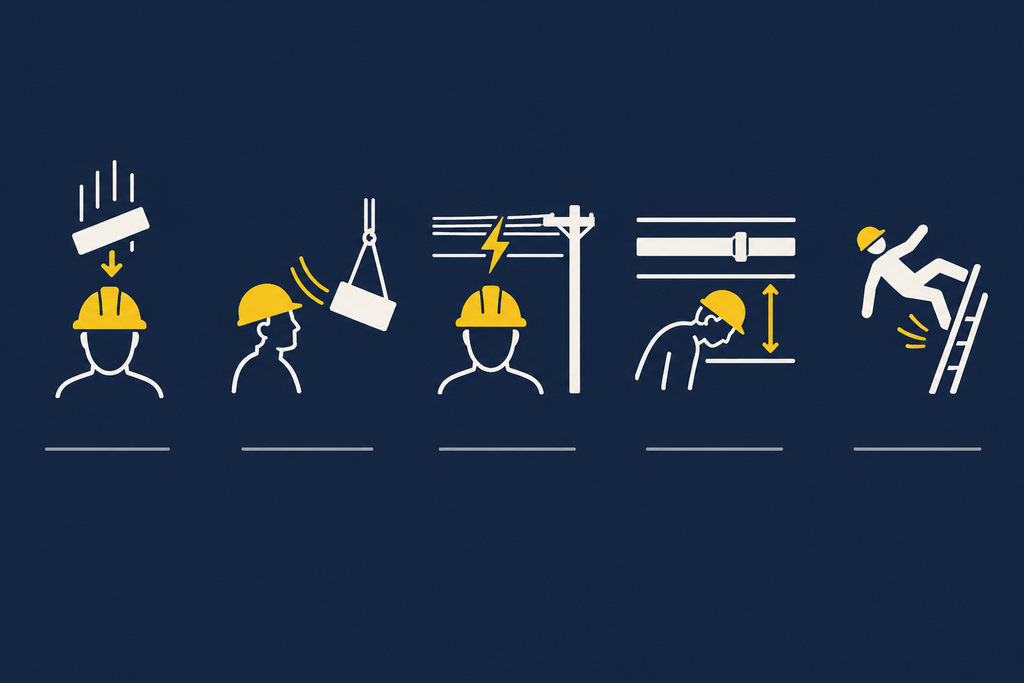
Workplace head hazards fall into five recurring types, and each one points to different protection:
- Falling objects: tools, materials, or debris dropped from above, common around scaffolding and overhead work.
- Flying or swinging objects: loads in motion, equipment arms, or debris thrown sideways, which can strike the side of the head.
- Electrical contact: live conductors close enough to touch the head.
- Worker-generated bumps: standing up into a low pipe, beam, or cabinet edge in a tight space.
- Slips, trips, and falls: the head striking the ground or a structure, often after the headgear has come off.
When Does OSHA Require Head Protection?
OSHA requires protective helmets whenever workers face a potential head injury from falling objects (29 CFR 1910.135, general industry). In construction, 29 CFR 1926.100 adds impact, falling or flying objects, and electrical shock and burns. Where exposed electrical conductors could contact the head, the helmet must also be designed to reduce electrical shock hazard.
According to OSHA’s Safety and Health Information Bulletin SHIB 3-6-2024, compliance runs through three editions of ANSI Z89.1: 2009, 2003, and 1997. The construction rule’s text lists the same three editions as of its current version. It also accepts any head protection that the employer can show is at least as effective as headgear built to those editions.
The maritime standards carry parallel requirements: 29 CFR 1915.155 for shipyards, 1917.93 for marine terminals, and 1918.103 for longshoring. Under every one of these rules, the employer must assess workplace hazards first and then decide what type of head protection fits. That hazard assessment, not a habit or a brand preference, is what decides your headgear. For when each rule applies, OSHA’s own exceptions and who pays for head protection, see our guide to OSHA hard hat requirements.
What Are the Main Types of Head Protection?
There are three core categories. Hard hats and safety helmets are certified to ANSI/ISEA Z89.1 for falling and flying objects. Bump caps are certified to ANSI/ISEA 100-2024 for minor bumps against fixed objects only. Specialty markings and manufacturer-approved add-ons (face shields, hearing protection, heat or cold ratings) build on a certified base rather than replacing it.
Hard Hats and Safety Helmets
Z89.1 itself uses the word “helmet.” According to an October 2026 explainer by helmet maker STUDSON (sponsored content on Construction Dive), “hard hat” and “safety helmet” appear in the standard only as industry terms, and neither names a protection level. A full-brim hard hat and a compact, climbing-style safety helmet can carry identical ratings.
What does matter is printed on the label. Per OSHA’s 2024 bulletin:
- Type I protects against blows to the top of the head.
- Type II protects against blows to the top and sides.
- Class G (General) is proof-tested at 2,200 volts for low-voltage conductors.
- Class E (Electrical) is proof-tested at 20,000 volts for higher-voltage conductors.
- Class C (Conductive) provides no electrical protection.
For full side-by-side comparisons, see Type I vs Type II hard hats and hard hat Class E vs G vs C.
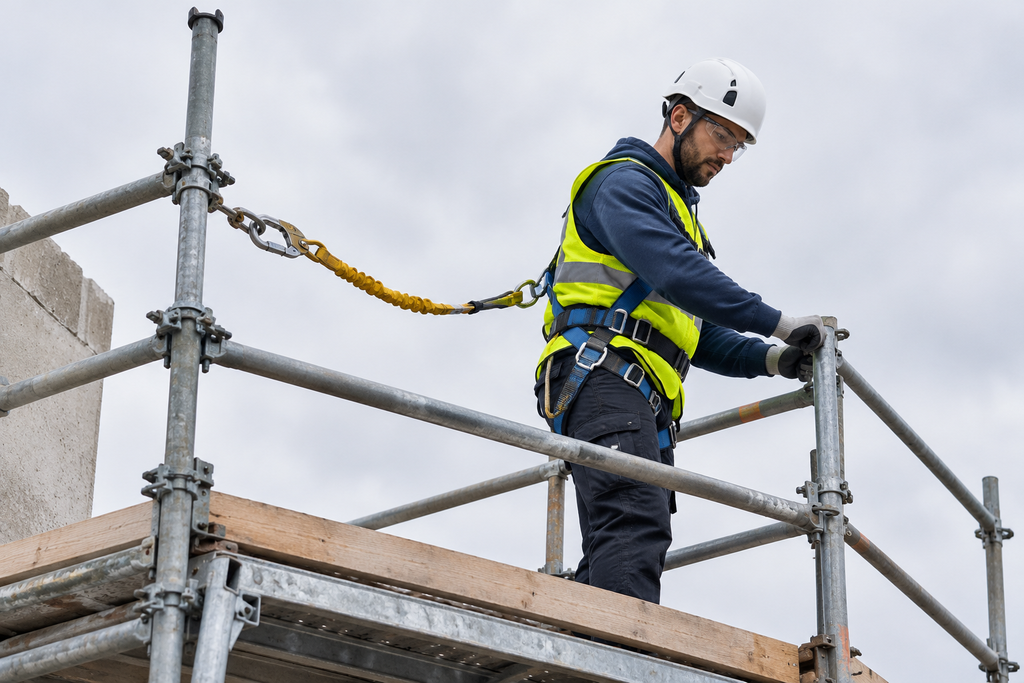
Climbing-style safety helmets usually pair a shorter brim with a chin strap and a padded, snug fit, so they stay on during a slip or an awkward reach. For what OSHA’s 2023 switch did and didn’t change, and what the lab tests show, see our full hard hat vs safety helmet comparison. After its own job hazard analysis, OSHA chose Type II, Class G safety helmets for its employees, as its 2024 bulletin reports. The same bulletin recommends that employers consider chin straps for all head protection.
Bump Caps
Bump caps look like a baseball cap with a hard shell or insert inside. They protect against worker-generated impact: standing up under a vehicle, or catching a low pipe in a crawl space. ANSI/ISEA 100-2024, approved in January 2025, is the first U.S. standard for them. Before it, manufacturers usually pointed to the European EN 812 standard.
According to ISEA, the standard sorts bump caps into two performance levels, Level 1 and Level 2, and it covers universal inserts that fit inside ordinary caps. ISEA is also explicit that bump caps are not a replacement for Z89.1 head protection. If anything can fall or fly toward you, a bump cap is the wrong tool. For test energies, OSHA’s own letter on bump caps and a five-question check, see our full bump cap vs hard hat comparison.
Specialty Markings and Add-Ons
OSHA’s 2024 bulletin highlights optional label markings for specific conditions:
- HT: heat-resistant headgear for high temperatures or molten materials.
- LT: headgear preconditioned and tested at low temperatures for cold environments.
- HV: high-visibility headgear for road and construction work.
Face shields, goggles, hearing protection, and communication systems can be attached, but only accessories that the manufacturer approves for that specific helmet.
What Changed in ANSI/ISEA Z89.1-2026?
ISEA released ANSI/ISEA Z89.1-2026 in September 2026, the first revision since 2014. It keeps Type I, Type II, and Classes G, E, and C unchanged. It adds two optional markings, Type I+ and Type II+, which require a tested chin strap and a retention test. OSHA’s regulations don’t reference the 2026 edition.
According to the STUDSON explainer, here is what the “+” adds. Both “+” designations require a chin strap that meets minimum width, strength, and elongation requirements. Both also require a retention test that simulates pulling the helmet off a headform during a fall. Type I+ goes further and adds front, rear, and side impact testing to the top-impact Type I design.
The trap to avoid: Type I+ sounds like it outranks Type II, but it doesn’t. The same explainer notes that Type II still includes off-center penetration testing that Type I+ lacks, so Type II and Type II+ remain the more demanding impact designations. Two other details:
- The 2026 edition renames the “High Visibility” marking to “Enhanced Visibility,” with no change in performance.
- The edition still sets no requirement for rotational impact energy.
Expect few products on shelves with 2026 markings for a while. A manufacturer can’t mark a helmet to the new edition until it has been tested to it. Your existing Type I and Type II headgear stays compliant, as ISEA’s own announcement confirms that the revision doesn’t make currently compliant products obsolete. Our ANSI Z89.1 hard hat standard explained guide covers every edition since 1969, the actual test limits, and which editions OSHA accepts.
How Do You Read a Head Protection Label?
Every certified hard hat or safety helmet carries a label inside the shell. It lists the standard and edition, the Type, the Class, and any optional markings such as reverse wear or temperature ratings. Bump caps carry their own standard number instead. Reading those markings tells you exactly what the headgear was tested to handle. Color isn’t part of the rating; for what each shell color usually signals on site, see hard hat colors meaning. For cold work, the LT mark and approved winter liners matter; see hard hat winter liner. Not sure the label is genuine? See how to spot a fake hard hat. For how shell materials affect heat and electrical ratings, see hard hat materials.
| Marking on the label | What it means | Why it matters |
|---|---|---|
| ANSI/ISEA Z89.1 + edition year (e.g. Z89.1-2014) | The edition the headgear was tested to | OSHA’s rules name the 1997, 2003, and 2009 editions; check with your employer or safety officer if yours is newer |
| Type I | Top-impact protection only | Fine where hazards come straight down |
| Type II | Top and side impact protection | Better wherever objects can swing or fly from the side |
| Type I+ / Type II+ | 2026 edition: tested chin strap plus retention test (Type I+ also adds front, rear, and side impact testing) | Built to stay on in a fall; Type I+ still isn’t equal to Type II |
| Class G | Proof-tested at 2,200 V | Low-voltage exposure |
| Class E | Proof-tested at 20,000 V | Higher-voltage and utility work |
| Class C | No electrical protection | Never use near conductors |
| Reverse-wear mark | Tested for backward wear | Without it, OSHA’s bulletin says don’t wear it in reverse |
| HT / LT | High-temperature or low-temperature rating | Hot processes or molten material, or cold environments |
| HV (EV in the 2026 edition) | High or enhanced visibility | Being seen on road and construction sites |
| ANSI/ISEA 100-2024, Level 1 or 2 | A bump cap, not a hard hat | Bumps against fixed objects only |
| Date of manufacture | When it was made | The starting point for the manufacturer’s service-life guidance |
Hard Hat vs. Safety Helmet vs. Bump Cap: Which One Do You Need?
Start with the hazard, not the style. Anything that can fall, fly, or swing into your head calls for Z89.1 head protection, with Type II if blows can come from the side. Electrical exposure adds a Class E or Class G requirement. A bump cap is enough only when the sole risk is bumping into fixed objects.
OSHA’s 2024 bulletin gives job-specific starting points, summarized here:
| Work situation | Starting point per OSHA’s 2024 bulletin |
|---|---|
| Construction with falling objects, equipment impact, or awkward positions | Type II with a chin strap |
| Oil and gas sites with multiple hazards | Type II with integrated eye and face protection |
| Work at height | Head protection with a chin strap so it can’t fall off |
| Electrical work or proximity to conductors | Class G or Class E, with no vented shells |
| High heat or molten materials | HT-marked headgear |
| Cold environments | LT-marked headgear |
| Low clearance, with no falling or flying object risk | Bump cap (ANSI/ISEA 100-2024); this row isn’t from OSHA’s bulletin, which doesn’t cover bump caps |
When you’re unsure between two rows, take the more protective option. Then confirm it against your employer’s hazard assessment, which is what OSHA’s rules actually rely on.\

What Are the Most Common Head Protection Mistakes?
The most common head protection mistakes happen after purchase. They include wearing headgear backward without a reverse-wear mark, adding unapproved accessories, storing it in a hot vehicle, skipping inspections, and keeping it in service after an impact. OSHA’s 2024 bulletin addresses each of these directly, along with a few others.
- Wearing it backward without the reverse-wear mark. Only headgear that carries that mark has been tested for reverse wear.
- Using vented headgear for electrical work. OSHA’s bulletin rules this out regardless of the shell’s Class marking.
- Leaving it on the dashboard. OSHA’s bulletin advises against storing head protection in a car or anywhere it’s exposed to direct sunlight or extreme temperatures.
- Leaving the chin strap unfastened at height. An unfastened strap gives up the main advantage of a strapped helmet.
- Bolting on accessories that aren’t from the helmet’s manufacturer. OSHA’s bulletin refers only to manufacturer-approved add-ons.
- Painting or customizing the shell without checking the manufacturer’s guidance. A University of Kentucky OHS document notes that decals are usually fine but some paints call for caution, so check before you customize.
- Substituting a bump cap where a hard hat is required. ISEA states that bump caps are not a replacement for Z89.1 protection.
How Often Should Head Protection Be Inspected and Replaced?
Inspect head protection before every use and replace it on the manufacturer’s schedule. Replace it immediately after any impact. Neither OSHA’s regulations nor its 2024 bulletin sets a fixed expiration date. Service life depends on storage, handling, and exposure to UV and harsh conditions, so the manufacturer’s guidance and the date of manufacture on the label set the clock. For a step-by-step fit, a date code decoder and a printable checklist, see how to wear a hard hat.
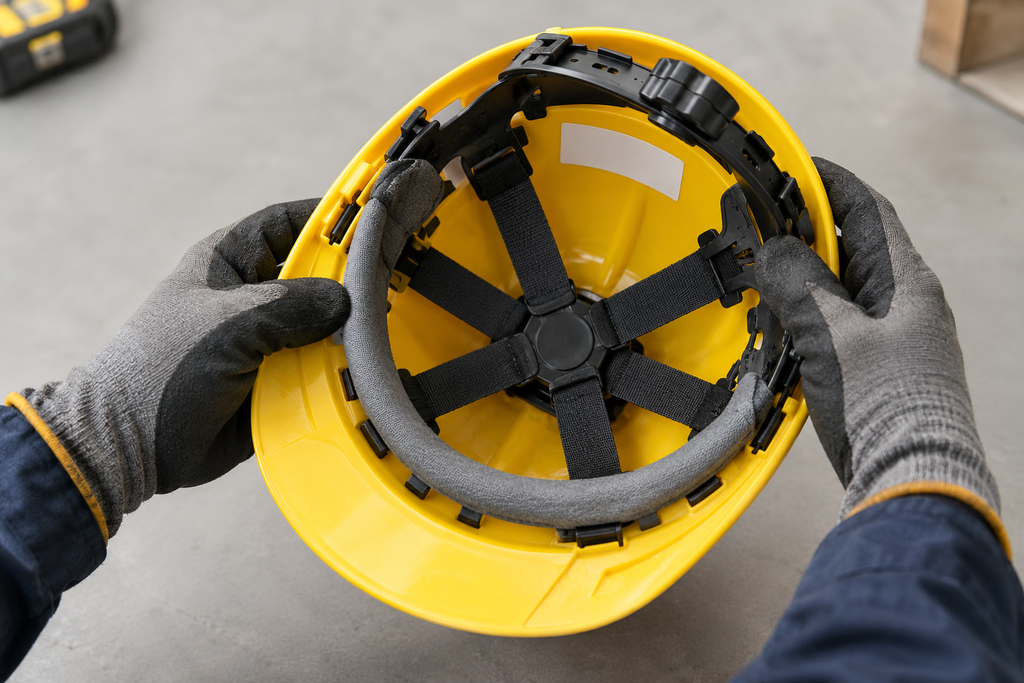
OSHA’s bulletin lays out a pre-use check:
- Check the shell for cracks, dents, or other damage.
- Check the suspension and chin strap for wear.
- Check the labels and certification marks for legibility.
- Inspect attached accessories.
- Confirm the fit is snug without pressure points.
The bulletin also recommends recording each inspection along with the purchase date, so you can track the headgear’s lifespan.
The rule with no exceptions comes from the same bulletin. If head protection takes an impact or significant force, retire it right away, even when nothing looks wrong. It’s designed for single-impact protection and may not perform the same way a second time.
Choosing the Right Head Protection for Your Job
By now the pattern is clear: identify the hazard, match it to a Type and Class, then confirm the label says what you need. If falling or flying objects are possible, start at Z89.1 Type II and work down only with good reason. Every topic touched on here (Type I vs. Type II, Classes, hard hats vs. safety helmets, fit and maintenance, bump caps) gets its own deeper guide in this series.
Frequently Asked Questions
What is head protection? Head protection is personal protective equipment that guards your head against impact, penetration, and electrical hazards at work. In the U.S. it covers hard hats and safety helmets certified to ANSI/ISEA Z89.1 and bump caps certified to ANSI/ISEA 100-2024. It also covers add-ons such as face shields or hearing protection approved by the helmet’s manufacturer. Each category is tested for a different hazard, so they aren’t interchangeable.
Is a safety helmet better than a hard hat? Not automatically. Under ANSI/ISEA Z89.1, “hard hat” and “safety helmet” are industry names, not protection levels. What counts is the Type, the Class, and any “+” marking on the label. Climbing-style helmets often come as Type II with a chin strap, which suits work at height, and OSHA chose Type II, Class G safety helmets for its own staff. A Type II hard hat passes the same impact tests.
Can a bump cap replace a hard hat? No. Bump caps are tested under ANSI/ISEA 100-2024 for worker-generated impacts, such as standing up into a pipe or catching a cabinet edge. ISEA states plainly that they aren’t a replacement for Z89.1 head protection. If anything can fall, fly, or swing toward your head, or OSHA’s head protection rules apply to your work area, you need a Z89.1-certified hard hat or safety helmet instead.
If you could be exposed to minor bumps, what head protection do you need?
If your only risk is bumping into fixed objects, a bump cap certified to ANSI/ISEA 100-2024 is enough. Training quizzes often phrase this as “what class of hard hat,” but a Class rates electrical protection, not bump protection. If anything could also fall or fly toward you, you need a Z89.1 hard hat. If there’s no electrical hazard, Class C is acceptable.
Which head protection is OSHA-approved?
OSHA doesn’t approve products by name. Its rules, 29 CFR 1910.135 and 1926.100, require helmets built to the 1997, 2003 or 2009 edition of ANSI Z89.1, or shown to be at least as effective. Most hard hats and safety helmets labelled ANSI/ISEA Z89.1 meet that. Bump caps don’t, so they can’t replace a hard hat where OSHA requires head protection.
Does OSHA require the new ANSI Z89.1-2026 edition? No. As of October 2026, OSHA’s head protection rules (29 CFR 1910.135 and 1926.100) name the 1997, 2003, and 2009 editions of ANSI Z89.1, and publishing a new edition doesn’t change OSHA’s text. The 2026 Type I+ and Type II+ markings are optional. Existing Type I and Type II headgear stays acceptable. Your employer’s hazard assessment decides whether the added retention testing is worth specifying.
What hard hat Class do I need for electrical work? Class E head protection is proof-tested at 20,000 volts and designed for higher-voltage exposure. Class G is proof-tested at 2,200 volts for low-voltage conductors, and Class C offers no electrical protection at all. According to OSHA’s 2024 head protection bulletin, vented hard hats and helmets can’t be used for electrical work, even when the shell carries an electrical Class.
Do hard hats expire? Neither OSHA’s regulations nor its 2024 bulletin sets a fixed expiration date. OSHA points you to the manufacturer’s service-life guidance, noting that lifespan depends on storage, handling, and exposure to UV and harsh conditions. Check the date of manufacture on the label and follow the maker’s replacement interval for the shell and suspension. Retire the headgear immediately after any impact, even with no visible damage.
Can I wear my hard hat backward? Only if the label carries a reverse-wearing mark. OSHA’s 2024 bulletin says that only head protection with that mark can be worn in reverse, because that’s the only headgear tested that way. The 2026 edition of Z89.1 also adds reverse-wear checks for its new “+” designations. If your hard hat has no reverse mark, wear it brim-forward, even if a face shield or visor makes backward wear tempting.
Is Type I+ better than Type II? Not necessarily. Type I+ is an upgrade over Type I: it adds front, rear, and side impact testing plus a required chin strap and retention test. According to a 2026 explainer from helmet maker STUDSON, though, Type II still includes off-center penetration testing that Type I+ doesn’t. If side impacts are a real risk on your job, compare Type II and Type II+ options before anything marked Type I+.
Where to Go Next
- OSHA standards hub: the regulations behind head protection requirements and how they apply across general industry and construction.
- ANSI standards hub: how ANSI/ISEA consensus standards like Z89.1 and ISEA 100 work and how they’re revised.
- Standards We Cite: every standard this site references and how we source it.