
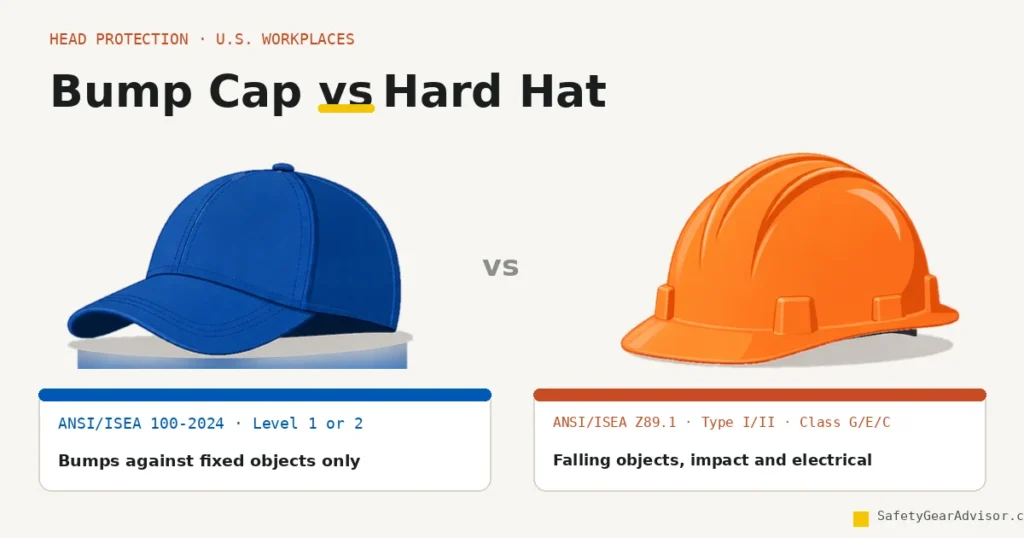
You need head protection for work in a crawl space, under a vehicle or along a low pipe rack, and a full hard hat feels like too much. A bump cap looks like the answer, but the bump cap vs hard hat choice decides whether you’re compliant and protected. Here’s exactly where the line sits for U.S. workplaces, based on OSHA’s rules and the standards behind each product.
A bump cap protects only against bumping your head into fixed objects, such as pipes, beams or vehicle undersides. A hard hat certified to ANSI/ISEA Z89.1 protects against falling and flying objects and, depending on its Class, electrical contact. Wherever OSHA requires head protection, a bump cap can’t replace a hard hat.
What You Need to Know
- Bump caps are for worker-generated impacts only: you moving into something stationary, never something falling onto you.
- OSHA’s rules don’t “approve” products by name. They require helmets meeting a listed edition of ANSI Z89.1, and bump caps aren’t built to that standard.
- The U.S. bump cap standard is ANSI/ISEA 100-2024, approved in January 2025. It rates bump caps Level 1 or Level 2.
- A hard hat’s top-impact test uses more than four times the energy of the toughest bump cap test.
- No hard-hat-level hazard at all? Then a bump cap is a sensible, lighter choice, and the decision is your employer’s policy.
Bump Cap vs Hard Hat: What Is the Actual Difference?
The difference is the hazard each one is built for. A bump cap cushions the blow when your head strikes something stationary, and the energy involved is small. A hard hat absorbs falling or flying objects, resists penetration and, if Class G or E, reduces electrical shock. Each is tested to a different standard at very different energies.
Ergodyne describes the bump cap as protection against “worker-generated impact”: you stand up under a shelf or turn into a pipe. Hard hats handle “object-generated impact,” where the hazard comes to you.
| Bump cap | Hard hat / safety helmet | |
|---|---|---|
| Protects against | Bumps against fixed objects | Falling and flying objects, penetration, and electrical contact (Class G or E) |
| U.S. standard | ANSI/ISEA 100-2024 (Level 1 or 2) | ANSI/ISEA Z89.1 (Type I or II; Class G, E or C) |
| Meets OSHA 1910.135 / 1926.100 | No | Yes, if built to a listed Z89.1 edition |
| Typical build | Cap with a hard shell or insert, foam padding | Rigid shell with a suspension that holds it off your head |
| Electrical rating | None | Class G (2,200 V) or Class E (20,000 V); Class C has none |
| Typical users | Mechanics, food processing, warehouse picking, appliance techs | Construction, oil and gas, forestry, mining |
The hard hat’s suspension matters. According to Ergodyne, it keeps space between the shell and your skull, so a blow from a falling object is less likely to reach your head. For how Type I and Type II differ, see our guide to Type I vs Type II hard hats.
How Much Impact Is Each One Tested For?
The gap is larger than most people expect. ANSI/ISEA 100-2024 tests bump caps at 7.5 joules (Level 1) or 12.5 joules (Level 2). ANSI/ISEA Z89.1 tests a Type I hard hat’s top with a 54.5-joule strike. That’s more than four times the toughest bump cap test, and over seven times Level 1.
| Test | Standard | Impact energy | Pass criteria |
|---|---|---|---|
| Bump cap, Level 1 | ANSI/ISEA 100-2024 | 7.5 J, one point front and one back of the crown | Force transmission limit; no penetration at the apex |
| Bump cap, Level 2 | ANSI/ISEA 100-2024 | 12.5 J, two points front and two back | Force transmission limit; no penetration at the apex |
| Bump cap (Europe) | EN 812:2012 | 12.5 J (5 kg from 250 mm) | Transmitted force at most 15 kN |
| Hard hat, Type I top impact | ANSI/ISEA Z89.1-2014 (R2019) | 54.5 J | Average transmitted force under 3,780 N (850 lb) |
| Hard hat, Type II impact attenuation | ANSI/ISEA Z89.1-2014 (R2019) | 30.6 J | Maximum acceleration 150 g or less |
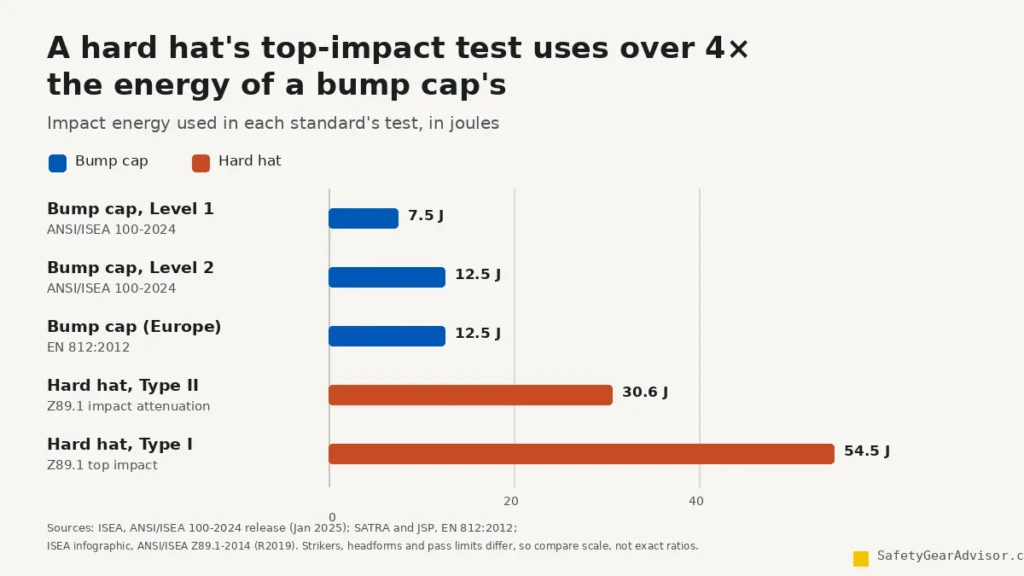
Sources: ISEA’s January 2025 release for ANSI/ISEA 100-2024; SATRA’s and JSP’s EN 812 test summaries; ISEA’s hard hat testing infographic for Z89.1-2014 (R2019). The bump cap force limits for ANSI/ISEA 100-2024 aren’t published in ISEA’s summary.
Treat the joules as a guide to scale, not a precise ratio: each standard uses its own striker, headform and pass limit. The direction is clear, though. A bump cap is tested for the knock you give yourself, and a hard hat for something heavy arriving from above. The ANSI Z89.1 standard explained covers the full hard hat test set.
Are Bump Caps OSHA Approved?
No, and the question has a wrong premise. OSHA’s rules don’t approve products by name; they set the standard headgear must meet. 29 CFR 1910.135 and 1926.100 require helmets built to the 1997, 2003 or 2009 edition of ANSI Z89.1, or shown to be equally effective. Bump caps don’t qualify.
The rules apply where head injury is possible. Under 1910.135(a), that means falling objects or exposed electrical conductors in general industry. Under 1926.100(a), it means impact, falling or flying objects, or electrical shock and burns in construction.
OSHA has addressed bump caps directly. In a January 21, 1980 letter, it refused a request to let sewer rehabilitation workers wear bump caps in manholes instead of helmets. The agency accepted that falling-object risk there was minimal. It still found that “Bump caps would not provide adequate employee head protection for all exposures in manholes,” because they aren’t constructed to give the protection the standards require.
The reverse also holds. In its 1977 Elliott Company letter, OSHA said that where employees aren’t exposed to possible head injury, 1910.132(a) and 1910.135 don’t require head protection. In that case, whether you wear a bump cap is a matter of company policy. See OSHA hard hat requirements for how employers make that hazard call.
What Is the Bump Cap Standard?
In the United States, it’s ANSI/ISEA 100-2024, the first U.S. standard for industrial bump caps. ANSI approved it in January 2025. It covers bump caps and universal bump cap inserts, and it sets performance, testing and labeling criteria. It’s voluntary: Ergodyne notes it isn’t enforceable by OSHA. Before it, manufacturers usually referred to Europe’s EN 812.
ISEA is blunt about its limits. Its CEO, Cam Mackey, said the standard “is not a replacement for products covered by ANSI/ISEA Z89.1.” ISEA also states that bump caps aren’t intended to protect against falling or moving objects.
Level 1 vs Level 2 Bump Caps
Both levels must pass a penetration test at the apex of the crown. Level 1 adds a 7.5-joule force transmission test at one point on the front and one on the back. Level 2 raises it to 12.5 joules at two points on the front and two on the back, so it covers a harder knock across more of the cap.
According to ISEA, the standard also requires:
- Accessories that don’t break compliance: installed accessories or replacement parts must not make the cap fail.
- Breakaway chin straps: optional, but if fitted, they must release at a low force to prevent strangulation.
- Instructions: intended uses, size adjustment and fitting (including reverse wearing, if allowed), and care and inspection guidance.
- Flame-resistance marking: a cap not marked FR hasn’t been tested for flame resistance.
ANSI/ISEA 100-2024 vs EN 812
They test similar energies: EN 812 drops a 5 kg striker from 250 mm, which is 12.5 joules, matching Level 2. The main difference is inserts. According to ISEA, EN 812 doesn’t address universal bump cap inserts that fit inside an ordinary baseball cap. ANSI/ISEA 100-2024 adds testing and wording so inserts can meet it.
That matters if you buy for a U.S. workplace. A cap or insert marked only EN 812 isn’t wrong, but ANSI/ISEA 100-2024 is now the U.S. reference to look for.
When Can You Use a Bump Cap Instead of a Hard Hat?
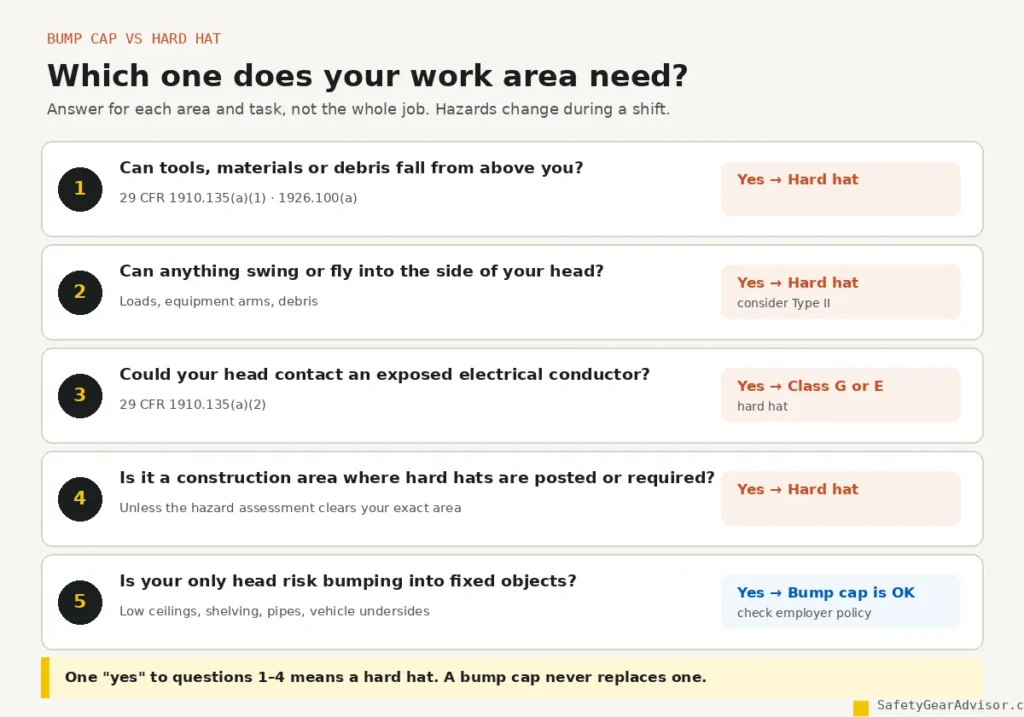
Only when bumping into fixed objects is the sole head hazard. If anything can fall, swing or fly toward your head, or your head could contact an exposed electrical conductor, OSHA requires a Z89.1 helmet. The five-question check below settles the bump cap vs hard hat choice for your work area. One “yes” in questions 1–4 means hard hat.
| # | Question | If yes |
|---|---|---|
| 1 | Can tools, materials or debris fall from above you? | Hard hat (1910.135(a)(1); 1926.100(a)) |
| 2 | Can anything swing or fly into the side of your head: loads, equipment arms, debris? | Hard hat, Type II worth considering (Type I vs Type II) |
| 3 | Could your head contact an exposed electrical conductor? | Class G or Class E hard hat (1910.135(a)(2)); see Class E vs G vs C |
| 4 | Are you on a construction site where hard hats are posted or required? | Hard hat, unless your employer’s hazard assessment clears your exact area |
| 5 | Is your only head risk striking stationary objects (low ceilings, shelving, vehicle undersides, pipes)? | Bump cap is a reasonable choice; check your employer’s policy |
Ergodyne lists typical bump cap work as mechanics under vehicles, airline workers in aircraft holds, appliance and cable technicians in crawl spaces, assembly line workers near low machinery, and food processing in tight spaces.
Hazards change during a shift. If the mechanic’s bay has an overhead crane, or the warehouse aisle has pickers working on a mezzanine above, the answer for that area is a hard hat.
Bump Cap vs Safety Helmet: Is a Safety Helmet Any Different?
A safety helmet is not a bump cap. “Safety helmet” usually means a climbing-style helmet with a chin strap, built to the same ANSI/ISEA Z89.1 standard as a hard hat. So a bump cap vs safety helmet comparison follows the same rule. The helmet carries a Type and Class and meets OSHA requirements, while the bump cap does neither.
Safety helmets stay on better during a slip or fall because of the chin strap and snug fit. Our head protection guide compares hard hats, safety helmets and bump caps side by side.
Common Mistakes With Bump Caps and Hard Hats
Most bump cap vs hard hat errors come from treating a bump cap as a lighter hard hat. It isn’t one: it’s a separate product for a separate hazard.
- Wearing a bump cap in a hard hat area “just for a quick job.” OSHA’s rules apply whenever the hazard exists, and the 1980 manhole letter shows the agency doesn’t accept bump caps as a substitute.
- Assuming any hard-shell cap is certified. Look for ANSI/ISEA 100-2024 and its Level on the product or in its instructions. Caps sold before 2025 may reference only EN 812, or nothing.
- Using a bump cap near live electrical parts. It has no Z89.1 Class rating, so it isn’t the electrical protection 1910.135(a)(2) requires.
- Wearing a bump cap for hot work. Unless it’s marked FR, it hasn’t been tested for flame resistance.
- Modifying the cap or adding unapproved accessories. ISEA warns that alterations and attachments may affect performance.
- Putting a bump cap over a hard hat requirement on paper. A written hazard assessment that names “bump cap” for an area with overhead work is itself the problem. Fix the assessment, not just the headgear.
Frequently Asked Questions
Can I wear a bump cap on a construction site?
Only in an area where your employer’s hazard assessment finds no risk of falling or flying objects, impact from moving objects, or electrical contact. 29 CFR 1926.100(a) requires protective helmets wherever those hazards are possible, and a bump cap doesn’t meet the ANSI Z89.1 editions the rule names. On most active sites, especially near overhead work, that means a hard hat, not a bump cap.
Is a bump hat the same as a bump cap?
Yes. “Bump hat” is another name for a bump cap: a cap with a hard shell or insert that protects against knocks on fixed objects. The name doesn’t change the rules. A bump hat vs hard hat comparison is the same as a bump cap comparison: the bump hat is tested to ANSI/ISEA 100-2024 or EN 812, and it can’t replace a Z89.1 hard hat where OSHA requires head protection.
Do bump caps expire or need replacing?
ANSI/ISEA 100-2024 requires every bump cap to come with the manufacturer’s care and inspection guidance, so the service life and inspection steps come from your cap’s instructions. Follow them, and check the shell, padding and any insert regularly. Treat a cracked shell or a crushed insert as a failed cap. Our sources give no fixed, standard-wide replacement interval for bump caps.
Can I put a bump cap insert in any baseball cap?
Not automatically. ANSI/ISEA 100-2024 is the first standard to cover universal inserts, but an insert meets it only as tested and used per the manufacturer’s instructions. ISEA warns that alterations, attachments and accessories can affect performance. Use the cap style and fit the insert maker specifies, and check that the insert itself is marked to ANSI/ISEA 100-2024.
Do bump caps protect against electrical shock?
Don’t rely on one for that. Bump caps don’t carry the Class G or Class E ratings that ANSI Z89.1 hard hats are proof-tested for: 2,200 volts and 20,000 volts. Under 29 CFR 1910.135(a)(2), work near exposed electrical conductors that could contact your head requires a helmet designed to reduce electrical shock. That means a Class G or Class E hard hat.
Is a bump cap considered PPE?
Yes, a bump cap is personal protective equipment for one hazard: striking your head on stationary objects. It isn’t the head protection OSHA requires under 1910.135 or 1926.100, which must meet a listed ANSI Z89.1 edition. Where an employer issues bump caps for low-clearance work with no falling-object or electrical hazard, they’re a reasonable, lighter choice.
Do I need a bump cap if OSHA doesn’t require a hard hat?
OSHA doesn’t require one. In its 1977 Elliott Company letter, OSHA said that where workers aren’t exposed to possible head injury, 1910.132(a) and 1910.135 don’t require head protection. Wearing it becomes a matter of employment conditions. Many employers still require bump caps in low-clearance areas because cuts and bruises from fixed objects are common and preventable.
Where to Go Next
- Head Protection guide: hard hats, safety helmets and bump caps compared by hazard, with a full label chart.
- OSHA hard hat requirements: when 1910.135 and 1926.100 apply, how employers assess the hazard, and who pays.
- ANSI Z89.1 hard hat standard explained: the Types, Classes, test limits and editions behind every certified hard hat.
- Hard hat vs safety helmet: once you know you need certified head protection, how a traditional hard hat and a safety helmet differ.