
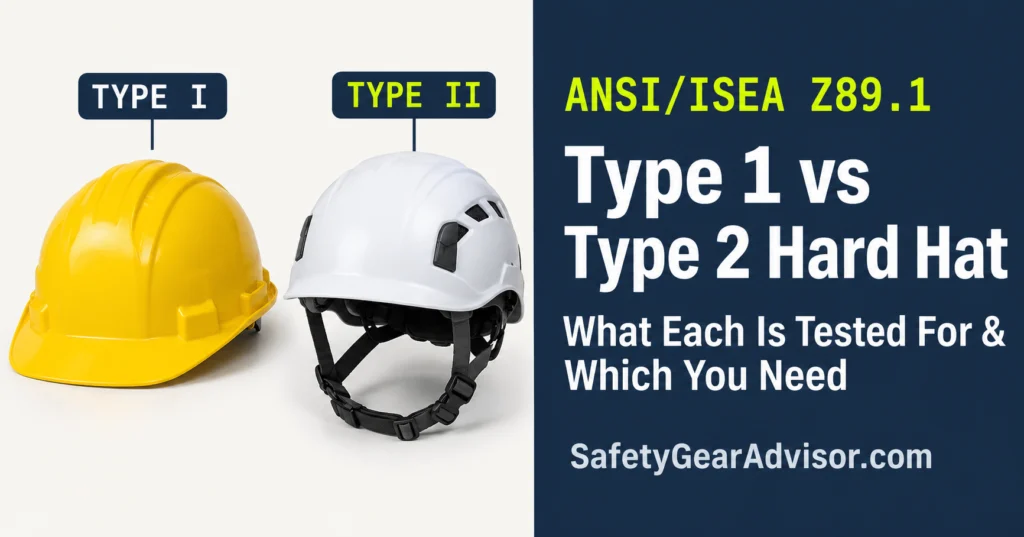
Two hard hats sit side by side in the catalogue. They look almost the same, but one says Type I, the other says Type II, and the Type II costs more. The difference is real, it’s printed on the label, and choosing between them takes one question about your worksite. This guide covers the type 1 vs type 2 hard hat decision from the test lab to the job site, including the new Type I+ and Type II+ ratings.
Everything here comes from the ANSI/ISEA Z89.1 standard’s published text and ISEA’s 2026 announcement, OSHA’s 2024 safety helmet bulletin and its 2026 interpretation, NIOSH research, and MSA Safety’s test summary. Each claim names its source.
A Type 1 hard hat is certified to reduce the force of blows to the top of the head only. A Type 2 hard hat is also tested for impacts and penetration to the front, back and sides. Both types come from ANSI/ISEA Z89.1. OSHA doesn’t mandate either; your hazard assessment decides, and any side-impact risk points to Type 2.
What You Need to Know
- Type II passes everything Type I does, plus two more tests: impact energy attenuation and off-center penetration, both away from the crown.
- The 2026 edition makes it a four-way choice. Type I+ and Type II+ add a tested chin strap and retention testing. Type I+ also adds side impact protection, but it still isn’t Type II.
- OSHA doesn’t require a specific Type. In 2026 it said top-only helmets may not be enough where a hazard assessment finds blows to the side of the head, and gave Type II as an example of suitable protection.
- Before 2026, neither Type required a chin strap. NIOSH notes that OSHA/ANSI standards didn’t require chin straps on Type I or Type II construction helmets.
- Type and Class are separate. A Type II hat can be Class G, E or C, and vented shells are out for electrical work.
What’s the Difference Between a Type 1 and Type 2 Hard Hat?
The difference is where the hat is certified to protect you. In NIOSH’s words, Type I helmets “reduce the force resulting from a blow to the top of the head,” while Type II covers “a blow to either the top or sides of the head.” ANSI/ISEA Z89.1 defines both; style and price don’t set the Type.
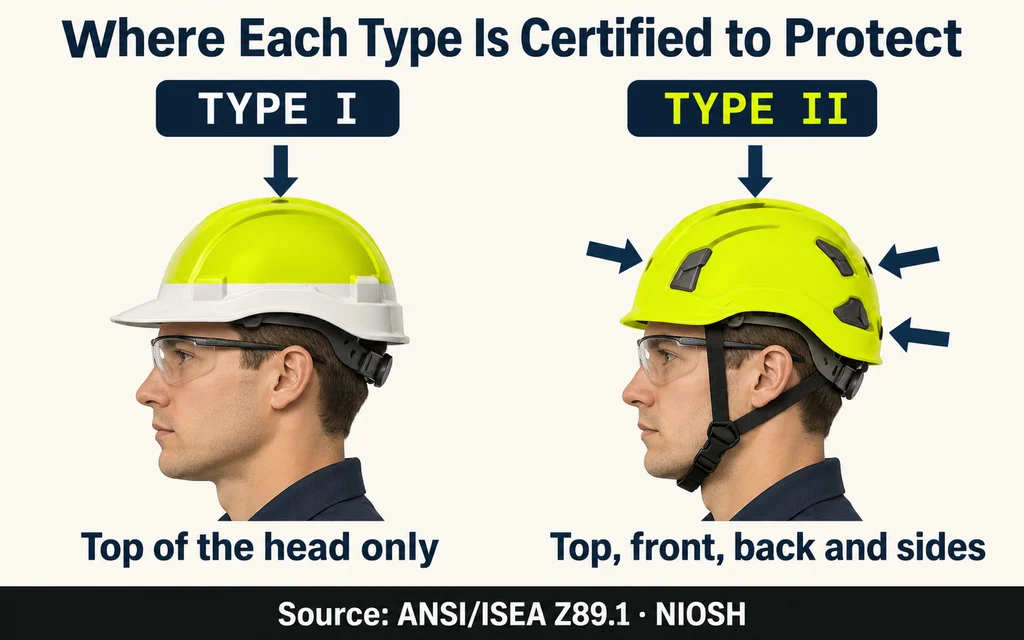
The 2009 edition of ANSI/ISEA Z89.1, the newest edition OSHA’s rules name, uses the same split in §4.1. According to MSA Safety’s test summary, Type II helmets protect the front, back, sides and top of the head. A 2024 NIOSH study of Type I helmets is blunt about the limit: a Type I helmet “is not designed for protection from lateral impacts.”
Type has nothing to do with electrical protection. That’s the Class rating (G, E or C), printed separately on the same label. For how Type and Class fit into the full standard, see our ANSI Z89.1 hard hat standard explainer.
What Does Each Type Have to Pass?
Both types must pass flammability, force transmission and apex penetration tests, plus the electrical tests for their Class. A Type II hat must also pass impact energy attenuation, where it’s struck at angles away from the crown, and off-center penetration. If a Type II hat comes with a chin strap, the strap must pass a retention test.
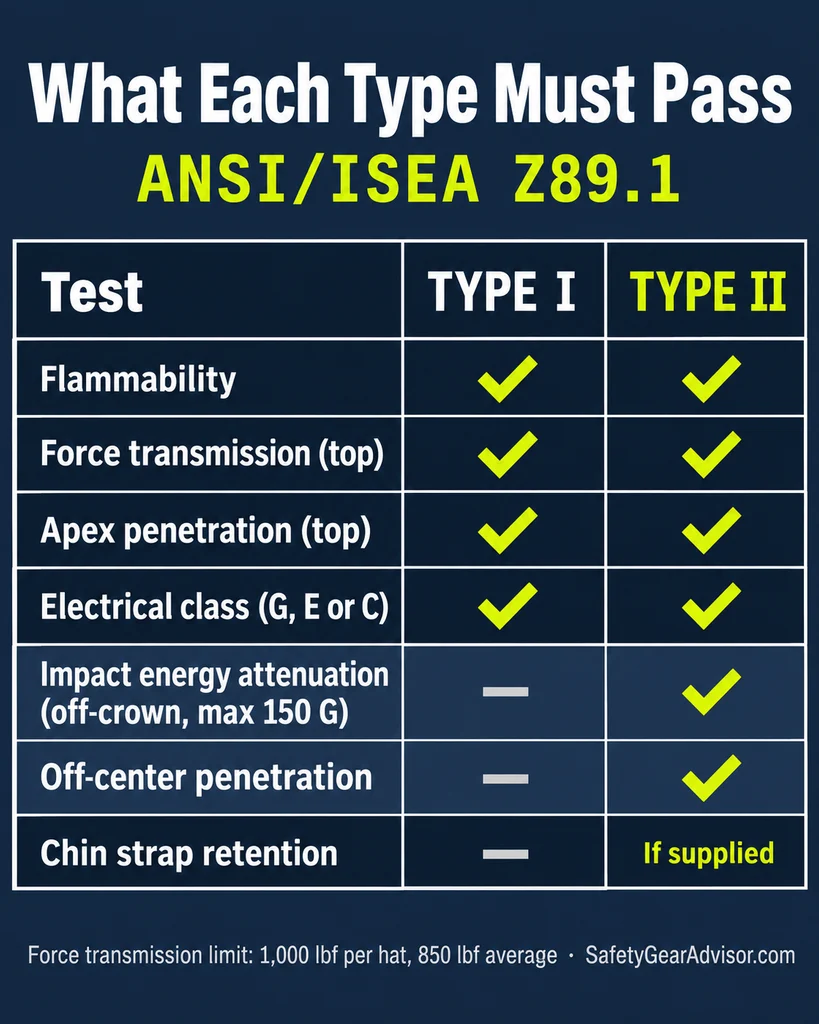
| Test | Type I | Type II | Requirement (2009 edition / MSA summary) |
|---|---|---|---|
| Flammability | ✔ | ✔ | No visible flame 5 seconds after the test flame is removed (MSA) |
| Force transmission (top) | ✔ | ✔ | No sample over 1,000 lbf (4,450 N); conditioned average no more than 850 lbf (3,780 N) (§7.1.2) |
| Apex penetration (top) | ✔ | ✔ | Penetrator must not touch the headform (§7.1.3) |
| Electrical insulation (Class G or E) | ✔ | ✔ | Class G: 2,200 V for 1 minute; Class E: 20,000 V for 3 minutes (Class C not tested) |
| Impact energy attenuation (off-crown) | n/a | ✔ | Peak acceleration no more than 150 G; struck “at various angles above a designated test line” (§7.2.1; MSA) |
| Off-center penetration | n/a | ✔ | Penetrator must not touch the headform when striking above the test line (§7.2.2) |
| Chin strap retention | n/a | If a strap is supplied | Strap stays attached and stretches no more than 1 inch (MSA) |
Sources: ANSI/ISEA Z89.1-2009 (section numbers shown); MSA Safety, “What Is the Difference Between Type 1 and Type 2 Hard Hats?” (updated May 2025).
Look at the two Type II-only rows. A Type I hat’s certification says nothing about a blow to the side of the head, and nothing about a sharp object striking off-center. That’s the gap you’re paying to close with Type II.
Type 1, Type 1+, Type 2 or Type 2+? How the 2026 Edition Changes the Choice
ANSI/ISEA Z89.1-2026, announced by ISEA on September 11, 2026, keeps Type I and Type II unchanged and adds two optional ratings. Type I+ and Type II+ both require a tested chin strap and helmet retention testing. Type I+ also adds multi-directional impact protection, but it still lacks Type II’s off-center penetration test.
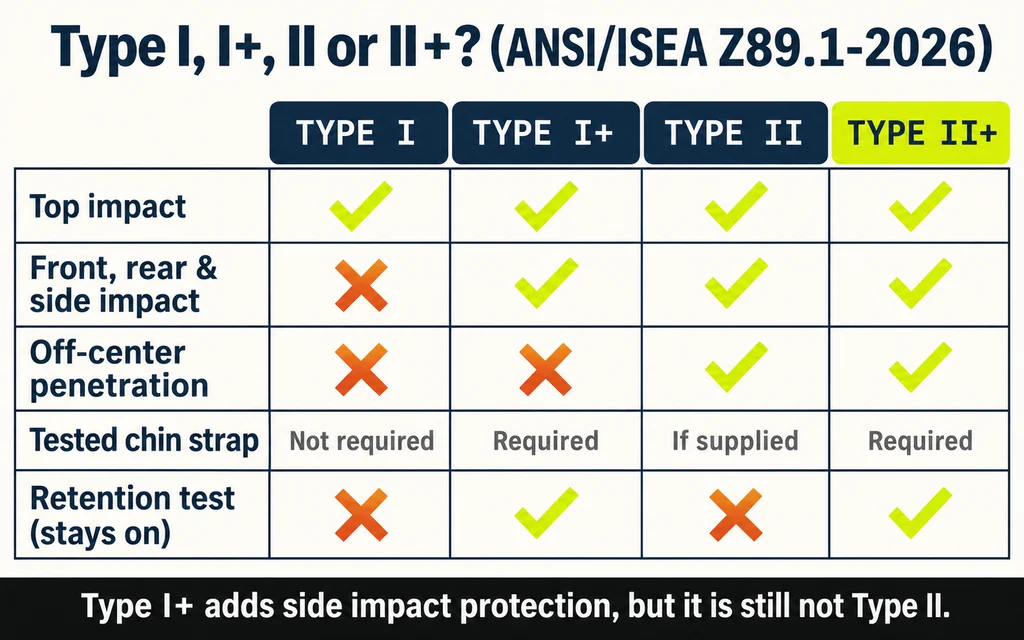
| What it’s certified for | Type I | Type I+ | Type II | Type II+ |
|---|---|---|---|---|
| Top impact and apex penetration | ✔ | ✔ | ✔ | ✔ |
| Impact protection to front, rear and sides | No | ✔ (“multi-directional,” per ISEA) | ✔ | ✔ |
| Off-center penetration | No | No (per Koroyd) | ✔ | ✔ |
| Tested chin strap | Not required | Required | Tested only if supplied | Required |
| Helmet retention test (stays on in slips and trips) | No | ✔ | No | ✔ |
| Named in OSHA’s rules (via edition) | Yes, under 1997, 2003 and 2009 | No; qualifies only if shown at least as effective | Yes, under 1997, 2003 and 2009 | No; qualifies only if shown at least as effective |
Sources: ISEA Z89.1-2026 announcement; MSA Safety; Koroyd (a helmet-technology company that says it took part in the 2026 update) for the Type I+ penetration detail, which is consistent with ISEA’s wording.
How to read the matrix:
- Side or off-center hazards: the real choice is Type II or Type II+.
- Falls or work at height: the “+” retention testing matters, and Type II+ covers both concerns.
- Overhead-only hazards: a Type I hat still meets the standard.
A helmet can only carry a “+” marking after being tested to the 2026 edition, so check the label inside the shell rather than the product listing.
Does OSHA Require Type 2 Hard Hats?
No. OSHA’s rules don’t name a Type. But in a 2026 letter of interpretation, reported by Occupational Health & Safety on October 26, 2026, OSHA said top-only helmets may not be enough where a hazard assessment finds risk of side blows. The employer must then protect against those hazards, and OSHA gave Type II as an example.
That makes the hazard assessment the deciding document. Under 29 CFR 1910.132(d), general industry employers must assess hazards and select PPE that protects against them. The construction rule, 29 CFR 1926.100(a), names “impact, or… falling or flying objects” as triggers, and impacts from the side are part of that.
OSHA’s own choice is a useful signal. Its 2024 Safety and Health Information Bulletin reports that, after a job hazard analysis, OSHA chose Type II, Class G safety helmets for its own staff. The same bulletin points construction, oil and gas and work-at-height situations toward Type II or chin-strapped helmets. For the full compliance picture, see OSHA hard hat requirements.
When Should You Choose a Type 2 Hard Hat?
Choose Type 2 whenever anything can strike the head from an angle rather than straight down. That includes swinging loads, moving equipment, tight spaces where workers stand up into structures, and anywhere a slip or fall could throw the head sideways. A Type 1 is defensible only where the hazard assessment shows purely overhead hazards.
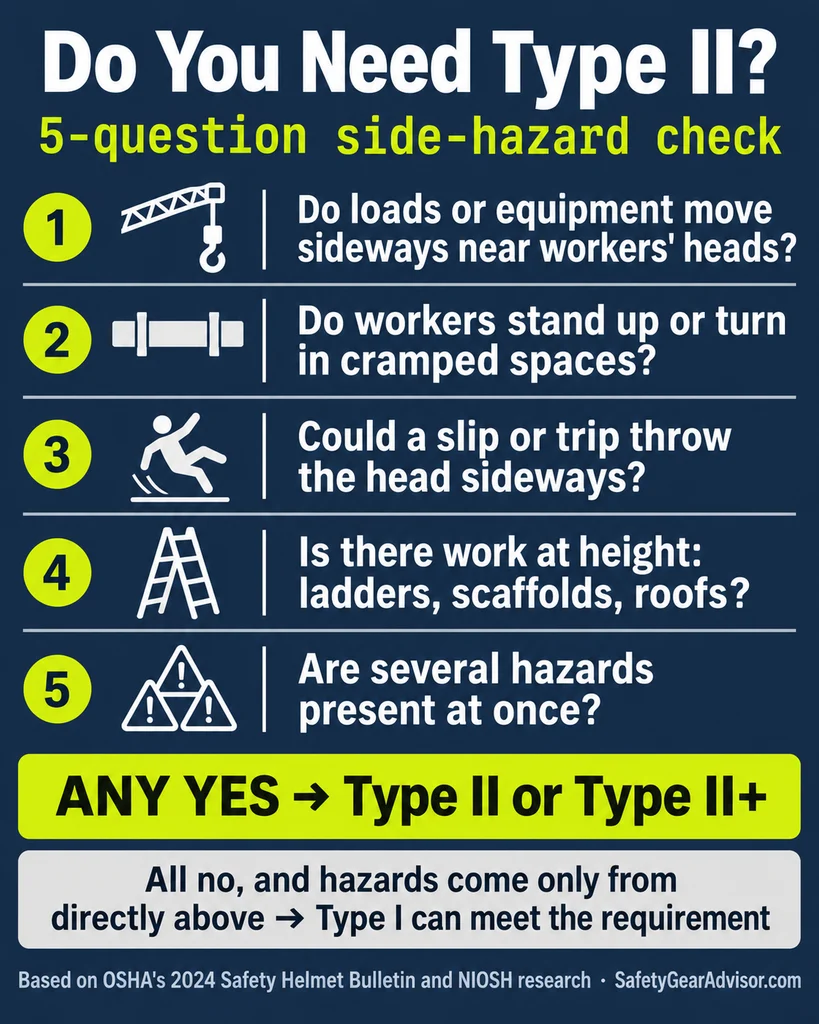
Side-hazard check. Run it during your hazard assessment. One “yes” points to Type II or Type II+.
| Ask | Why it matters | Source |
|---|---|---|
| Does equipment or a load move horizontally near workers’ heads (crane loads, excavator arms, swinging materials)? | Blows arrive from the side, outside Type I’s tested zone | OSHA 2024 bulletin: construction with “equipment impact” → Type II |
| Do workers stand up, turn or climb in cramped areas where they can strike structures? | Contact is often at the front, back or sides of the helmet | OSHA 2024 bulletin: “awkward positions” → Type II |
| Could a slip, trip or fall throw the head against something? | NIOSH notes lateral impacts from falls are likely to cause rotational accelerations in the brain | NIOSH, 2022 |
| Is work done at height (ladders, scaffolds, roofs)? | Falls caused more than half of fatal work-related TBIs; a helmet must also stay on | NIOSH, 2022; OSHA 2024 bulletin: chin strap at height |
| Are there several hazards at once (oil and gas, heavy industry)? | Multiple angles of exposure | OSHA 2024 bulletin: oil and gas → Type II with integrated eye/face protection |
If every answer is “no” and the only hazard is objects falling from directly above, a Type I hat meets the requirement. Record that reasoning in the assessment, so the choice holds up if it’s questioned later.
Are Type 2 Hard Hats Worth the Extra Cost?
For most sites with any side exposure, yes. NIOSH’s 2022 review found that newer helmet designs “offered significantly more protection than basic Type I helmet designs.” Designs with an added foam layer reduced “the probability of serious head injury nearly 30%.” The same review noted that newer-design helmets cost around five times as much as traditional ones.
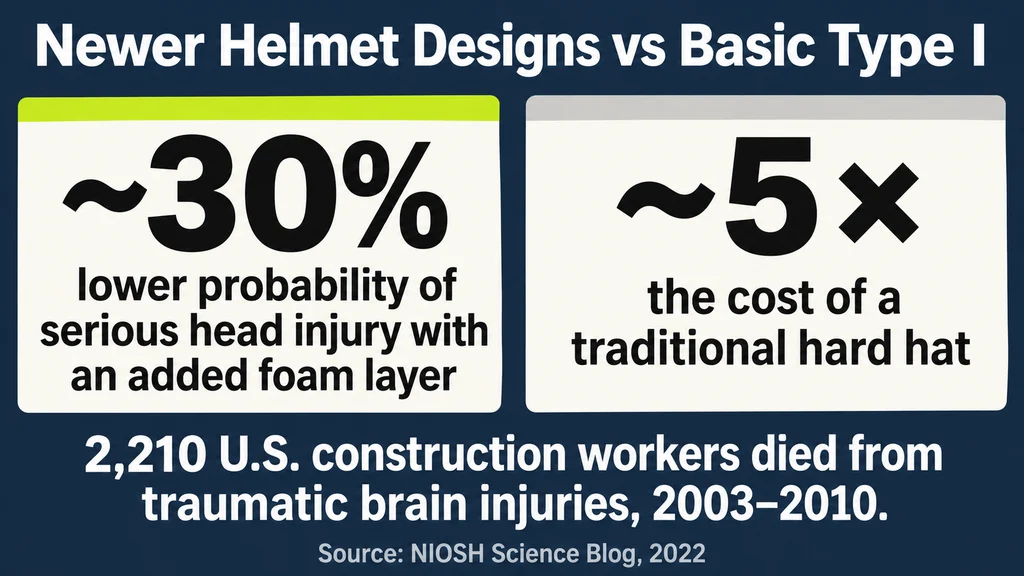
Put those two numbers next to the stakes. NIOSH counts 2,210 construction workers who died from traumatic brain injuries between 2003 and 2010. Weigh the price gap per worker against that.
There’s a limit to keep in mind. Type II certification tests linear impact, not rotation. ISEA’s summary of the 2026 edition lists no rotational-impact test, so features sold as “rotational protection” are the manufacturer’s claim, not part of the Type II or Type II+ rating.
Common Mistakes When Choosing Between Type 1 and Type 2
Most mistakes come from judging a hard hat by how it looks instead of what its label says. People assume a climbing-style helmet is automatically Type II, or a brimmed cap automatically Type I, or treat Type I+ as a Type II substitute. Others forget that Type, Class and venting are three separate decisions.
- Choosing by style. Helmet shape doesn’t set the Type. Read “TYPE I” or “TYPE II” on the label inside the shell.
- Treating Type I+ as Type II. Type I+ adds side impact protection and a retention-tested strap, but not Type II’s off-center penetration testing.
- Assuming Type II means a chin strap is included. Type II only requires a strap test if a strap is supplied. Only the “+” ratings require one.
- Picking a vented Type II for electrical work. OSHA’s 2024 bulletin says vented helmets can’t be used for electrical work, whatever the Type.
- Citing “OSHA requires Type II” in a site rule. OSHA doesn’t. Cite your hazard assessment instead, which is what OSHA’s 2026 interpretation points to.
- Keeping a Type II helmet in service after a hit. OSHA’s 2024 bulletin says any helmet that takes an impact should be retired, even with no visible damage.
Frequently Asked Questions
Can you tell a Type 1 from a Type 2 hard hat by looking at it? Not reliably. A brimmed cap-style hard hat and a climbing-style helmet can each be certified as either Type, and inner foam liners aren’t always visible. The only dependable check is the marking inside the shell, which under ANSI/ISEA Z89.1 must state the Type and Class, such as “TYPE II CLASS E.” If the marking is missing or unreadable, treat the hat’s Type as unknown and replace it.
Do Type 2 hard hats have to come with a chin strap? No. According to NIOSH, OSHA and ANSI standards didn’t require chin straps on Type I or Type II construction helmets, and under ANSI/ISEA Z89.1 a strap is tested only if the manufacturer supplies one. The 2026 edition changes that only for the new “+” ratings: Type I+ and Type II+ helmets must have a tested chin strap and pass a helmet retention test.
Is a Type 1 hard hat still acceptable? Yes, where the hazard assessment shows only overhead hazards, meaning objects that can fall straight down onto the crown. Type I helmets meet ANSI/ISEA Z89.1 and OSHA’s rules for that exposure. OSHA’s 2026 interpretation says top-only protection may not be enough once side hazards are identified, so record why Type I was judged sufficient for the task.
What type of hard hat does OSHA use for its own staff? Type II, Class G. OSHA’s 2024 Safety and Health Information Bulletin on safety helmets reports that, after conducting a job hazard analysis, OSHA chose Type II, Class G safety helmets for its employees. That’s OSHA’s internal choice, not a requirement for other employers. The bulletin itself is advisory and creates no new legal obligations.
Does a Type 2 hard hat protect against rotational head injuries? Not by certification. ANSI/ISEA Z89.1 tests linear impact force and acceleration, and ISEA’s summary of the 2026 edition lists no rotational-impact test. NIOSH notes that lateral impacts, like those in some falls, are likely to cause rotational accelerations linked to concussion. Rotational-protection features exist on some helmets, but their performance claims come from the manufacturer, not the Type rating.
Can a Type 2 hard hat be Class E? Yes. Type and Class are independent ratings under ANSI/ISEA Z89.1, so a Type II hat can be Class G (2,200 V), Class E (20,000 V) or Class C (no electrical protection). Check both on the label. One catch from OSHA’s 2024 bulletin: vented hard hats and helmets can’t be used for electrical work, so many vented Type II designs are ruled out for it.
Is a Type 2 hard hat better for work at height? For side impacts, yes, but staying on the head matters just as much at height. OSHA’s 2024 bulletin recommends head protection with a chin strap for work at height, and NIOSH reports falls caused more than half of fatal work-related brain injuries. A Type II+ helmet covers both side impacts and tested retention. A Type II with a strap covers the side impacts.
Should I replace all my Type 1 hard hats with Type 2? Only where your hazard assessment finds side, off-center or fall-related exposure; OSHA doesn’t require a blanket switch. A practical approach is to switch as each hat reaches the end of its manufacturer’s service life, starting with the highest-exposure crews. Replace any Type I hat immediately if it takes an impact, and choose its replacement based on the current hazard assessment.
Where to Go Next
- ANSI Z89.1 hard hat standard explained: every Type, Class and test limit, plus the edition history behind the label.
- OSHA hard hat requirements: when hard hats are legally required and what employers must do, from the hazard assessment to paying for them.
- Head Protection guide: hard hats, safety helmets and bump caps compared by hazard.
- Bump cap vs hard hat: when a bump cap is enough and when OSHA requires a hard hat.
- Hard hat vs safety helmet: how the two differ in design, chin straps and side protection, and when a safety helmet is the better choice.
Sources: ANSI/ISEA Z89.1-2009 (law.resource.org); ISEA Z89.1-2026 announcement; OSHA SHIB 3-6-2024; 29 CFR 1910.132 and 1926.100 (osha.gov); Occupational Health & Safety, “OSHA Says Helmets Must Match Head Hazards…” (Oct. 26, 2026); NIOSH Science Blog, “Construction Helmets and Work-related Traumatic Brain Injury” (Nov. 10, 2022); Wu et al., NIOSH, Bio-Medical Materials and Engineering (2024); MSA Safety; Koroyd.