

You’ve been asked to set the hard hat rule for a site, and someone has already asked whether they really need one inside the excavator cab. OSHA’s answer is more specific than a blanket “always,” and it comes with duties most hard hat guides skip: a written hazard assessment, training, and paying for the gear.
This guide covers the OSHA hard hat requirements in both rulebooks, general industry (29 CFR 1910.135) and construction (29 CFR 1926.100). It’s built from OSHA’s regulatory text, its general PPE rules, its published letters of interpretation and its current penalty schedule. Each point names its source.
OSHA requires hard hats wherever workers face a possible head injury from falling objects (29 CFR 1910.135), and in construction also from impact, flying objects, or electrical shock and burns (29 CFR 1926.100). The employer must assess the hazard, supply ANSI Z89.1-compliant head protection at no cost to workers, and train them to use it.
What You Need to Know
- The trigger is exposure, not the job title. OSHA says that where workers aren’t exposed to possible head injury, its standards don’t require head protection.
- The employer pays. Hard hats aren’t on OSHA’s short list of PPE exceptions, so employers must provide them free, replacements included.
- The paperwork is real. General industry employers must certify their PPE hazard assessment in writing and train workers before they work.
- Construction has no “distance rule.” OSHA uses a “zone of danger” test, and a closed vehicle cab generally protects better than a hard hat.
- Penalties run up to $16,550 per serious violation and $165,514 per willful or repeated violation, for penalties assessed after January 15, 2026.
When Does OSHA Require a Hard Hat?
OSHA requires a hard hat when a worker faces a possible head injury, and the triggers differ by industry. In general industry, 29 CFR 1910.135 covers falling objects plus exposed electrical conductors. In construction, 29 CFR 1926.100 covers impact, falling or flying objects, and electrical shock and burns. The hazard decides, not the site or the job title.
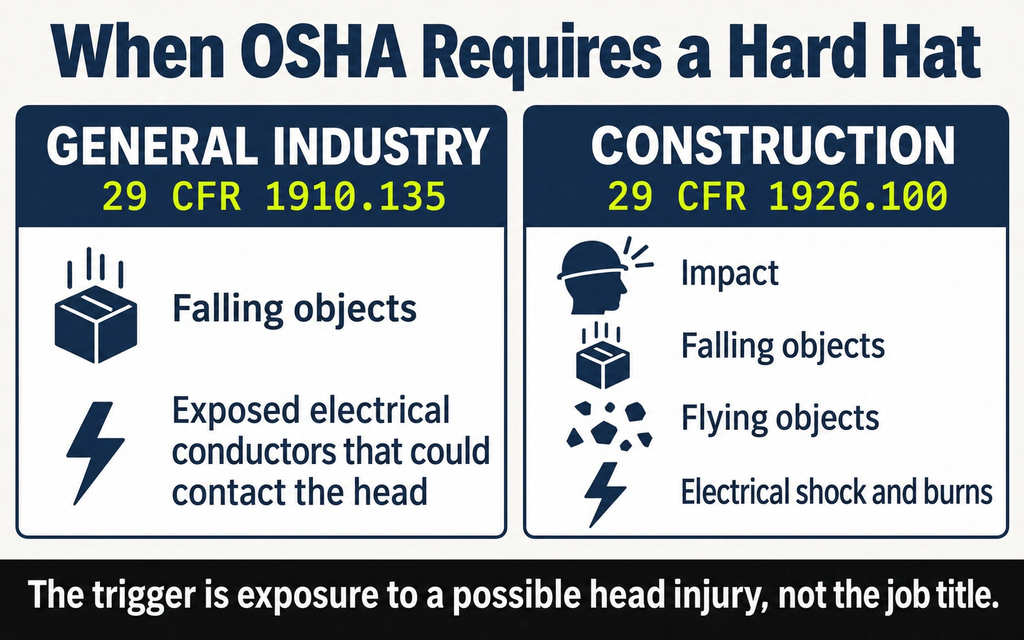
The exact triggers, from OSHA’s regulatory text:
| Rule | Who it covers | Hard hat required when… |
|---|---|---|
| 29 CFR 1910.135(a)(1) | General industry | Workers are “in areas where there is a potential for injury to the head from falling objects” |
| 29 CFR 1910.135(a)(2) | General industry | Workers are near exposed electrical conductors “which could contact the head” (helmet must be designed to reduce shock hazard) |
| 29 CFR 1926.100(a) | Construction | There is “a possible danger of head injury from impact, or from falling or flying objects, or from electrical shock and burns” |
| 29 CFR 1926.100(b)(2) | Construction | Workers face high-voltage shock and burns: head protection must also meet the “Electrical Insulation” section of a listed ANSI edition |
The construction trigger is broader. “Impact” covers a worker striking their head on something, not just something striking them. Shipyards, marine terminals and longshoring have parallel rules (29 CFR 1915.155, 1917.93 and 1918.103), which OSHA updated alongside 1910.135 in 2012.
Is a Hard Hat Required Everywhere on a Construction Site?
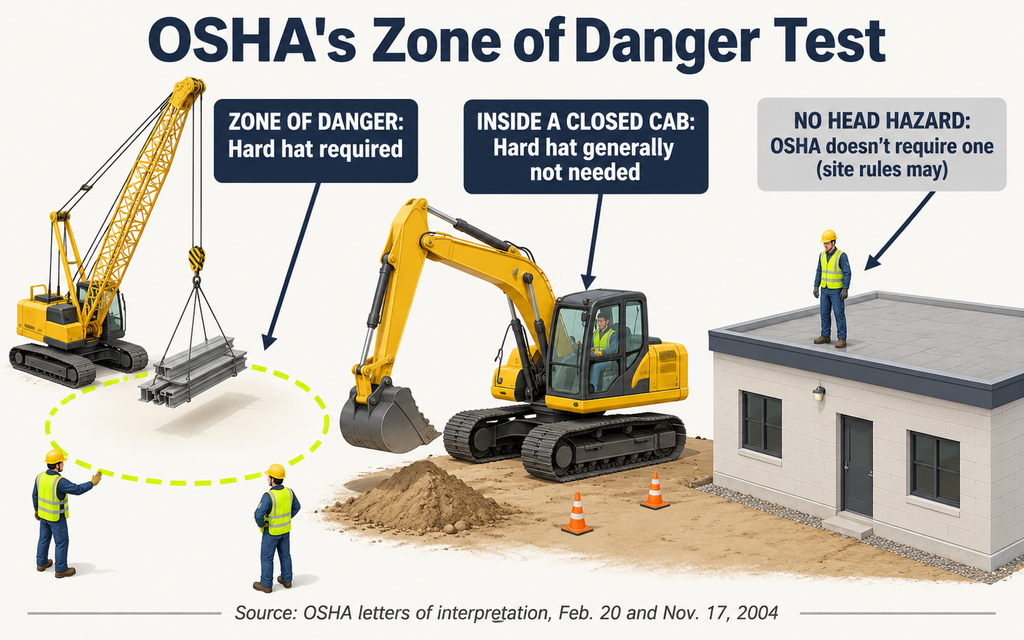
No. OSHA doesn’t require hard hats across an entire construction site by default. In a November 17, 2004 letter of interpretation, OSHA said the requirement turns on whether a worker is in a “zone of danger,” and that 1926.100 sets no specific distance from equipment. The employer must “evaluate the activities of its employees” to decide who’s exposed.
Three OSHA letters show where the line falls:
- Hazards from someone else’s equipment count. The 2004 letter says the requirement “may arise by virtue of an employee’s location near other equipment,” such as a crane. Your crew needs hard hats under another contractor’s load.
- A closed vehicle cab usually replaces the hard hat. The same letter says a cab “will provide more protection from overhead hazards than a hard hat,” so a hard hat generally isn’t needed inside it.
- No overhead hazard, no OSHA requirement. In a February 20, 2004 letter about roofers on a one-story roof with no work overhead, OSHA said that “where employees are not exposed to possible head injuries, head protection is not required by OSHA standards.”
Where OSHA doesn’t require a hard hat and the only risk is bumping into fixed objects, see when a bump cap is enough.
That’s the surprising part for most people: a site-wide “hard hats at all times” rule is usually a contractor’s choice, not OSHA’s. OSHA allows it, though. Both letters stress that “OSHA standards set minimum safety and health requirements,” so a general contractor can require more.
Do You Need a Hard Hat Here? A Six-Question Check
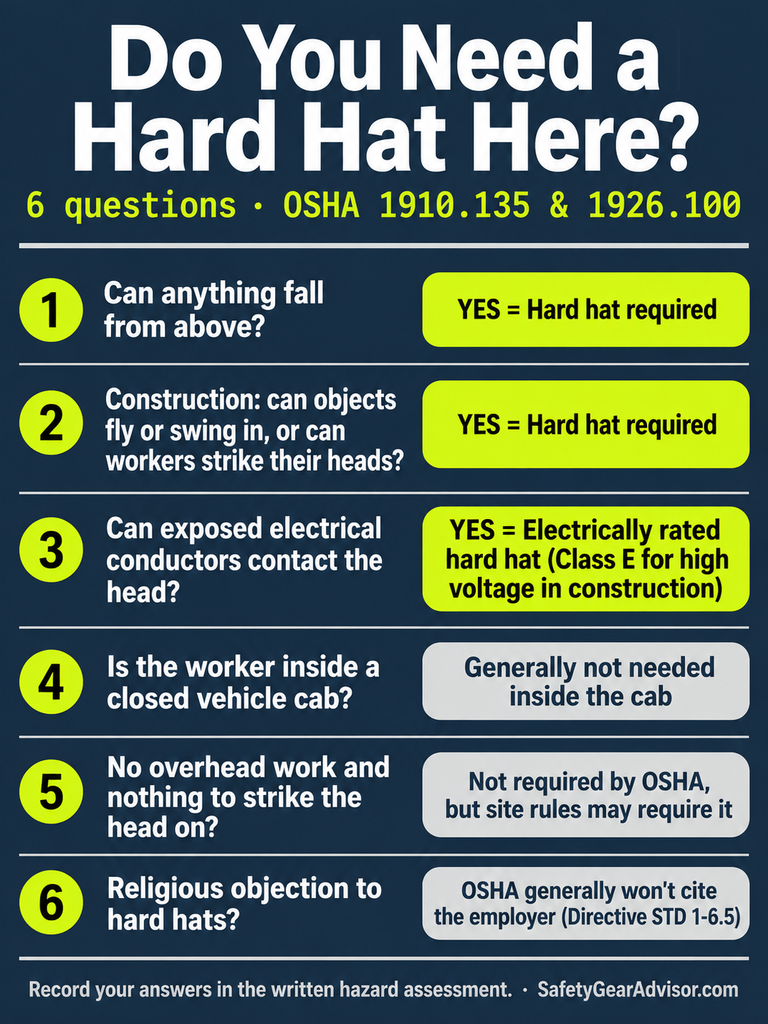
Run these six questions for any work area. A “yes” on question 1, 2 or 3 means OSHA requires head protection there. Questions 4 to 6 cover the situations OSHA has addressed in letters of interpretation, where the answer depends on the conditions.
| # | Ask | If yes | OSHA basis |
|---|---|---|---|
| 1 | Can anything fall onto workers from above (tools, materials, loads, debris)? | Hard hat required | 1910.135(a)(1); 1926.100(a) |
| 2 | Construction: can objects fly or swing into workers, or can workers strike their heads? | Hard hat required | 1926.100(a) (“impact… falling or flying objects”) |
| 3 | Can exposed electrical conductors contact the head? | Hard hat with electrical protection required (Class E for high voltage in construction) | 1910.135(a)(2); 1926.100(b)(2) |
| 4 | Is the worker inside a closed vehicle or equipment cab? | Hard hat generally not needed inside the cab, but it’s needed again on stepping out into the zone | OSHA letter of interpretation, Nov. 17, 2004 |
| 5 | Is there no overhead work and nothing to strike the head on? | OSHA doesn’t require one; the employer or general contractor still can | OSHA letter of interpretation, Feb. 20, 2004 |
| 6 | Does a worker object to hard hats for religious reasons? | OSHA generally won’t cite the employer; the hazard still exists, so manage it by other means | OSHA Directive STD 1-6.5, per OSHA letter of May 16, 2001 |
Write the answers into your hazard assessment. In general industry, that assessment has to be certified in writing anyway (see the next section).
What Must Employers Do Under OSHA’s Hard Hat Rules?
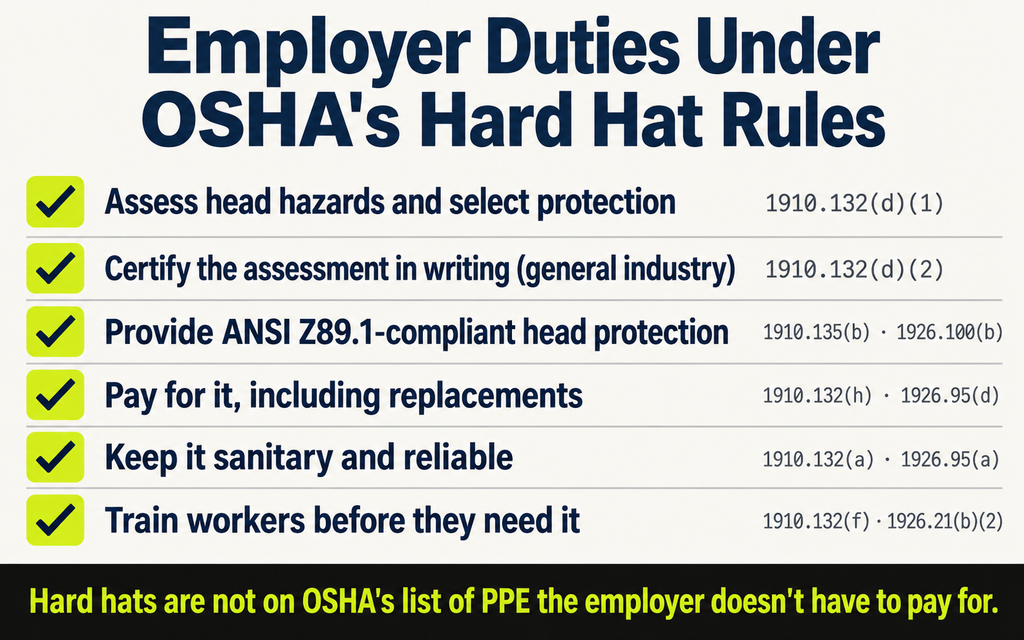
OSHA’s hard hat rules work together with its general PPE rules. Employers must assess hazards and select protection, make sure it fits, provide it at no cost to workers, keep it in reliable condition, and train workers before they need it. General industry employers must also certify the hazard assessment in writing. Each duty and its citation is in the checklist below.
| Duty | What it means for hard hats | General industry | Construction |
|---|---|---|---|
| Assess and select | Identify head hazards, choose head protection that protects against them, and tell affected workers what was selected | 1910.132(d)(1) | 1926.100(a) (hazard-based duty) |
| Certify in writing | A written certification naming the workplace evaluated, the person certifying, and the date(s), identified as “a certification of hazard assessment” | 1910.132(d)(2) | No equivalent paragraph in 1926.95 or 1926.100 |
| Meet a listed standard | Head protection meets ANSI Z89.1-1997, -2003 or -2009, or is shown to be at least as effective | 1910.135(b) | 1926.100(b) |
| Ensure fit | “Select PPE that properly fits each affected employee” | 1910.132(d)(1) | Not stated in 1926.95 or 1926.100 |
| Pay for it | Provided “at no cost to employees,” replacements included unless the worker lost it or intentionally damaged it | 1910.132(h) | 1926.95(d) |
| Check employee-owned gear | If a worker brings their own, “the employer shall be responsible to assure its adequacy” | 1910.132(b) | 1926.95(b) |
| Maintain it | Provided, used and “maintained in a sanitary and reliable condition” | 1910.132(a) | 1926.95(a) |
| Train | Teach when PPE is needed, what’s needed, how to don, doff, adjust and wear it, its limitations, and its care, useful life and disposal; workers must demonstrate understanding first; retrain when things change | 1910.132(f)(1)–(3) | 1926.21(b)(2): a general duty to instruct each employee in recognizing and avoiding unsafe conditions and the rules for their work; no PPE-specific topic list |
Two details trip up employers. First, payment: the exceptions in 1910.132(h) and 1926.95(d) cover non-specialty safety-toe footwear, prescription safety eyewear worn off the job, everyday clothing and weather gear. Hard hats aren’t among them, so charging workers for hard hats, or deducting their cost, isn’t allowed.
Second, training timing. Under 1910.132(f)(2), workers must show they understand the training “before being allowed to perform work requiring the use of PPE.” A hard hat handed out at the gate with no explanation doesn’t meet that.
Which Hard Hats Meet OSHA Requirements?
A hard hat meets OSHA’s requirements if it’s built to ANSI Z89.1-1997, -2003 or -2009, the three editions both rules name, or if the employer shows it’s at least as effective as one that is. Newer editions (2014, 2019 reaffirmation, 2026) qualify through that second route. Match the Type and Class to the hazards your assessment found.
For electrical exposure, the Class matters most. Construction workers exposed to high-voltage shock and burns need head protection that also meets the listed editions’ electrical insulation section, which in practice means a Class E rating. See hard hat Class E vs G vs C for which class fits which voltage.
Neither OSHA rule prescribes Type I vs. Type II; the hazard assessment decides. OSHA’s interpretation index lists an August 17, 2026 letter titled “OSHA’s Head Protection Requirements and Selection and Use of Type II Safety Helmets.” If your site is weighing Type II, read that letter on osha.gov before setting the rule. Our Type 1 vs Type 2 hard hat guide compares what each one is tested for.
What Happens If You Don’t Meet OSHA Hard Hat Requirements?
Missing head protection or a skipped hazard assessment can be cited as a violation. OSHA’s current maximum penalties are $16,550 per serious or other-than-serious violation, $16,550 per day for failure to abate, and $165,514 per willful or repeated violation. Those amounts apply to penalties assessed after January 15, 2026.
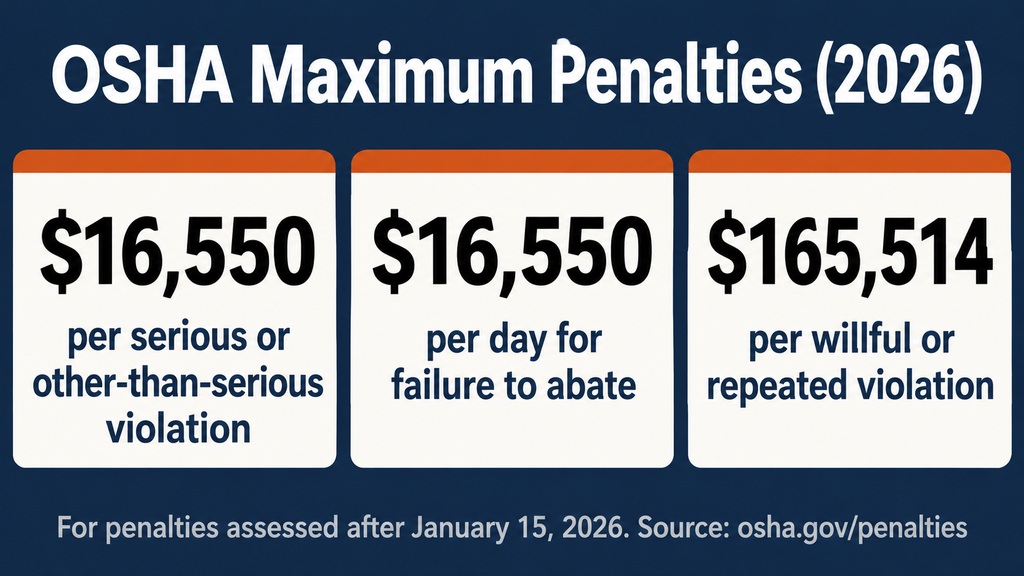
Those are maximums per violation, so the exposure grows with every uncovered worker and uncorrected condition. OSHA calls its standards minimums. States that run their own OSHA-approved plans can set stricter rules, so check your state plan’s version if you work in one.
Common Mistakes With OSHA Hard Hat Requirements
The most common mistakes come from treating OSHA’s rule as either broader or narrower than it is. Some employers ban hard-hat-free zones OSHA would allow; others skip the written assessment or charge workers for replacements. Others set rules OSHA’s own letters contradict. Each of the mistakes below is answered by a specific OSHA paragraph or letter.
- Assuming OSHA requires hard hats everywhere on site. OSHA’s test is exposure. A blanket rule is fine as company policy, but say so, rather than citing OSHA for it.
- Ignoring hazards from other crews’ equipment. OSHA’s 2004 letter says exposure “may arise by virtue of an employee’s location near other equipment.”
- Skipping the written certification. In general industry, an unwritten assessment fails 1910.132(d)(2) even if the right hard hats were chosen.
- Charging for hard hats or replacements. Only loss or intentional damage shifts replacement cost to the worker (1910.132(h)(5); 1926.95(d)(5)).
- Accepting a worker’s own hard hat without checking it. The employer remains responsible for its adequacy (1910.132(b); 1926.95(b)).
- Allowing bill-to-rear wear on any hat. OSHA’s 1992 position, reaffirmed in 2002 and 2011 letters, is that hats worn bill-to-rear aren’t reliable protection unless certified for it. The 2009 ANSI edition contains provisions for testing that.
- Giving every electrical worker a Class G hat. For high-voltage exposure in construction, 1926.100(b)(2) points to the electrical insulation test, which in practice means Class E.
Frequently Asked Questions
Who pays for hard hats under OSHA rules? The employer. Under 29 CFR 1910.132(h) for general industry and 1926.95(d) for construction, required PPE must be provided at no cost to employees. The exceptions cover items like non-specialty safety-toe boots, prescription safety eyewear worn off the job, and everyday clothing, and hard hats aren’t among them. Employers also pay for replacements unless the worker lost the hard hat or damaged it on purpose.
Is a hard hat required everywhere on a construction site? Not by OSHA. In a November 17, 2004 letter, OSHA said the construction rule applies to workers in a “zone of danger” where head injury is reasonably foreseeable, and sets no distance-from-equipment rule. Areas with no overhead work and no head-impact hazard don’t require hard hats under OSHA. General contractors can still require them site-wide, because OSHA’s rules are minimums.
Do workers need a hard hat inside an equipment cab? Generally no. OSHA’s November 17, 2004 letter of interpretation says a vehicle cab “will provide more protection from overhead hazards than a hard hat,” so a hard hat usually isn’t required while the operator stays inside. Once the operator steps out into an area with falling, flying or impact hazards, the hard hat requirement applies again. Keep one in the cab for that moment.
Can employees bring their own hard hats? Yes. Both 1910.132(b) and 1926.95(b) allow employee-owned PPE, but the employer stays responsible for making sure it’s adequate and kept sanitary. In practice, that means checking the ANSI Z89.1 marking, the Type and Class against your hazard assessment, and the hat’s condition. Under 1910.132(h)(6) and 1926.95(d)(6), employers don’t have to reimburse workers who choose to use adequate gear they own.
Does OSHA require a written hazard assessment for hard hats? In general industry, yes. 29 CFR 1910.132(d)(2) requires a written certification that identifies the workplace evaluated, the person certifying the evaluation, and the date or dates, and states that the document is a certification of hazard assessment. The construction rules (1926.95 and 1926.100) don’t contain an equivalent certification paragraph, though construction employers still have to identify head hazards to know where hard hats are required.
Can a worker refuse a hard hat for religious reasons? OSHA addressed this in a May 16, 2001 letter of interpretation. Under OSHA Directive STD 1-6.5, which superseded a 1975 memorandum, OSHA generally doesn’t cite employers whose employees object to hard hats for personal religious convictions. The head hazard doesn’t go away, so employers should still reduce it through other controls, such as keeping those workers out of overhead-hazard zones where possible.
Does OSHA require a specific hard hat color? No. Neither 29 CFR 1910.135 nor 1926.100 mentions hard hat color. They set hazard triggers and point to ANSI Z89.1 for performance. Many sites use colors to identify roles, but that’s company or site policy, not an OSHA requirement. The exception is visibility: ANSI Z89.1 has an optional high-visibility test (renamed “Enhanced Visibility” in the 2026 edition), marked on qualifying hats.
Does OSHA require Type II hard hats? OSHA’s head protection rules don’t prescribe Type I or Type II. They require head protection matched to the hazards the employer identifies, built to a listed ANSI Z89.1 edition or shown to be at least as effective. Type II covers blows to the top and sides, so it fits sites with side-impact or falling hazards. OSHA’s index lists an August 17, 2026 letter on Type II safety helmets; read it before setting a site rule.
Where to Go Next
- Head Protection guide: choosing between hard hats, safety helmets and bump caps by hazard, with a full label chart.
- ANSI Z89.1 hard hat standard explained: the Types, Classes, test limits and editions behind OSHA’s requirements.
- OSHA standards hub: the OSHA regulations behind every PPE category on this site.
- Hard hat vs safety helmet: how the two differ in design, chin straps and side protection, and when a safety helmet is the better choice.
- How to wear a hard hat: fit, date codes, a pre-shift checklist and when to replace the shell and suspension.
Sources: 29 CFR 1910.132 and 1926.100 (osha.gov); 29 CFR 1910.135 (eCFR); 29 CFR 1926.95 and 1926.21 (Cornell LII); OSHA letters of interpretation dated July 22, 1992 (via the April 17, 2002 letter), May 16, 2001, April 17, 2002, February 20, 2004, November 17, 2004 and May 9, 2011; OSHA letter index for 1910.135; OSHA penalties page; OSHA 2012 head protection direct final rule.