
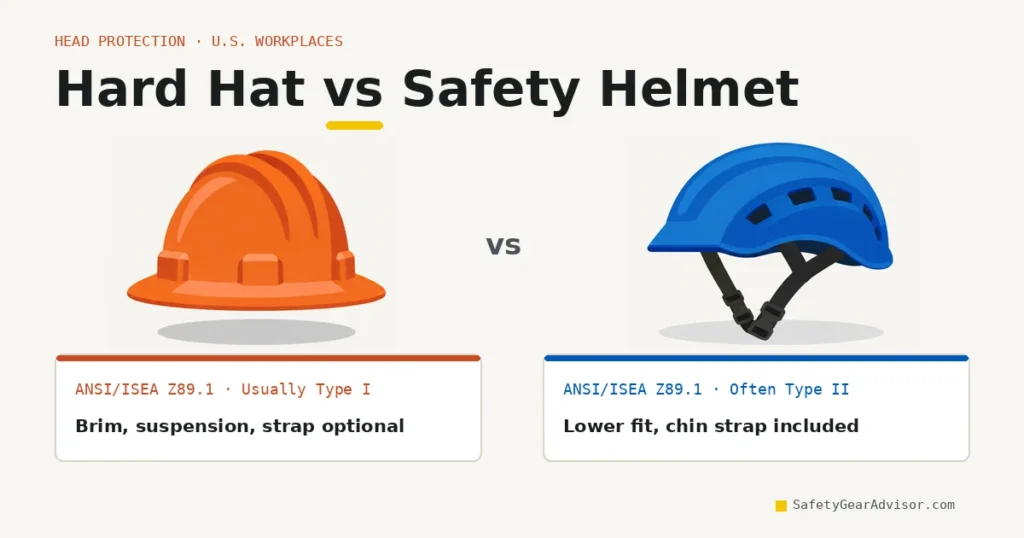
Your client’s site rules now say “helmets only”, or you’ve seen OSHA inspectors in climbing-style helmets, and you’re wondering whether your crew’s hard hats are out of date. They aren’t automatically. The hard hat vs safety helmet question comes down to what each one is rated for, and here’s how to decide for U.S. workplaces.
“Hard hat” and “safety helmet” are style names, not protection levels. Both are certified to ANSI/ISEA Z89.1, and both meet OSHA’s rules if they carry a listed rating. Safety helmets usually add side protection and a chin strap, which OSHA recommends, but the Type and Class on the label decide protection.
What You Need to Know
- OSHA switched its own staff to safety helmets in December 2023, but didn’t change the rule. A Z89.1 hard hat still meets 29 CFR 1910.135 and 1926.100.
- The label beats the style. Type I or Type II and Class G, E or C tell you what the headgear was tested for, whatever it looks like.
- Chin straps are the clearest advantage. OSHA’s bulletin says they should be considered for all head protection, especially for work at height.
- Lab research is mixed. A 2022 study found two climbing-style helmets did worse than a basic Type I hard hat in a simulated fall.
- Vented helmets can’t be used for electrical work, whichever style they are.
Hard Hat vs Safety Helmet: What’s the Real Difference?
The difference is design, not certification. A hard hat has a brim, a raised shell and a webbing suspension. A safety helmet is a rounder, climbing-style shell that sits lower and usually comes with a chin strap. Both are made to the same U.S. standard, ANSI/ISEA Z89.1, so what protects you is the rating printed inside.
The construction research group CPWR, quoted by Safety+Health magazine in April 2024, puts it simply. A hard hat “typically refers to the traditional style”, with a bulkier shell and a brim. A helmet is “a climbing style of headgear that’s more rounded and consistently has a chin strap.”
Here’s the surprising part: neither OSHA’s rules nor ANSI/ISEA Z89.1 use the term “hard hat” at all. They say “protective helmet” and “head protection”. According to CPWR, the manufacturer decides which name a product gets.
| Hard hat (traditional) | Safety helmet (climbing style) | |
|---|---|---|
| Standard in the U.S. | ANSI/ISEA Z89.1 | ANSI/ISEA Z89.1 (some also carry the European EN 12492 mountaineering standard) |
| Type rating | Most are Type I (top impact); Type II versions exist | Often Type II (top and side impact); check the label |
| Class rating | G, E or C | G, E or C |
| Chin strap | Usually an optional accessory | Usually included |
| Shape | Brim (cap or full brim), sits high on a suspension | Short peak, sits lower, padded or foam liner |
| Meets OSHA | Yes, if built to a listed Z89.1 edition | Yes, on the same condition |
For what Type I and Type II are tested for, see our guide to Type 1 vs Type 2 hard hats.
What Did OSHA Actually Say About Safety Helmets?
OSHA recommended safety helmets; it didn’t require them. In a December 11, 2023 trade release, OSHA said it was replacing the hard hats its own employees wear with safety helmets. Its 2024 bulletin, SHIB 3-6-2024, explains that choice and its recommendations. The head protection rules themselves were not changed.
According to OSHA’s release, traditional hard hats date back to the 1960s, protect the top of the head with minimal side-impact protection, and lack chin straps, so they can fall off in a slip or trip. The release recommends helmets for construction, oil and gas, high-temperature and electrical work, work at heights, and wherever regulations or industry standards require them. The page now carries an OSHA archive notice saying it may no longer represent current policy.
OSHA’s bulletin SHIB 3-6-2024 is more measured. After its own job hazard analysis, OSHA “determined Type II, Class G safety helmets were the most appropriate form of head protection for its employees”, and the bulletin notes other employers may reach different conclusions. It still lists the 1997, 2003 and 2009 editions of ANSI Z89.1 as the way to meet the rules.
Claim check: what OSHA said vs what you’ll hear
| What you’ll hear | What OSHA’s documents say | Verdict |
|---|---|---|
| “OSHA banned hard hats.” | OSHA switched its own employees to helmets; the rules still accept Z89.1 head protection | False |
| “Hard hats are no longer OSHA compliant.” | The bulletin still names ANSI Z89.1-2009, 2003 and 1997 as the way to comply | False |
| “OSHA requires safety helmets for construction.” | It recommends considering Type II head protection with chin straps in construction | Recommendation, not a rule |
| “OSHA says helmets are better for everyone.” | OSHA chose Type II, Class G helmets after its own hazard analysis, and says employers may conclude differently | Partly true |
| “Any helmet is fine for electrical work.” | Vented hard hats or helmets “cannot be used for electrical work”; use Class G or E | False |
A law firm’s review of the announcement, published on JD Supra, reached the same conclusion: the announcement “does not change existing regulations and standards” for head protection. For when OSHA requires head protection at all, see OSHA hard hat requirements.
Is a Safety Helmet Safer Than a Hard Hat? What the Lab Tests Found
Not automatically. Independent lab research shows that design details such as a Type II impact liner and a chin strap matter more than whether a product is called a helmet or a hard hat. In one widely cited 2022 study, two climbing-style helmets performed worse than a basic Type I hard hat in a simulated fall.
Bottlang and colleagues (Heliyon, 2022) tested six designs: a Type I and a Type II hard hat, two climbing-style helmets (one web suspension, one foam), a helmet with MIPS and a prototype with the authors’ own CEL liner. They used 31 J falling-object impacts based on Z89.1-2014, then a 275 J impact representing a fall.
| Design | Fall test: estimated concussion probability |
|---|---|
| Hard hat, Type I | about 8% |
| Hard hat, Type II | about 30% |
| Climbing-style helmet, foam | about 56% |
| Climbing-style helmet, web suspension | about 99% |
| Helmet with MIPS | about 86% |
| Prototype CEL liner (authors’ own design) | about 2% |
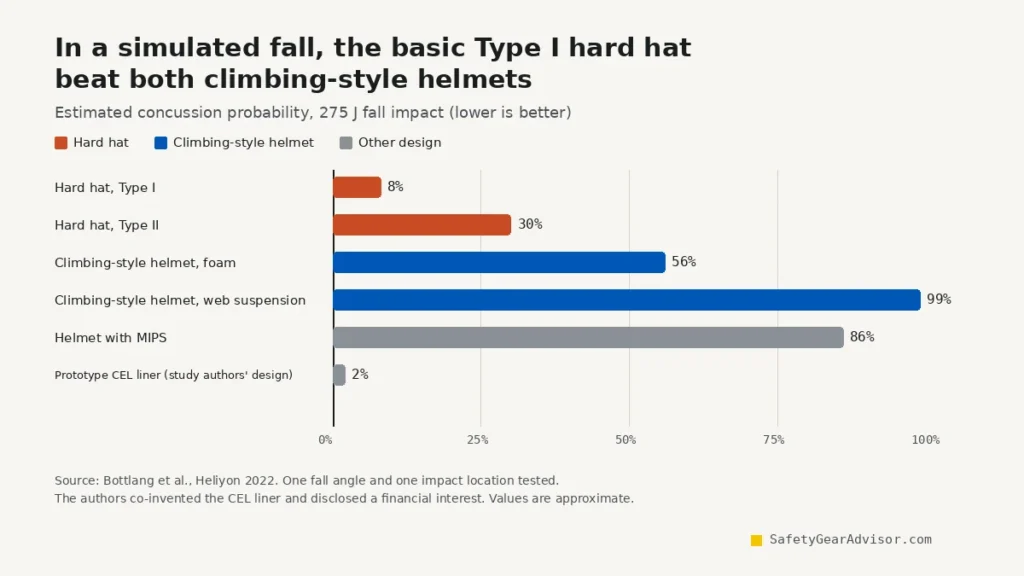
The same study found the opposite for side, front and rear falling-object hits: those caused “a several-fold increase in head acceleration in all helmets except HH Type II and CEL helmets.” So the Type II hard hat did best against off-centre falling objects, and the Type I hard hat did best in the fall test.
Read it with two cautions. The authors are co-inventors of the CEL liner and have a financial interest in it, and they tested one fall angle and one impact location.
Later work points in different directions. A 2024 steel-plant evaluation by the same group found Type II helmets with impact liners gave significantly more protection than Type I and climbing-style helmets. A 2026 study by Tan, Yu and Ghajari found foam-based helmets protected better than suspension-based ones in simulated falls and trips.
The practical reading: choose the Type and liner for your hazards, and keep the headgear on with a chin strap. The style name alone doesn’t tell you which protects better.
Which Should Your Crew Wear? A Five-Question Check
Start with the hazard, then the label. If anything can strike the sides of the head, or a worker could fall, a Type II helmet or hard hat with a chin strap is the better match. If the only hazard is overhead falling objects at ground level, a Type I hard hat still meets OSHA. Electrical exposure decides the Class.
| # | Question | If yes |
|---|---|---|
| 1 | Could a worker fall, or work at height? | Choose head protection with a chin strap; OSHA’s bulletin recommends it for work at height |
| 2 | Can anything hit the side, front or back of the head: swinging loads, equipment, tight spaces? | Choose Type II, in either style |
| 3 | Is there exposure to electrical conductors? | Class G (2,200 V) or Class E (20,000 V), with no vents (Class E vs G vs C) |
| 4 | Does the client, general contractor or industry standard require helmets? | Wear helmets on that site; OSHA’s release lists this case |
| 5 | Is the only hazard overhead falling objects, at ground level? | A Type I hard hat meets OSHA; a helmet is optional |
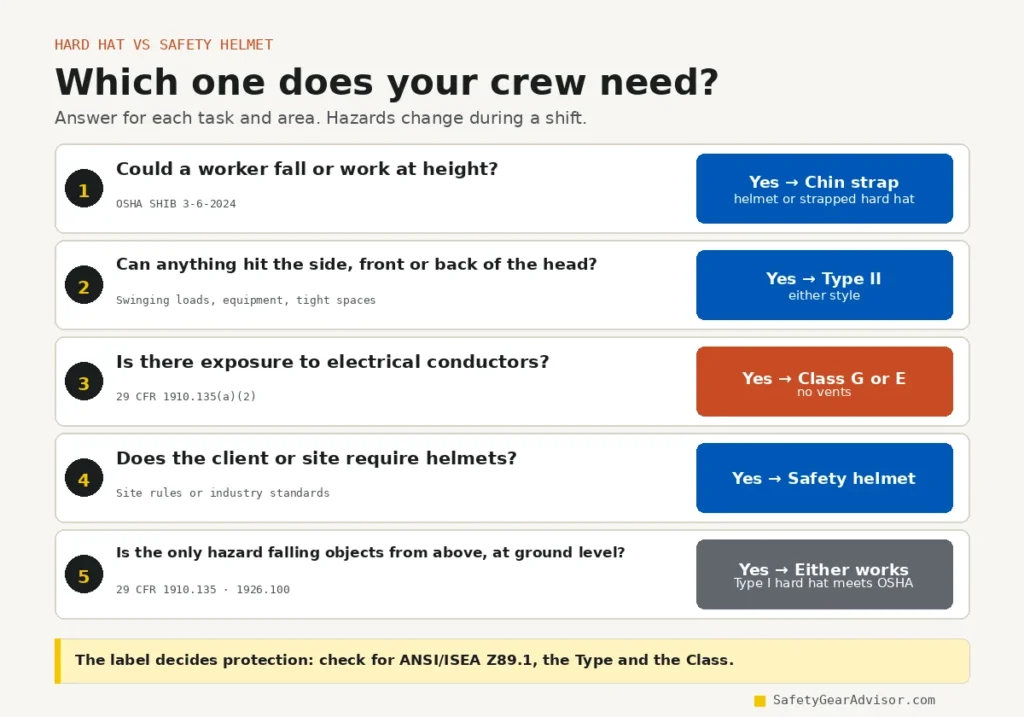
Hazards change from task to task. A crew that works on the ground in the morning and on a scaffold in the afternoon should be equipped for the afternoon.
Common Mistakes When Switching to Safety Helmets
Most mistakes come from treating “helmet” as a rating. It’s a shape. A helmet that lacks the right Type, Class or certification can protect less than the hard hat it replaced.
- Buying climbing helmets instead of industrial ones. A helmet certified only to EN 12492, the European mountaineering standard, isn’t an ANSI Z89.1 product. Check for the Z89.1 marking.
- Assuming every helmet is Type II. Many are, but some are Type I. Read the label.
- Buying vented helmets for electricians. OSHA’s bulletin says vented helmets can’t be used for electrical work.
- Leaving the chin strap unfastened. The strap is the main reason helmets stay on in a fall. An unfastened strap gives none of that benefit.
- Adding stickers, paint or non-approved accessories. Only use accessories the manufacturer approves for that model.
- Keeping a helmet after a hit. OSHA’s bulletin says to discard any hard hat or helmet once it’s been impacted, even with no visible damage.
Frequently Asked Questions
Does OSHA require safety helmets instead of hard hats?
No. This is a common training-quiz premise, and it’s wrong. In December 2023 OSHA switched its own employees to safety helmets and recommended them for construction, oil and gas, and other work. But 29 CFR 1910.135 and 1926.100 still accept any head protection built to ANSI Z89.1-1997, 2003 or 2009, or shown to be equally effective. A compliant hard hat still meets the rule.
How do I tell if a safety helmet is ANSI approved?
Look at the label inside the shell. It should read “ANSI/ISEA Z89.1” with an edition year, a Type (I or II) and a Class (G, E or C). ANSI doesn’t approve individual products; manufacturers certify that they meet the standard. A helmet marked only “EN 12492” or “EN 397” meets a European standard, not Z89.1. Our ANSI Z89.1 explainer shows how to read the full marking.
Can a safety helmet be Class E for electrical work?
Yes. Class is separate from style, so a safety helmet can be Class E (proof-tested at 20,000 volts) or Class G (2,200 volts) if its label says so. It must not be vented: OSHA’s 2024 bulletin says vented hard hats or safety helmets cannot be used for electrical work. Many popular helmets come in vented and non-vented versions, so check the exact model.
Do safety helmets need a chin strap?
OSHA doesn’t require one, but its 2024 bulletin says chin straps “should be considered for use with all head protection”, and it specifically recommends them for work at height. Most safety helmets include one. The new ANSI/ISEA Z89.1-2026 edition adds optional Type I+ and Type II+ markings for headgear whose chin strap and retention have been tested. OSHA’s rules don’t reference that edition yet.
Is a climbing helmet OK on a construction site?
Only if it’s also certified to ANSI/ISEA Z89.1. Recreational climbing helmets and helmets made only to EN 12492 are designed for mountaineering. According to PPE specialist Chris Tidy, EN 12492 requires ventilation, which rules them out for electrical work. Industrial “climbing-style” helmets look similar but are certified to Z89.1 with a Type and Class. Check the label, not the shape.
Do safety helmets expire?
Neither OSHA’s rules nor its 2024 bulletin sets a fixed expiry date for hard hats or helmets. Follow the manufacturer’s service-life guidance, inspect the shell and liner before each use, and replace the helmet after any impact. OSHA’s bulletin says to discard head protection that has been impacted or shows damage or degradation, even if the damage isn’t visible.
Where to Go Next
- Type 1 vs Type 2 hard hat: what each Type is tested for, and the new Type I+ and II+ ratings.
- OSHA hard hat requirements: when OSHA requires head protection and what employers must do.
- Head Protection guide: hard hats, safety helmets and bump caps compared by hazard.
- How to wear a hard hat: fit, date codes, a pre-shift checklist and when to replace the shell and suspension.
Sources: OSHA trade release, December 11, 2023; OSHA SHIB 3-6-2024, Head Protection: Safety Helmets in the Workplace (osha.gov); Safety+Health magazine; JD Supra; Bottlang et al., Heliyon, 2022; 2024 steel-plant helmet evaluation (same research group); Tan, Yu and Ghajari, 2026.