
You flip your hard hat over, the label says “ANSI/ISEA Z89.1-2014,” and your safety program says OSHA wants the 2009 edition. Is the hat compliant? Almost certainly, and by the end of this guide you’ll know exactly why. You’ll also know what the Type and Class letters mean, what the hat had to survive in testing, and what the new 2026 edition adds.
Everything here comes from OSHA’s regulatory text, OSHA’s 2012 Federal Register rule, the published text of the 2009 edition of ANSI Z89.1, and ISEA’s own announcements for the 2014 and 2026 editions. Each claim names its source.
ANSI Z89.1 is the American National Standard for industrial head protection, published by ISEA. It rates hard hats by Type (I: top impact; II: top and side) and Class (G: 2,200 V; E: 20,000 V; C: no electrical protection). OSHA’s rules name the 1997, 2003 and 2009 editions; the 2026 edition adds optional Type I+ and II+.
What You Need to Know
- OSHA’s list of editions hasn’t changed since 2012. That’s when OSHA added the 2009 edition by direct final rule. Every edition since, including 2014, 2019 and 2026, sits outside that list.
- Newer editions still work for compliance. Both OSHA head protection rules accept headgear the employer can show is “at least as effective” as a helmet built to a listed edition.
- Type and Class are separate ratings. Type covers where the hat absorbs a blow; Class covers electrical insulation. Read both on the label.
- The edition year isn’t an expiration date. Service life comes from the manufacturer’s instructions, which the standard requires them to provide.
- Z89.1-2026 is optional to adopt. ISEA says it doesn’t make currently compliant head protection obsolete.
What Is ANSI Z89.1?
ANSI Z89.1 is the U.S. consensus standard for industrial head protection, formally “American National Standard for Industrial Head Protection.” ISEA writes and publishes it, and the American National Standards Institute (ANSI) approves each edition. It isn’t a law by itself. OSHA’s head protection rules make it enforceable by naming specific editions.
The 2009 edition describes its own scope in one line: the standard “describes Types and Classes, testing and performance requirements for protective helmets” (§1.1). In practice, it tells manufacturers how a hard hat must perform in impact, penetration and electrical tests, and what it must say on its label.
It doesn’t cover bump caps. Those have their own standard, ANSI/ISEA 100-2024, and ISEA states that bump caps are “not a replacement for products covered by ANSI/ISEA Z89.1.” For how the two fit together on a jobsite, see the Head Protection guide.
What Do Type and Class Mean Under ANSI Z89.1?
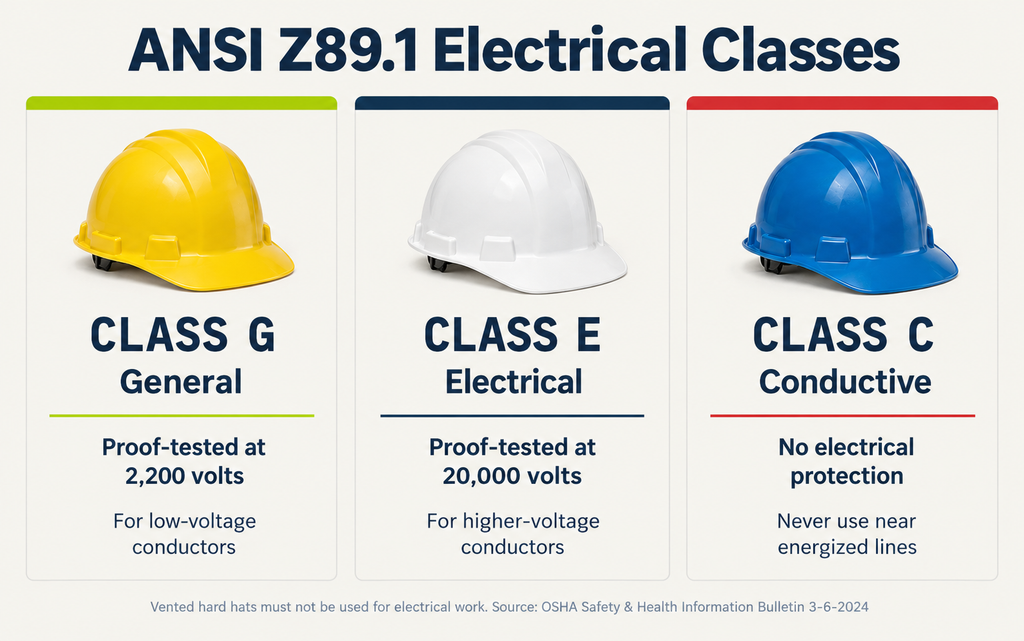
Every Z89.1 hard hat carries two independent ratings. Type describes impact coverage: Type I reduces the force of a blow “only to the top of the head,” while Type II covers “the top or sides.” Class describes electrical protection: Class G is proof-tested at 2,200 volts, Class E at 20,000 volts, and Class C has no electrical protection.
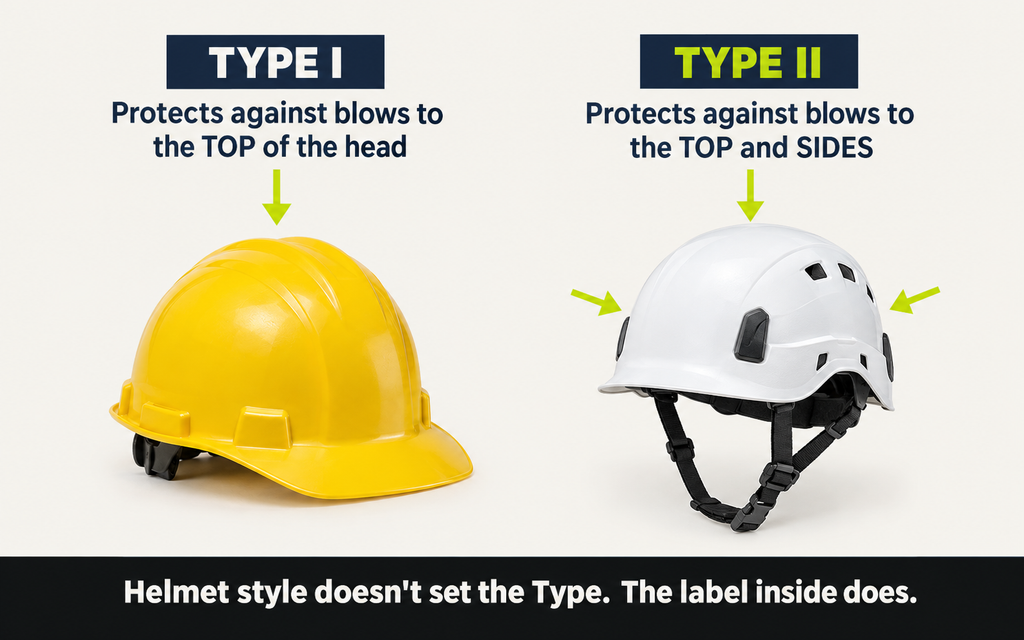
Those definitions come from §4.1 and §4.2 of the 2009 edition, and OSHA’s 2024 Safety and Health Information Bulletin on safety helmets uses the same wording. So a “Type II, Class E” hard hat is rated for top and side impacts and for higher-voltage exposure. For side-by-side comparisons, see Type 1 vs Type 2 hard hats compared and hard hat Class E vs G vs C.
The letters weren’t always this way. According to a University of Kentucky occupational health guide, the 1986 edition used “Type 1” and “Type 2” to describe brim style, and Classes A, B and C for electrical protection. The 1997 edition replaced those with today’s impact Types and renamed the Classes G (formerly A), E (formerly B) and C.
What Does a Z89.1 Hard Hat Have to Pass?
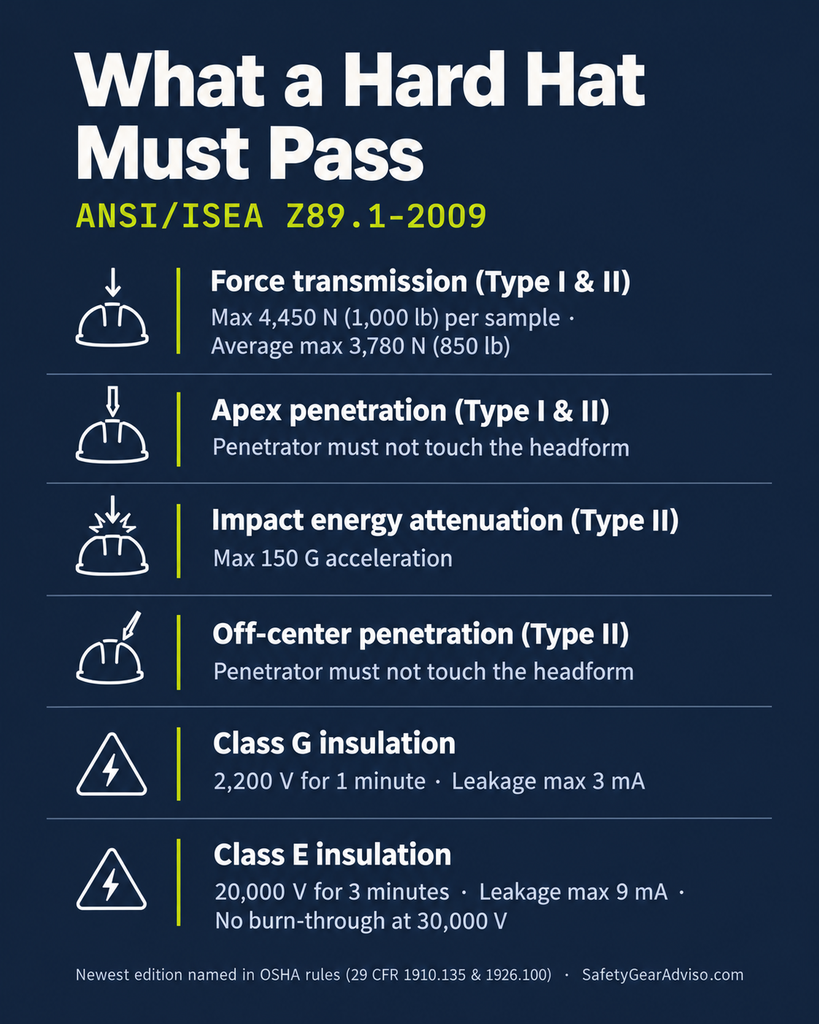
Under the 2009 edition, the newest one OSHA names, every hard hat must pass force transmission and apex penetration tests. Type II hats must also pass impact energy attenuation and off-center penetration tests. Class G and Class E hats must pass electrical insulation tests at their rated voltages. The specific limits are in the table below.
| Test (2009 edition section) | Applies to | Pass requirement |
|---|---|---|
| Force transmission (§7.1.2) | Type I and II | No single sample transmits more than 4,450 N (1,000 lb); the average of maximum forces for each test condition stays at or below 3,780 N (850 lb) |
| Apex penetration (§7.1.3) | Type I and II | The penetrator must not touch the top of the test headform |
| Impact energy attenuation (§7.2.1) | Type II only | Maximum acceleration no higher than 150 G |
| Off-center penetration (§7.2.2) | Type II only | The penetrator must not touch the headform when striking anywhere above the test line |
| Electrical insulation, Class G (§7.1.4.1) | Class G | Withstands 2,200 V AC for 1 minute, with leakage no higher than 3 mA |
| Electrical insulation, Class E (§7.1.4.2) | Class E | Withstands 20,000 V AC for 3 minutes, with leakage no higher than 9 mA, and doesn’t burn through at 30,000 V |
| Electrical insulation, Class C (§7.1.4) | Class C | Not tested |
Source: ANSI/ISEA Z89.1-2009, published by Public.Resource.Org because OSHA incorporates it by reference into federal law.
What the table doesn’t show: later editions aren’t freely published, so their exact test values can’t be quoted here. According to a 2014 Safety Equipment Institute (SEI) news release, the 2014 edition kept “the core performance requirements contained in the previous edition.” Its main addition was an optional higher-temperature preconditioning step.
How Has ANSI Z89.1 Changed Since 1969?
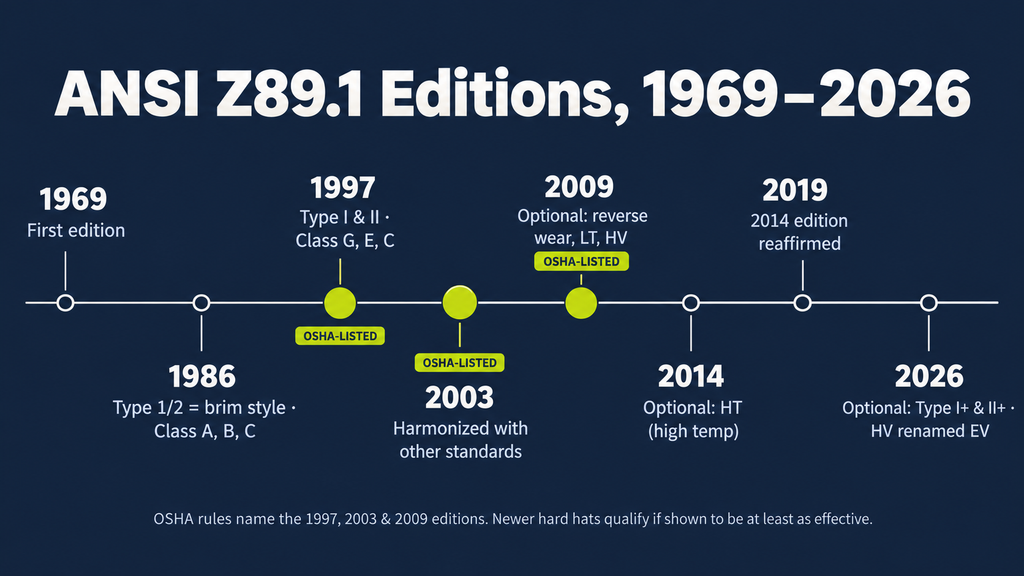
ANSI Z89.1 has been revised repeatedly since 1969. The 1997 edition introduced today’s Type I/Type II and Class G/E/C system. Later editions added optional tests: reverse wear, low and high temperature, and visibility. The 2026 edition added “+” designations for retention. Use the year on your hard hat’s label to find it in the table below.
| Edition | What changed | Named in OSHA’s rules today? |
|---|---|---|
| 1969 | Earliest edition; OSHA’s construction rule still cited it until 2012 | No. Removed in 2012 because, per OSHA, no helmets tested to it were still “available or in use” |
| 1986 | Type 1/2 described brim style; Classes A, B, C | No. Removed in 2012 as “out of date” |
| 1997 | Type I (top) and Type II (top and sides) introduced; Classes renamed G, E, C; date of manufacture must be marked | Yes |
| 2003 | Revised mainly “to harmonize with other national standards” and dropped component requirements that added no user value | Yes |
| 2009 | Three optional tests: reverse donning, lower temperature (LT, -30°C) and high visibility (HV) | Yes (the newest one listed) |
| 2014 | Optional higher-temperature preconditioning (marked HT); core performance requirements unchanged | No, but usable under “at least as effective” |
| 2014 (R2019) | Reaffirmation of the 2014 text | No, same as 2014 |
| 2026 | Optional Type I+ and Type II+, tested chin strap and retention, reverse-wear checks for “+” helmets, and HV renamed EV | No, but usable under “at least as effective” |
Sources: OSHA’s 2012 Federal Register direct final rule; the University of Kentucky guide (1986 to 2009 changes); the SEI release (2014); the ANSI blog (R2019 designation); ISEA (2026); and OSHA’s 2024 bulletin for the HT marking.
OSHA vs. ANSI: Which Hard Hat Standard Do You Actually Have to Meet?
You have to meet OSHA. OSHA’s rules then point to ANSI Z89.1. Both 29 CFR 1910.135 (general industry) and 29 CFR 1926.100 (construction) name the 1997, 2003 and 2009 editions. Both also accept head protection the employer demonstrates is at least as effective as a helmet built to one of those editions.
The surprising part is how old that list is. OSHA added the 2009 edition through a direct final rule published June 22, 2012. The same rule removed the 1986 edition and, in construction, the 1969 edition. The eCFR version of 1910.135, current as of August 13, 2026, still lists exactly those three editions. Fourteen years and three ANSI revisions later, OSHA’s list hasn’t moved.
That gap is why the “at least as effective” clause matters. The construction text, 1926.100(b)(3), says OSHA “will deem any head protection device that the employer demonstrates is at least as effective as” a helmet built to a listed edition “to be in compliance.” Because the 2014 edition kept the 2009 core performance requirements, a 2014-certified hard hat is a straightforward case to make. The 2026 edition keeps Type and Class and adds tests on top.
Two construction-specific details are worth knowing:
- Electrical work has its own rule. 1926.100(b)(2) requires head protection for workers exposed to high-voltage shock and burns to also meet Section 9.7 (“Electrical Insulation”) of a listed edition. In practice, that means a Class E rating.
- Hazard assessment comes first. OSHA’s general PPE rule requires the employer to assess workplace hazards before choosing protection. OSHA confirmed this for overhead crane loads in a June 6, 2024 letter of interpretation.
If your question is specifically whether OSHA requires Type II helmets for side-impact hazards, OSHA’s interpretation index lists a letter dated August 17, 2026, titled “OSHA’s Head Protection Requirements and Selection and Use of Type II Safety Helmets.” Read it directly on osha.gov before setting a site rule. For when OSHA requires a hard hat at all, and what employers must do, see our guide to OSHA hard hat requirements.
What Changed in ANSI/ISEA Z89.1-2026?
ISEA announced ANSI/ISEA Z89.1-2026 on September 11, 2026, the first revision since 2014. It keeps Type I, Type II and Classes G, E and C unchanged. It adds an optional “+” designation for helmets tested beyond the base standard for chin strap retention and helmet retention. Type I+ also gets multi-directional impact protection.
According to ISEA’s release, the new tests are:
- Chin strap retention: keeps head protection secured during impacts and falls.
- Helmet retention: keeps the helmet properly positioned during slips and trips.
- Multi-point impact (Type I+ only): front, rear and side protection.
ISEA describes Type II+ as “chin strap and enhanced retention (with Type II impact protection).” The edition also adds reverse-wear checks for “+” helmets. It renames the High Visibility (HV) marking to Enhanced Visibility (EV), with “no change to visibility performance.”
Don’t rank Type I+ above Type II by the plus sign. According to Koroyd, a helmet-technology company that says it took part in the update process, Type I+ adds off-center force transmission testing but not Type II’s off-center penetration requirement. ISEA’s release wording, which gives Type II+ “Type II impact protection” but Type I+ “multi-directional impact protection,” is consistent with that.
ISEA’s summary also doesn’t list a rotational-impact test, so the 2026 edition doesn’t certify one. ISEA is explicit that the revision “does not replace existing requirements or make current compliant head protection obsolete.”
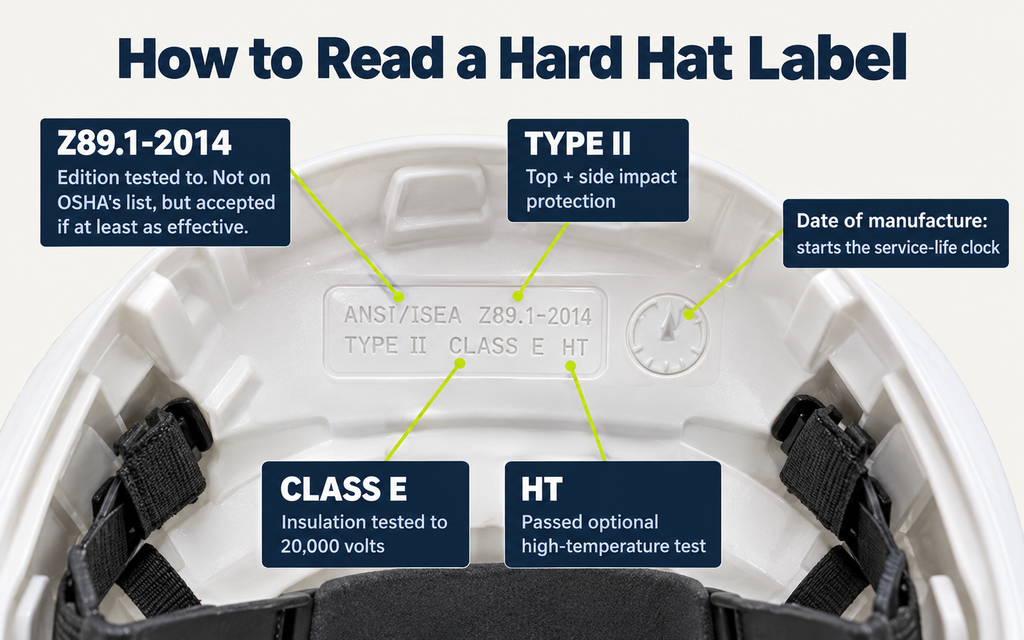
How Do You Read the ANSI Z89.1 Marking on a Hard Hat?
Under §6.2 of the 2009 edition, every helmet must be permanently marked with five things, in characters at least 1.5 mm tall:
- The manufacturer’s name or identification mark
- The date of manufacture
- The standard designation, ANSI/ISEA Z89.1
- The Type and Class, followed by any optional-test markings
- The approximate head-size range
A worked example: a label reading “ANSI/ISEA Z89.1-2014 TYPE II CLASS E HT” tells you five things.
- It was tested to the 2014 edition, which isn’t on OSHA’s list but qualifies under “at least as effective.”
- It’s rated for top and side impacts (Type II).
- It passed high-voltage insulation testing (Class E).
- It passed the optional higher-temperature preconditioning (HT).
- Separately, the date of manufacture tells you where it sits against the manufacturer’s service-life guidance.
Optional markings only appear if the helmet passed that extra test. Under the 2009 edition, a reverse-donning mark means the helmet passed its required tests worn backward. LT means it passed after conditioning at -30°C, and HV means it met color and luminance limits. A helmet with no Z89.1 marking at all gives you nothing to show OSHA. For a quick meaning-by-marking chart, see the label table in the Head Protection guide.
Common Mistakes When Applying ANSI Z89.1
The most common mistakes come from misreading the edition year and the plus sign. People treat a newer edition as non-compliant, or an older one as expired. They assume “+” beats Type II, or that the standard sets a replacement date. Each one is cleared up by what OSHA’s rules and the standard actually say.
- Rejecting a 2014 or 2026 hard hat because OSHA lists 2009. OSHA’s “at least as effective” clause exists for exactly this case.
- Treating the edition year as an expiration date. The edition is the test protocol, not a lifespan. Check the separate date of manufacture.
- Expecting the standard to set a replacement interval. The 2009 edition requires manufacturers to supply “useful service life guidelines” (§6.1). The interval is theirs to set, not the standard’s.
- Keeping a hat in service after an impact. The 2009 edition’s informational appendix says any helmet that has taken an impact should be removed from service.
- Using a Class C hat near energized conductors. Class C isn’t tested for electrical insulation at all.
- Wearing a hat backward without the reverse mark. Only helmets marked for reverse donning were tested that way.
- Calling a hard hat “OSHA approved.” OSHA’s rules point to consensus standards rather than listing approved products. The label to look for is the Z89.1 marking.
Frequently Asked Questions
What is the current edition of ANSI Z89.1? The current edition is ANSI/ISEA Z89.1-2026, which ISEA announced on September 11, 2026. It replaced the 2014 edition, which was reaffirmed in 2019 and labeled “2014 (R2019).” Hard hats certified to earlier editions stay in service: ISEA says the 2026 revision doesn’t make currently compliant head protection obsolete. Manufacturers can only mark a helmet to the 2026 edition after it has been tested to it.
Does OSHA accept hard hats certified to ANSI Z89.1-2014 or 2019? Yes, through the “at least as effective” route rather than by name. OSHA’s rules (29 CFR 1910.135 and 1926.100) list the 1997, 2003 and 2009 editions, and both accept headgear the employer shows is at least as effective as a helmet built to one of them. The 2014 edition kept the 2009 edition’s core performance requirements and added an optional high-temperature test, so equivalence is a straightforward case to document.
Who publishes ANSI Z89.1? The International Safety Equipment Association (ISEA) develops and publishes ANSI Z89.1, and the American National Standards Institute approves each edition as an American National Standard. ANSI itself doesn’t write the requirements or test hard hats. Copies of the current edition are sold through ISEA. The 2009 edition is publicly readable because OSHA incorporates it into federal regulations by reference.
What’s the maximum force a Z89.1 hard hat can transmit? Under the 2009 edition, no single test sample may transmit more than 4,450 newtons (1,000 pounds) of force to the headform. The average of the maximum forces for each test condition must stay at or below 3,780 newtons (850 pounds). Type II hard hats must also keep peak acceleration at or below 150 G in the separate impact energy attenuation test (§7.2.1).
Are old Class A and Class B hard hats still acceptable? Class A and Class B come from the 1986 edition, which OSHA removed from its rules in 2012 as out of date. The 1997 edition replaced them with Class G and Class E. A hat marked only to the 1986 edition isn’t built to any edition OSHA currently lists. An employer would have to demonstrate it’s at least as effective, which is a hard case for a hat that old.
Does ANSI Z89.1 cover bump caps? No. Bump caps have their own standard, ANSI/ISEA 100-2024, which covers lighter protection against bumping into fixed objects. ISEA states that bump caps are not a replacement for products covered by ANSI/ISEA Z89.1, which protect against falling and flying objects. If OSHA’s head protection rules apply to a work area, a bump cap doesn’t meet them. Our bump cap vs hard hat guide explains when each one is the right choice.
Does ANSI Z89.1-2026 test for rotational impact? ISEA’s summary of the 2026 edition doesn’t include a rotational-impact test. Its new tests cover chin strap retention, helmet retention, and front, rear and side impact for Type I+. Some helmets are sold with rotational-energy systems, but under Z89.1-2026 that feature isn’t part of what the “+” marking certifies. Check the manufacturer’s own test claims separately.
Does a newer edition mean the hard hat is better? Not by itself. The edition tells you which test protocol the hat was certified to, not how protective it is. A Type II, Class E hat certified to the 2009 edition and one certified to 2014 met the same core performance requirements, according to the 2014 SEI release. What changes between editions is mostly optional tests. Read the Type, Class and optional markings, not just the year.
Where to Go Next
- Head Protection guide: how to choose between hard hats, safety helmets and bump caps by hazard, with a full label-meaning chart.
- OSHA standards hub: the OSHA regulations behind head protection and other PPE requirements.
- ANSI standards hub: how ANSI/ISEA consensus standards like Z89.1, Z87.1 and Z359 work.
- Hard hat vs safety helmet: how the two differ in design, chin straps and side protection, and when a safety helmet is the better choice.
- Fake hard hat: how to check a label is genuine and spot impossible claims.
Sources: ANSI/ISEA Z89.1-2009 (law.resource.org); 29 CFR 1926.100 (osha.gov); 29 CFR 1910.135 (eCFR, current as of 8/13/2026); OSHA direct final rule, FR Doc. 2012-15030, June 22, 2012; OSHA SHIB 3-6-2024; OSHA letter of interpretation, June 6, 2024; ISEA Z89.1-2026 release; ISEA bump cap standard release; SEI 2014 news release; University of Kentucky OHS head protection guide; ANSI blog; Koroyd.