
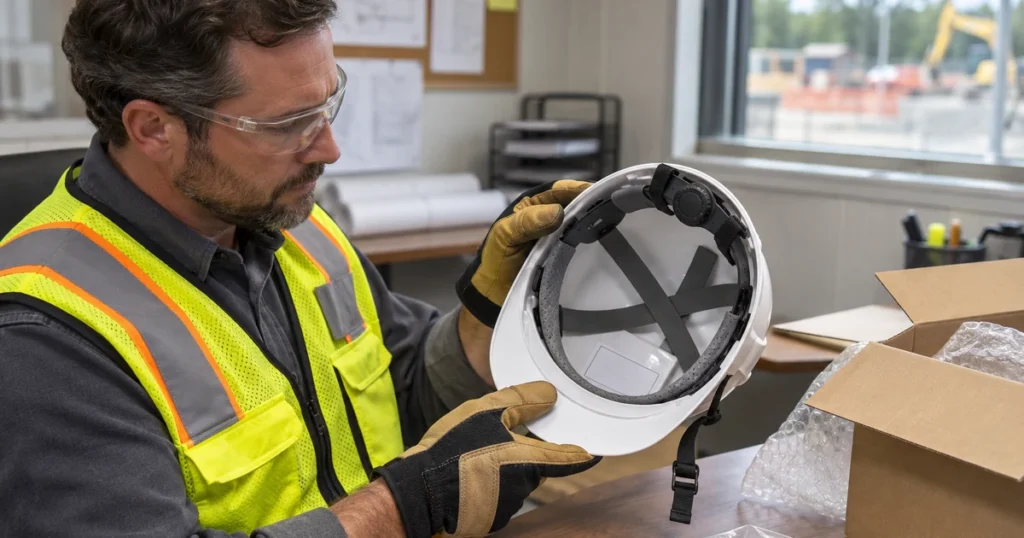
A $12 hard hat just arrived from an online order, and the label inside looks thin, blurry or missing. Here’s how to tell a fake hard hat from a genuine one in about five minutes, what the label must show, and what to do for U.S. workplaces if it fails.
A genuine hard hat has permanent markings inside showing the manufacturer, date of manufacture, the ANSI Z89.1 edition, its Type and Class, and head size range. A fake is missing these, contradicts them (such as vented Class E) or copies a known brand. ANSI certifies nothing, so check the label and the seller.
What You Need to Know
- The label is the first test. No manufacturer, no date or no ANSI Z89.1 marking means you can’t treat it as OSHA-compliant head protection.
- “ANSI certified” is a red flag. ISEA says ANSI doesn’t make, approve, certify or test any products.
- Most hard hats are self-declared. Third-party certification is optional; the Safety Equipment Institute (SEI) publishes a list you can search.
- Some claims are impossible. A vented hard hat can’t be Class E, and one hat can’t be both Class C and Class E.
- Big brands get recalled too. Check the CPSC recall list as well as the label.
What Counts as a Fake Hard Hat?
“Fake” covers four different problems. A counterfeit copies a real brand. An uncertified hat makes no ANSI claim at all. An overclaimed hat carries a label or listing that promises more than it can deliver. A novelty hat was never meant to protect anyone. Each needs a slightly different check.
| Kind | What it is | How it usually shows itself |
|---|---|---|
| Counterfeit | A copy of a known brand and model | Price far below the brand’s, sold by an unfamiliar seller, logo or molding slightly off, label details that don’t match the brand’s own |
| Uncertified | A plain hard hat with no standard claimed | No “ANSI/ISEA Z89.1” marking, or only vague words like “safety helmet” or “construction hat” |
| Overclaimed | A hat whose label or listing claims a Type, Class or standard it can’t meet | Impossible combinations, typos in the standard name, “ANSI certified” wording |
| Novelty | A costume, party or souvenir hat | No suspension, no label, thin shell; often sold in toy or party categories |
Counterfeits aren’t just a theory. In the UK, JSP warned that copies of its MkII helmet were so poor they “can be split in two with your bare hands,” according to the Trades Union Congress, and the British Safety Industry Federation said the fakes originated from Asia or the Middle East.
What Must Be Printed Inside a Genuine Hard Hat?
Look inside the shell or under the brim for permanent markings. ANSI Z89.1 hard hats carry the manufacturer’s name or mark, the date of manufacture, the standard (“ANSI/ISEA Z89.1” with its year), the Type, the Class and the approximate head size range. If any of these is missing, stop and check further.
An Occupational Health & Safety summary lists the ANSI label items as “Name or identification mark of manufacturer, date of manufacture, ANSI/ISEA Z89.1, applicable Type, applicable Class, approximate headsize or range.” Virginia Tech’s environmental health and safety office gives the same list.
| Marking | What a genuine hat shows | Fake-hat warning sign |
|---|---|---|
| Manufacturer | A name or mark you can trace to a real company website | No name, or a name that doesn’t match the brand molded on the shell |
| Date of manufacture | A date stamp or dial, often under the brim | No date at all |
| Standard | “ANSI/ISEA Z89.1” plus an edition year, such as 2014 | “ANSI approved”, “OSHA approved” or “ANSI Z89” with no year |
| Type | Type I or Type II | Missing, or a Type claim that appears only in the online listing |
| Class | One letter: G, E or C | Several Classes claimed at once, or Class E on a vented shell |
| Size | A head size range, such as 6½ to 8 | Missing |
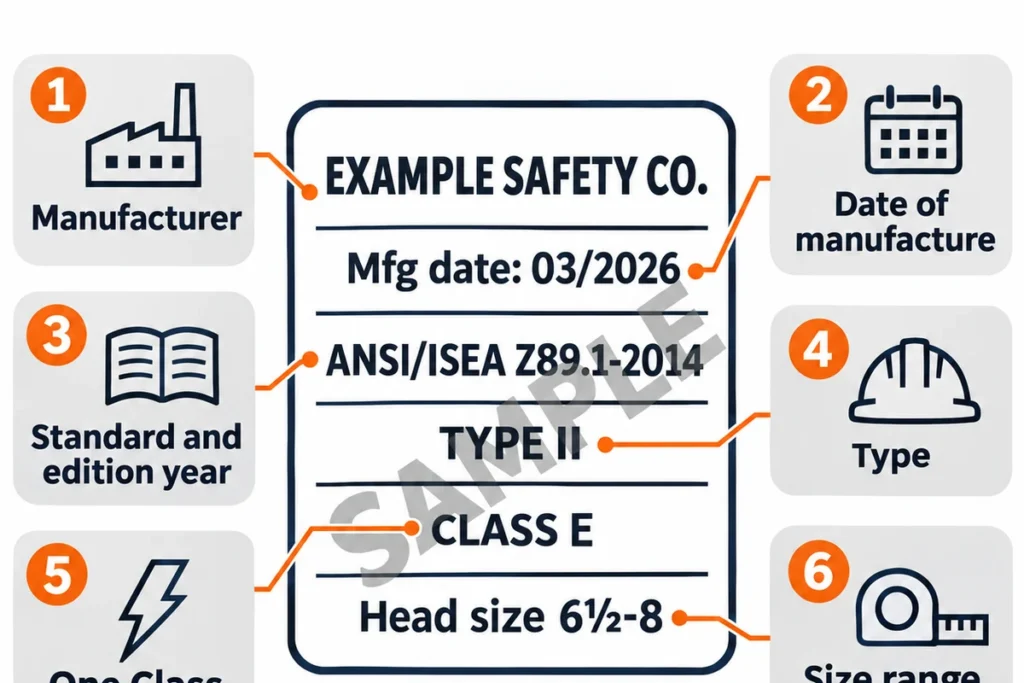
For what each marking means, see the ANSI Z89.1 hard hat standard. To read the date dial itself, see how to wear a hard hat. OSHA’s 2024 safety helmet bulletin also tells users to “Check that the labels are legible and not tampered with.”
Is My Hard Hat ANSI Certified? Who Actually Checks It
No hard hat is “ANSI certified,” because ANSI doesn’t certify products. The manufacturer tests the hat to ANSI/ISEA Z89.1 and declares it meets the standard. Some makers also pay an independent body, such as the Safety Equipment Institute, to certify the model. Only that second route gives you a public list to check.
The International Safety Equipment Association (ISEA), which writes Z89.1, says plainly that “ANSI doesn’t make, approve, certify, or test any products,” so it treats “ANSI certified” in a listing as a warning sign. ISEA also explains that U.S. PPE conformity is a mix of approaches and that “Self-declaration is the most common approach.”
Bullard, a hard hat maker, adds a distinction worth knowing: “Just because a helmet is third party tested does not mean it is certified.” It points buyers to SEI’s website to check whether head protection is certified.
The surprising part: OSHA doesn’t require third-party certification for hard hats. ISEA notes that OSHA “does not require any level of conformity assessment” for PPE other than respirators. So a hat can be legitimate without an SEI listing, which is why the label and the seller matter so much.
To check the SEI list, search the SEI Certified Product List by manufacturer or product. If the model appears there, you have independent confirmation. If it doesn’t, ask the seller for a dated test report.
How to Tell If a Hard Hat Is Real: A Five-Minute Check
Work from the outside in: the listing, the box, the label, the shell and then the paperwork. Most fakes fail in the first three steps. If a hat fails any step, don’t issue it until you’ve confirmed it with the manufacturer.
- The listing (before you buy). Check the seller name against the brand’s own list of authorized distributors. ISEA warns that marketplace seller names “can be similar and change often,” and that unauthorized sellers may supply counterfeit PPE.
- The box and instructions. A genuine hard hat comes with instructions covering sizing, care and service life. A bare hat in a plastic bag with no instructions is a warning sign.
- The label. Compare every marking against the table above. Then compare the label with the listing: if the listing says Type II but the label says Type I, the label wins.
- The shell and suspension. Look for a crisp, even molding, a brand mark that matches the label, and a suspension that clicks firmly into its keyways. Bullard’s squeeze test (pressing the sides in about an inch) is a quick check for a shell that’s brittle or cracks easily.
- The paperwork. For bulk orders, ask the seller or manufacturer for a dated test report or a certification letter. ISEA advises buyers to “Ask the seller or manufacturer for dated test reports.” Search the SEI list if the maker claims third-party certification.
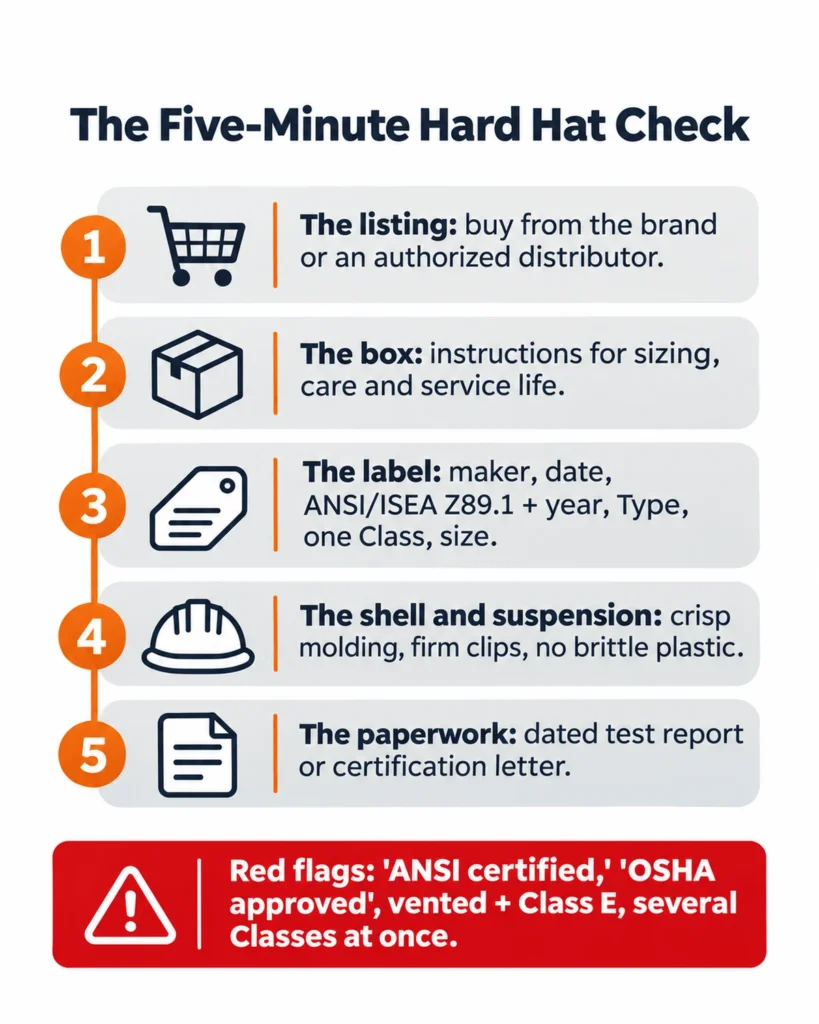
Keep one rule in mind throughout: the online listing is marketing, the label is the claim. When they disagree, believe the label, then verify it.
Impossible Claims: Labels and Listings That Can’t Be True
Some combinations can’t exist under ANSI Z89.1, so any hat or listing showing them is wrong. The most common are a vented hat claiming Class E, one hat claiming several Classes, and “ANSI certified” or “OSHA approved” wording. Spotting these takes seconds and needs no lab.
- Vented and Class E. ISEA flagged a listing that claimed Class E electrical protection on a vented hard hat, which it says can’t be done under ANSI/ISEA Z89.1-2014 (R2019). OSHA’s 2024 bulletin says vented head protection “cannot be used for electrical work”; see Class E vs G vs C.
- Class C, E and G at once. A listing seen on a major U.S. retail site on 26 Nov 2026 described one hard hat as Type I “Class C, E, and G.” Class C means no electrical protection, so a hat can’t be Class C and Class E at the same time. Check the single Class on the label.
- “ANSI certified.” ANSI doesn’t certify products, as ISEA states.
- “OSHA approved.” OSHA sets the rules but doesn’t approve individual products. Its rules accept head protection meeting the 1997, 2003 or 2009 editions of ANSI Z89.1, or head protection shown to be at least as effective. See OSHA hard hat requirements.
- A standard with no year. “Meets ANSI Z89” without an edition year can’t be checked against what OSHA accepts.
- A bump cap sold as a hard hat. A bump cap protects against bumps, not falling objects, and doesn’t meet Z89.1; see bump cap vs hard hat.
A wrong claim in a listing doesn’t always mean the hat itself is bad. It does mean you can’t rely on the listing, and you should read the label and contact the maker before the hat goes on anyone’s head.
Uncertified Hard Hats on Amazon and Other Marketplaces
Marketplaces such as Amazon, Walmart.com and eBay sell genuine hard hats alongside unknown brands from third-party sellers. A Homeland Security official told Consumer Reports that marketplaces are “never physically seeing or testing the item,” so the checking falls on you. Buy from the brand’s own store or an authorized distributor where you can.
ISEA’s guidance on buying PPE online advises buyers to “Buy from trusted sources” and to rely on a trained safety person’s hazard assessment, not the seller, to decide what protection is needed. It also found in its own mystery shopping that about 15% of high-visibility products failed a key ANSI/ISEA 107 test, a sign that online PPE claims aren’t always met.
There’s a second lesson from a genuine brand. In 2016, the U.S. Consumer Product Safety Commission announced that 3M was recalling about 7,500 vented hard hats sold online at Alliedelec.com, Amazon.com and HomeDepot.com. According to the CPSC, they had been “marketed to protect against electric shock,” but didn’t provide that protection. The label and the shell were genuine; the online claim was the problem.
What to Do If You Find a Fake Hard Hat
Take it out of service straight away and replace it with a hat whose label you’ve checked. Then report it, so the brand or the marketplace can act, and check whether any other hats from the same order are on site. Keep the hat and the order details until the report is dealt with.
- Remove it. Tag it “do not use” and issue a verified replacement.
- Check the batch. Pull every hat from the same order or seller and run the five-minute check on each.
- Report a suspected counterfeit to the brand. Many brands have a reporting route; 3M, for example, runs a counterfeit reporting page at 3M.com/3MVerify.
- Report it to the marketplace. Use the platform’s product safety or counterfeit reporting option, and ask for a refund.
- Check recalls. Search the CPSC recall list for the brand and model. Honeywell recalled about 82,500 Fibre-Metal E2 and North Peak A79 hard hats in the U.S. in 2018 because they “can fail to protect users from impact,” so genuine hats can be pulled too.
- Fix the buying route. Add the brand’s authorized distributors to your purchasing list.
Destroy a confirmed fake rather than giving it away, so it can’t end up on another worker’s head.
Common Mistakes When Checking a Hard Hat
Most mistakes come from trusting the listing, the price or the color instead of the label. A hard hat can look exactly like the real thing and still be a copy. These are the errors that let fakes through on U.S. job sites.
- Trusting the product photo. The photo may show a genuine label that isn’t on the hat you receive.
- Reading “ANSI” as enough. The label needs the full standard name with a year, plus Type and Class.
- Assuming a big marketplace has checked it. Third-party sellers are responsible for their own claims.
- Ignoring the suspension. A genuine shell with a mismatched, low-quality suspension isn’t a tested unit; the shell and suspension are tested together.
- Covering the label. Stickers or tape over the markings stop anyone from checking them later.
- Taking a CE or EN 397 mark as U.S. compliance. A European mark alone doesn’t show the hat meets ANSI Z89.1.
Frequently Asked Questions
How can you tell if a hard hat is fake?
Check the label inside the shell first. A genuine hard hat shows the manufacturer, date of manufacture, “ANSI/ISEA Z89.1” with an edition year, its Type, its Class and a head size range. Missing markings, impossible claims such as vented Class E, “ANSI certified” wording or a brand that doesn’t match the label all point to a fake.
Is my hard hat ANSI certified?
No hard hat is ANSI certified, because ANSI doesn’t certify products. The manufacturer tests the hat to ANSI/ISEA Z89.1 and declares it meets the standard on the label. Some models are also certified by an independent body, such as the Safety Equipment Institute, whose public list you can search by manufacturer or product.
What must be printed inside a hard hat?
ANSI Z89.1 hard hats carry the manufacturer’s name or mark, the date of manufacture, the standard designation with its year, the Type (I or II), the Class (G, E or C) and the approximate head size range. OSHA’s 2024 bulletin also tells users to check that labels are legible and haven’t been tampered with.
Are hard hats sold on Amazon OSHA compliant?
Some are and some aren’t. Genuine brands sell through Amazon, but so do unknown third-party sellers, and the marketplace usually doesn’t test the product. Compliance depends on the hat, not the store: check for a full ANSI Z89.1 label, buy from the brand or an authorized distributor, and ask for a dated test report for bulk orders.
Can a vented hard hat be Class E?
No. ISEA has flagged a listing claiming Class E on a vented hard hat as impossible under ANSI/ISEA Z89.1-2014 (R2019), and OSHA’s 2024 bulletin says vented head protection cannot be used for electrical work. Vented hats are generally rated Class C, meaning no electrical protection. If a vented hat claims Class E, treat the claim as false.
Does OSHA approve hard hats?
No. OSHA sets the rules but doesn’t approve or list individual products. Its rules accept head protection that meets the 1997, 2003 or 2009 editions of ANSI Z89.1, or that’s shown to be at least as effective. A hat labeled “OSHA approved” is using wording OSHA doesn’t issue, so check the ANSI marking instead.
What should I do with a fake hard hat?
Take it out of service immediately and replace it with a hat whose label you’ve checked. Check every hat from the same order, report a suspected counterfeit to the brand and the marketplace, and search the CPSC recall list. Destroy a confirmed fake rather than giving it away, so it can’t reach another worker.
Where to Go Next
- ANSI Z89.1 hard hat standard: what each label marking means and which edition your hat was tested to.
- OSHA hard hat requirements: the editions OSHA accepts and when head protection is required.
- Hard hat Class E vs G vs C: how to check an electrical claim before trusting it.
- How to wear a hard hat: reading the date code and the 60-second inspection for every shift.
- Bump cap vs hard hat: why a bump cap sold as a hard hat isn’t head protection under OSHA.
- Head Protection guide: hard hats, safety helmets and bump caps compared by hazard, with a full label chart.
Sources: ISEA, “Buying PPE Online” (last modified March 3, 2026) and conformity assessment page; Bullard, “OSHA corrects verbiage on head protection“; Safety Equipment Institute, Certified Product List and FAQs; Occupational Health & Safety, “Twelve Frequent Hard Hat Questions” (2014); Virginia Tech EHS, PPE Appendix B; OSHA SHIB, “Head Protection: Safety Helmets in the Workplace” (2024); CPSC, 3M hard hat recall (June 2016) and Honeywell hard hat recall (April 2018); Trades Union Congress / Construction Enquirer, JSP counterfeit warning (2013); Consumer Reports, bike helmets sold online; 3M Verify counterfeit reporting page.