
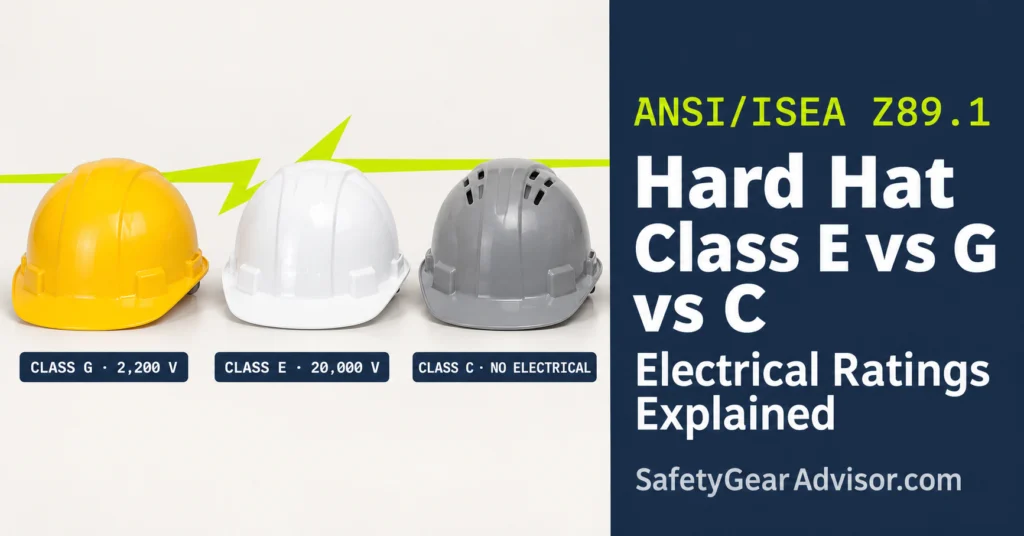
When you compare hard hat class E vs G vs C, three hats can look identical on the shelf and still differ by 20,000 volts. The letter that tells them apart, E, G or C, is the hard hat electrical class, and it’s the rating that matters most if your work brings you anywhere near energized conductors. This guide explains what each class was tested for, what OSHA requires near electricity, and the everyday things that can quietly strip a hat of its rating.
Everything here comes from OSHA’s regulations and letters of interpretation, OSHA’s 2024 safety helmet bulletin, the published text of the 2009 edition of ANSI/ISEA Z89.1, and MSA Safety’s test summary. Each claim names its source.
Hard hat classes come from ANSI/ISEA Z89.1. Class G (General) is proof-tested at 2,200 volts for low-voltage conductors. Class E (Electrical) is proof-tested at 20,000 volts for higher-voltage exposure. Class C (Conductive) has no electrical protection. Near exposed energised parts, OSHA requires non-conductive head protection, which rules out Class C.
What You Need to Know
- The voltages are lab proof tests, not working limits. Class E passed a 20,000-volt test on the shell. That doesn’t make it safe to touch a 20,000-volt line with your head.
- OSHA names the requirement, not the letter. Its rules require helmets “designed to reduce electrical shock hazard” near exposed conductors, and construction workers exposed to high voltage need the standard’s electrical insulation test, meaning Class E.
- Vents and electrical work don’t mix. OSHA’s 2024 bulletin says vented hard hats can’t be used for electrical work.
- Paint and stickers can cost you the rating. OSHA warned in 2009 that they “may eliminate electrical resistance.”
- Class is separate from Type. Any class can be Type I or Type II; check both on the label.
Hard Hat Class E vs G vs C: What’s the Difference?
The difference is how much electrical insulation the shell has been proven to provide. Class G is tested at 2,200 volts, Class E at 20,000 volts, and Class C isn’t tested at all, because it offers no electrical protection. All three are defined by ANSI/ISEA Z89.1, and all three still have to meet the same impact requirements for their Type.
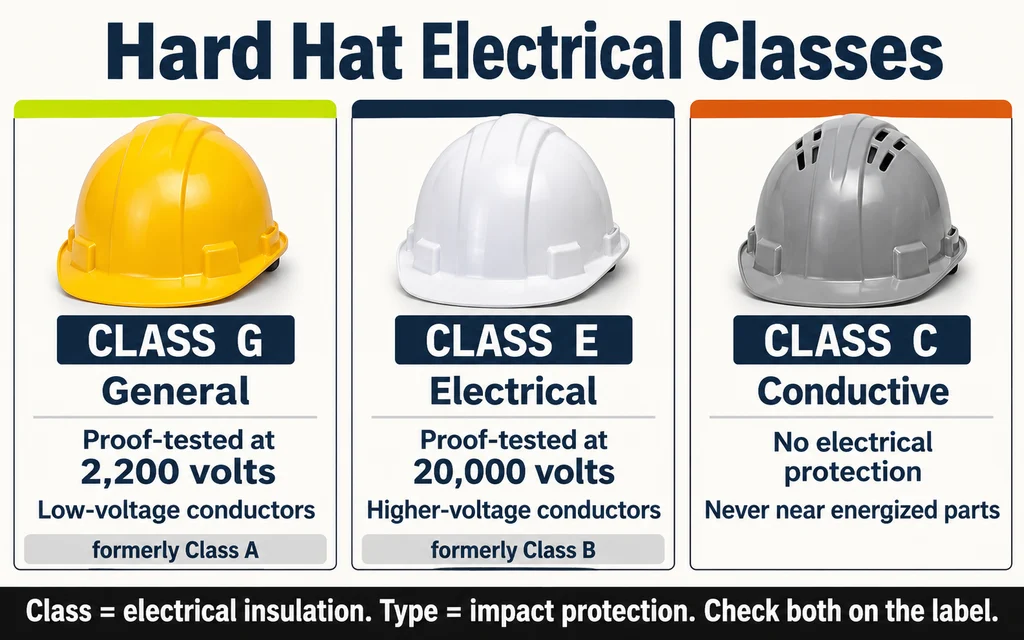
| Class G (General) | Class E (Electrical) | Class C (Conductive) | |
|---|---|---|---|
| Electrical protection | Low-voltage conductors | Higher-voltage conductors | None |
| Proof-test voltage | 2,200 V | 20,000 V | Not tested |
| Typical design | Non-vented | Non-vented | Often vented, or metal |
| Use near energized parts | Low voltage only | Yes, including high voltage | Never |
| Old name (1986 edition) | Class A | Class B | Class C |
Sources: ANSI/ISEA Z89.1-2009; OSHA Safety and Health Information Bulletin 3-6-2024 (class definitions); University of Kentucky OHS guide (former class names).
Read the class letter on the label inside the shell, next to the Type. Some older references call Class E “Class 3,” according to Zoro, but the current ANSI designation is Class E. For how class fits with Type and edition on the full label, see our ANSI Z89.1 hard hat standard explainer.
What Do the Class E and Class G Tests Actually Involve?
Each class is a pass/fail insulation test on the shell. Under ANSI/ISEA Z89.1-2009, the newest edition OSHA names, Class G samples must withstand 2,200 volts for one minute. Class E samples must withstand 20,000 volts for three minutes and must not burn through at 30,000 volts. Leakage current is capped at 3 and 9 milliamps respectively.
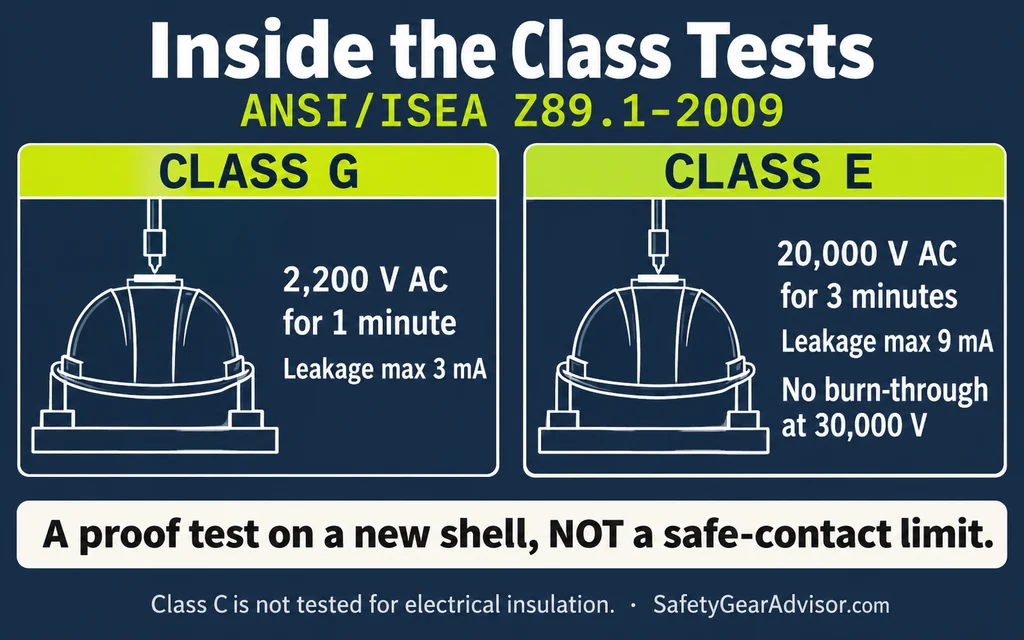
| Requirement | Class G | Class E | Class C |
|---|---|---|---|
| Test voltage and duration | 2,200 V AC, 1 minute | 20,000 V AC, 3 minutes | None |
| Maximum leakage current | 3 mA | 9 mA | n/a |
| Burn-through check | n/a | No burn-through at 30,000 V | n/a |
| When tested | Standard sequence | After impact testing, per MSA | n/a |
Sources: ANSI/ISEA Z89.1-2009 §7.1.4 (values); MSA Safety, “What Is the Difference Between Type 1 and Type 2 Hard Hats?” (Class E tested “after impact”).
What the numbers don’t mean: a proof test shows that a new, intact shell resisted that voltage in a lab, for that long, without leaking more than the limit. It’s not a promise that you can contact a conductor of that voltage. Retailers that describe Class E as protecting “up to 20,000 volts” blur that line. Ferguson’s guide adds a point many miss: the dielectric protection is “designated for the head only.” Your hands and body need their own electrical protective equipment.
Which Hard Hat Class Do You Need?
Match the class to the worst electrical exposure your hazard assessment finds. With no electrical exposure at all, any class works, including Class C. Near low-voltage conductors, Class G is the minimum. Near high-voltage conductors, or anywhere energized parts could contact the head in construction, use Class E.

Class selector:
| Your exposure | Minimum class | OSHA basis |
|---|---|---|
| No electrical conductors anywhere near the head | Any class (C acceptable) | 1910.135(a)(1) / 1926.100(a): impact protection only |
| Exposed electrical conductors that could contact the head (general industry) | G or E, never C | 1910.135(a)(2): helmet “designed to reduce electrical shock hazard” |
| Work near exposed energized parts with shock or burn risk (electrical work practices) | G or E (nonconductive), never C | 1910.335(a)(1)(iv): “nonconductive head protection” |
| Construction work exposed to high-voltage shock and burns | E | 1926.100(b)(2): must meet Section 9.7 “Electrical Insulation” of a listed ANSI edition |
| Unsure, or exposure changes during the day | E | Conservative choice: Class E is tested at roughly nine times Class G’s voltage |
If your crews move between areas, a single Class E hat covers every row; a Class C hat covers only the first. Write the chosen class into your hazard assessment. For the wider employer duties, see OSHA hard hat requirements.
What Does OSHA Require for Electrical Head Protection?
OSHA’s rules require electrical head protection wherever the head could contact exposed electrical conductors, but they describe performance rather than naming a class. General industry requires a helmet “designed to reduce electrical shock hazard” (1910.135(a)(2)) and “nonconductive head protection” near energized parts (1910.335(a)(1)(iv)). Construction requires the standard’s electrical insulation test for high-voltage exposure (1926.100(b)(2)).

The three rules in OSHA’s own words:
- 29 CFR 1910.135(a)(2), general industry: employers must ensure “a protective helmet designed to reduce electrical shock hazard is worn by each such affected employee when near exposed electrical conductors which could contact the head.”
- 29 CFR 1910.335(a)(1)(iv), electrical safety-related work practices: “Employees shall wear nonconductive head protection wherever there is a danger of head injury from electric shock or burns due to contact with exposed energized parts.”
- 29 CFR 1926.100(b)(2), construction: head protection for employees “exposed to high-voltage electric shock and burns” must also meet Section 9.7 (“Electrical Insulation”) of one of the listed consensus standards.
Those listed standards are ANSI Z89.1-1997, -2003 and -2009. The 2026 edition keeps Classes G, E and C unchanged, according to ISEA, so a hat certified to it qualifies through OSHA’s “at least as effective” clause. OSHA drew the same line decades ago: a 1979 letter of interpretation said a Class C helmet is acceptable on construction projects for impact and penetration, but “provides no protection for electrical hazards.”
What Can Compromise a Hard Hat’s Electrical Rating?
A class rating describes the hard hat as it left the factory. Vents, paint, stickers, solvents and physical damage can all undermine its electrical protection without any visible warning. OSHA has warned that paint and stickers “may eliminate electrical resistance,” and its 2024 bulletin bars vented hard hats from electrical work altogether.
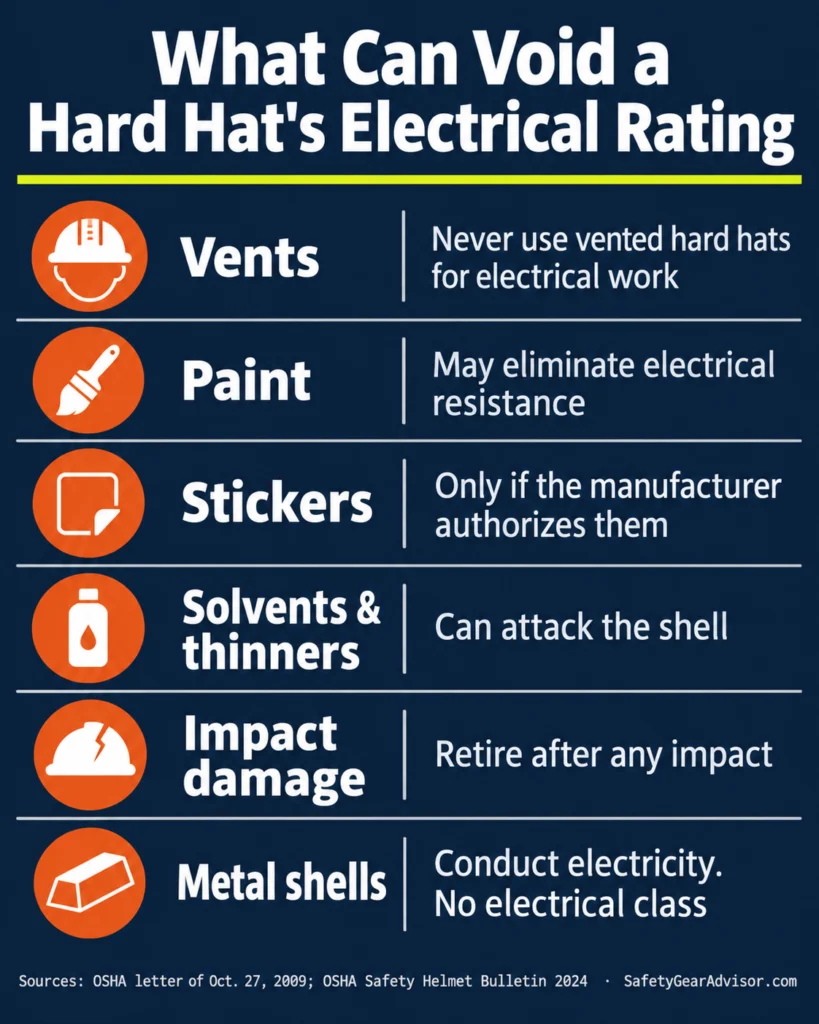
Rating-killer checklist. Check every electrically rated hat against it:
- Vents. OSHA’s 2024 bulletin says vented hard hats and helmets can’t be used for electrical work. Openings in the shell defeat the insulation the class depends on.
- Paint. OSHA’s October 27, 2009 letter says paint may eliminate electrical resistance, and that “paints, thinners, and solvents” can attack the shell itself.
- Stickers. The same letter allows paint and stickers only if the manufacturer authorizes them, or the employer can show the helmet’s reliability isn’t affected. Either way, they mustn’t hide cracks or damage; OSHA gives “see-through stickers” as an example.
- Impact damage. OSHA’s 2024 bulletin says to retire any helmet that has taken an impact, even with no visible damage. A cracked shell is a path for current.
- Conductive materials. Metal hard hats conduct electricity by nature. OSHA’s 2002 letter accepted an aluminum hard hat for a delivery driver, a situation with no stated electrical exposure, not for work near conductors.
- Unapproved accessories. Use only accessories the helmet’s manufacturer approves (OSHA 2024 bulletin), since add-ons aren’t covered by the class test.
When Is a Class C Hard Hat the Right Choice?
Class C is the right choice only where your hazard assessment finds no electrical exposure to the head. It gives the same impact protection as other hats of its Type, usually with vents for airflow, but no insulation. That makes it a reasonable pick for hot, non-electrical work, and the wrong hat anywhere conductors could contact the head.
Ventilation is the reason Class C exists. Distributors such as Ferguson and United Rentals describe Class C hats as lightweight and often vented for breathability, at the cost of electrical protection. Ferguson says most HVAC/R technicians keep both a Type II Class G and a Type II Class C hat on hand, switching by task.
If you use Class C on a site with any electrical work, make the rule visible. Mark Class C hats or limit them to defined areas, so a vented hat doesn’t drift into a crew working near energized equipment.
Common Mistakes With Hard Hat Electrical Classes
Most class mistakes come from reading the voltage as a limit, assuming every hard hat insulates, or customizing a rated hat until its rating no longer holds. Each one is answered by OSHA’s rules, its letters of interpretation, or the standard’s test method.
- Treating 20,000 V as a safe-contact limit. It’s a proof-test voltage for an intact shell, not permission to touch a conductor.
- Wearing Class C near energized parts. OSHA’s 1979 letter and 1910.335(a)(1)(iv) both rule it out.
- Using a vented Class E look-alike for electrical work. Vented shells can’t be used for electrical work (OSHA 2024 bulletin), whatever the marketing says.
- Decorating a Class E hat with stickers and paint. OSHA’s 2009 letter warns these may eliminate electrical resistance. Follow the manufacturer’s instructions.
- Assuming the hat protects the whole body. The rating covers the head only; gloves, sleeves and footwear have their own electrical ratings.
- Confusing Class with Type. A Type II hat isn’t automatically Class E. See our Type 1 vs Type 2 hard hat guide for the impact side.
Frequently Asked Questions
Is Class E better than Class G? For electrical protection, yes. A Class E hard hat is proof-tested at 20,000 volts, against 2,200 volts for Class G, with a burn-through check at 30,000 volts under the 2009 edition of ANSI/ISEA Z89.1. Where Class G is the minimum, Class E exceeds it. Impact protection depends on Type, not Class, so a Class E hat isn’t automatically better against falling objects.
What does 20,000 volts on a Class E hard hat actually mean? It’s the voltage the shell withstood in a three-minute laboratory proof test, with leakage current held to 9 milliamps, under ANSI/ISEA Z89.1-2009. It shows the insulation of a new, intact shell. It doesn’t mean contact with a 20,000-volt conductor is safe, and the protection covers the head only. Keep approach distances and other electrical protective equipment in place.
Which hard hat class do electricians need? At minimum, a nonconductive hat: Class G or Class E. OSHA’s 29 CFR 1910.335(a)(1)(iv) requires “nonconductive head protection” wherever there’s danger from contact with exposed energized parts. Construction workers exposed to high-voltage shock and burns need head protection meeting the standard’s electrical insulation section, which means Class E. Standardizing on Class E covers both cases with one hat.
Can you use a Class C hard hat on a construction site? Yes, but only where there’s no electrical exposure to the head. OSHA said in a 1979 letter of interpretation that a Class C helmet is acceptable on construction projects for protection against falling and flying objects, but “provides no protection for electrical hazards.” Under 29 CFR 1926.100, workers exposed to electrical shock and burns need electrically rated head protection instead.
Do stickers void a hard hat’s electrical rating? They can. In an October 27, 2009 letter, OSHA said “paints and stickers may eliminate electrical resistance” and can hide cracks or damage. OSHA doesn’t ban them outright: they’re acceptable if the manufacturer authorizes them, or the employer can show reliability isn’t affected, and they don’t conceal defects. Check the manufacturer’s instructions before decorating a Class E or Class G hat.
Can a vented hard hat be used for electrical work? No. OSHA’s 2024 Safety and Health Information Bulletin on safety helmets states that vented hard hats and helmets can’t be used for electrical work. Distributors such as PK Safety note that vented designs are sold as Class C for that reason. If your crews need airflow and electrical protection, look for non-vented Class E or Class G models with other cooling features, and confirm the class on the label.
Does a Class E hard hat protect against arc flash? Not by its class rating. Class E is an electrical insulation test against shock through the shell; it says nothing about the heat energy of an arc flash. OSHA separately requires eye and face protection wherever there’s danger from electric arcs or flashes (29 CFR 1910.335(a)(1)(iii)). Arc-rated face shields and clothing are selected through a separate process.
Can a metal hard hat ever be electrically rated? No. Metal conducts electricity, so metal hard hats offer no electrical insulation and fall outside Classes G and E. OSHA accepted an aluminum hard hat in a 2002 letter of interpretation for a delivery driver, a situation with no stated electrical exposure. Anywhere conductors could contact the head, use a non-vented, nonconductive Class G or Class E hat instead.
Where to Go Next
- Head Protection guide: hard hats, safety helmets and bump caps compared by hazard, with a full label chart.
- Bump cap vs hard hat: when a bump cap is enough, and why it has no electrical rating.
- ANSI Z89.1 hard hat standard explained: how Class, Type and edition appear on the label, and every test limit.
- OSHA hard hat requirements: when hard hats are required and what employers must do, from the hazard assessment to paying for them.
- Type 1 vs Type 2 hard hat: the impact side of the label: top-only vs top-and-side protection.
- Hard hat vs safety helmet: how the two differ in design, chin straps and side protection, and when a safety helmet is the better choice.
Sources: 29 CFR 1910.135 (eCFR); 29 CFR 1910.335 (Cornell LII); 29 CFR 1926.100 (osha.gov); OSHA letters of interpretation dated December 17, 1979, June 25, 2002 and October 27, 2009; OSHA SHIB 3-6-2024; ANSI/ISEA Z89.1-2009 (law.resource.org); ISEA Z89.1-2026 announcement; MSA Safety; Ferguson; Zoro; University of Kentucky OHS.