

Day one on site, someone hands you a hard hat, and nobody shows you how to adjust it or tells you how old it is. This guide covers how to wear a hard hat so it actually protects you, plus how to check it each shift and when to retire it, for U.S. workplaces.
Wear a hard hat level on your head, brim forward, with the suspension adjusted snug but not tight and nothing between the suspension and the shell. Only wear it backwards if the label carries a reverse-wear mark. Inspect it before each use, and replace it after any impact or on the manufacturer’s schedule.
What You Need to Know
- The suspension does the work. It holds the shell off your head, so a hat that sits directly on your skull, or has a cap stuffed under it, loses protection.
- Backwards is allowed only with a reverse-wear mark. OSHA’s 2024 bulletin says only head protection with that label or mark can be worn in reverse.
- There are two clocks. MSA and 3M say to replace the suspension at least every 12 months. Shells last up to five years, depending on the maker and the environment.
- The date code is the manufacture date, not an expiry date. MSA counts service life from first use, so write the in-service date inside the shell.
- Any impact ends its life. OSHA’s bulletin says to retire impacted head protection immediately, even if you can’t see damage.
How Do You Wear a Hard Hat Correctly?
Put the hard hat on level, brim facing forward, then tighten the ratchet or pin-lock until the headband is snug all the way round. The crown straps should hold the shell clear of your head, and nothing should sit between them and the shell. Add a chin strap where the hat could fall off.
Follow these steps every time you put it on:
- Check the suspension is installed properly. 3M ships its H-700 hard hats with the suspension uninstalled “to prevent distortion during shipping.” Each key must be pressed fully into its slot, with the brow pad toward the front brim.
- Open the headband fully. On a ratchet suspension, turn the knob counterclockwise to its largest size before you put the hat on.
- Put the hat on level. It should sit straight, not tipped back on your head or tilted to one side. Pushed back, it leaves your forehead exposed.
- Tighten until snug. Turn the ratchet clockwise until the headband grips evenly. 3M’s instructions warn: “DO NOT OVERTIGHTEN.” OSHA’s bulletin says head protection “should not be too loose or too tight.”
- Fasten the chin strap if you have one. OSHA’s 2024 bulletin says chin straps “should be considered for use with all head protection,” especially when working at height.
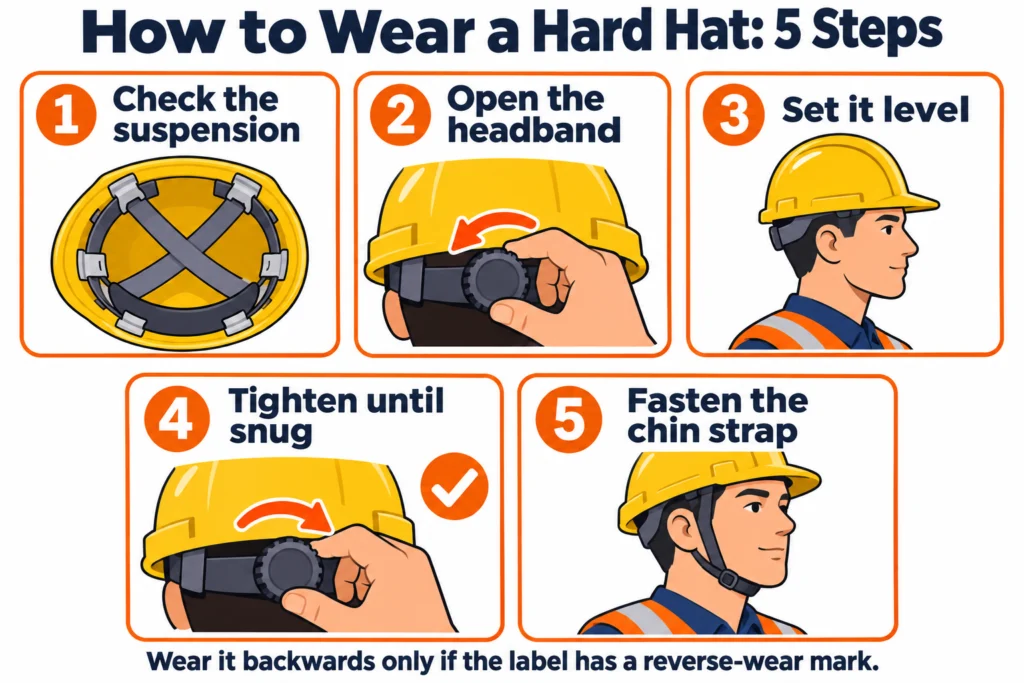
Then do a quick check: look down and turn your head from side to side; if the hat shifts or slides, tighten it a little more.
How Should a Hard Hat Fit?
A hard hat should fit snug enough to stay put when you bend over, without pressure points or red marks after a few minutes. OSHA’s 2024 safety helmet bulletin says to “adjust the suspension system to achieve a snug fit without excessive pressure points.” If it’s comfortable but slides, it’s too loose.
Two adjustments decide the fit:
- Headband size: the ratchet or pin-lock sets the circumference. Adjust it each time you change what you’re wearing on your head, for example adding a winter liner.
- Crown height: most suspensions have high, medium and low settings, changed by moving the keys into different slots. 3M ships its standard suspension at medium height and says to “ensure that both sides are at the same height level.”
The crown height matters more than most people realize. The straps keep a gap between your head and the shell, and that gap is part of how the hat absorbs a blow. Never store gloves, earplugs or anything else in that space; 3M’s instructions say, “Do not store objects between the suspension and the shell.”
Can You Wear a Hard Hat Backwards?
Only if the hat is marked for it. OSHA’s 2024 bulletin states that “only head protection having a reverse-wearing label or mark can be worn in reverse.” Look for the reverse-donning arrow on the label inside the shell. Without it, the hat wasn’t tested that way, so wear the brim forward.
Many toolbox talks still teach “never wear it backwards.” That rule dates from the 1969 edition of ANSI Z89.1, which tested hats only with the bill to the front. In a 2011 letter, OSHA confirmed it allows bill-to-the-rear wear when the manufacturer certifies the hat for it. It also noted that the 2009 edition of ANSI Z89.1 “contains provisions for testing a hard hat with the bill to the rear.”
If your hat is marked, reverse the suspension too. 3M’s instructions say that for reverse wear, the brow pad goes toward the back of the hat. For what the other label markings mean, see our guide to the ANSI Z89.1 hard hat standard.
What Can You Wear Under a Hard Hat?
Only a liner made for your hard hat. OSHA’s 2006 interpretation letter says the rules don’t specifically ban cold-weather headwear, but anything that detracts from the hat’s protection could break 29 CFR 1926.100. OSHA therefore recommends employers “permit only liners that are specifically designed” for the hard hat.
In practice, that rules out most of what people reach for:
| Item | OK under a hard hat? | Why |
|---|---|---|
| Winter liner made for your hat model | Yes | OSHA reads the ANSI standard’s “winter liners” as liners designed to be compatible with the hat |
| Beanie, hoodie hood or knit cap | Not recommended | OSHA says employers usually can’t tell whether a garment compromises protection |
| Baseball cap | No | NIOSH’s construction safety guidance says don’t wear a ball cap under your hard hat, so the space between shell and head stays clear |
| Cooling pad or sweatband the maker sells for that hat | Yes, if the maker approves it | It’s an approved accessory for that model |
Check the maker’s instructions as well. In the same letter, OSHA quotes Bullard’s advice that users should never wear anything inside a hard hat, because it may reduce the clearance between the shell and your head.
For choosing a liner and the LT mark, see hard hat winter liner.
How Long Do Hard Hats Last?
There’s no single legal expiry date. OSHA’s 2024 bulletin tells you to “refer to the manufacturer’s guidelines for recommended lifespan,” and leading makers set the suspension at about 12 months and the shell at up to five years. Harsh sun, heat or chemicals shorten both, and any impact ends the hat’s life immediately.
The two parts age separately. The suspension takes sweat, flexing and adjustment every day, so it wears out first. The shell degrades mainly from UV light, heat and chemicals. Here’s what three major manufacturers say:
| Manufacturer | Suspension | Shell | When the clock starts |
|---|---|---|---|
| MSA (V-Gard and others) | No more than 12 months | No more than 5 years; possibly as little as 2 in harsh conditions | Date of first use (MSA blog, 2019) |
| 3M (H-700/H-800 series) | At least every 12 months | Within 5 years, depending on work environment | Not stated in the H-700 manual |
| Bullard | Every 12 months on average | 2 years where exposure to heat, sunlight or chemicals is high; many employers replace all caps every 5 years | Not stated on its replacement page |
Two details surprise most people. First, MSA’s spec sheet for its V-Gard GREEN hard hat lists a storage life of two years from the date of manufacture, so a hat can age in the box. Second, Bullard says dropping a hard hat “more than eight to 10 feet warrants a replacement,” even if it looks fine.
A replacement suspension doesn’t reset the shell’s clock. Use only the original manufacturer’s parts. MSA warns that incorrect parts can void the certification.
How Do You Read a Hard Hat Date Code?
Look under the brim or inside the shell for a small clock-face stamp. On MSA’s standard caps and hats, the large number in the center is the year, and the arrow points to the month on the outer ring. A dial with “24” in the center and the arrow on 3 means the shell was molded in March 2024.
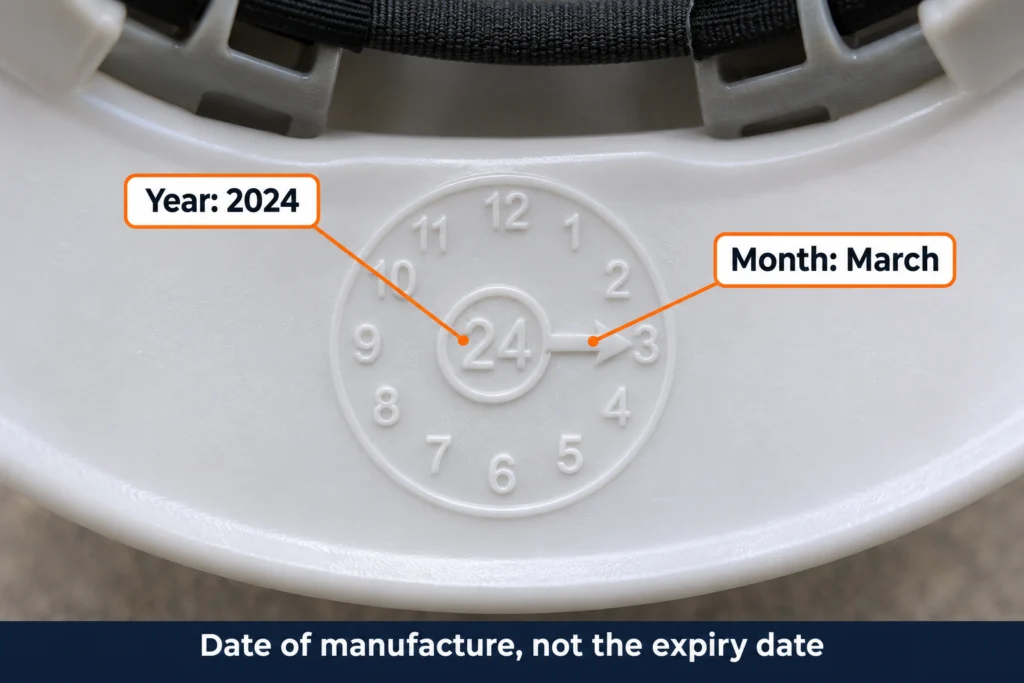
Worked example (MSA rules):
- Shell date code: March 2024. The hat sat in a store room until it was issued.
- First use: June 2025. Write “In service 06/2025” on the label inside the shell.
- Suspension due: June 2026 at the latest (12 months from first use).
- Shell due: June 2030 at the latest (5 years from first use), sooner if it shows damage or a harsh environment shortens it.
Check the suspension’s date too. MSA says suspensions are marked with their own month and year of manufacture, plus the headband size. If the suspension in an older hat has been replaced, the two dates won’t match, and that’s normal.
Not every code is a dial. MSA’s Skullgard helmets use a different stamp: four years printed in the center, each surrounded by four medallions, one of which is dotted for each quarter that has passed. Some older stamps also include a separate day dial.
Some 3M shells carry a fourth signal: a UV sensor. 3M says to replace the shell when the sensor turns white.
Hard Hat Inspection Checklist
Inspect your hard hat before each use; it takes about a minute. OSHA’s 2024 bulletin lists the core checks: shell, suspension and chin strap, labels, accessories and fit. It also asks you to record each inspection. If anything fails, take the hat out of service and replace the part or the whole hat.
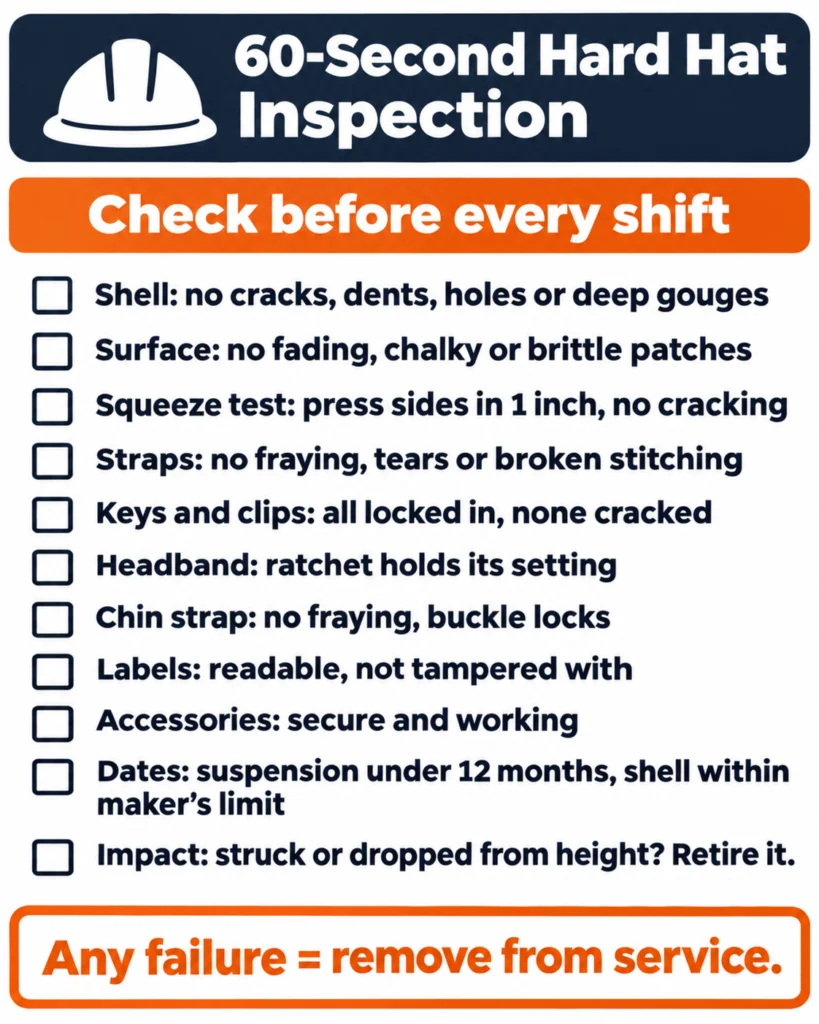
Before each shift (60 seconds):
- Shell: no cracks, dents, holes or deep gouges. OSHA’s bulletin lists cracks and dents as signs of damage.
- Shell surface: no fading, chalky texture or brittleness. MSA says fading means sunlight or UV has started weakening the shell.
- Squeeze test: Bullard’s test is to compress the shell inward from the sides about 1 inch (2.5 cm) with both hands. If it cracks, replace it immediately.
- Suspension straps: no fraying, tears or damaged stitching. MSA says to remove frayed or ripped webbing immediately.
- Suspension keys and clips: every key locked into its slot, no cracked or weakened plastic clips.
- Headband: the ratchet or pin-lock holds its setting.
- Chin strap (if fitted): no fraying, and the buckle locks.
- Labels: legible and not tampered with, as OSHA’s bulletin requires.
- Accessories: earmuffs, face shields and lamp clips securely fastened and working, per OSHA’s bulletin.
- Dates: suspension under 12 months from first use; shell within the maker’s limit.
- Impact history: if it has taken a blow or fallen from height, retire it.
For employers, OSHA’s bulletin recommends you “maintain a record of each inspection, noting the date, any findings, and actions taken” and document the purchase date. A simple log with the hat number, first-use date and inspection date does both.
How Do You Clean and Store a Hard Hat?
Clean the shell and suspension with mild soap and warm water, rinse, and let them air-dry. Store the hard hat out of direct sunlight and away from heat and chemicals. Never leave it on a vehicle dashboard or rear window shelf, where sunlight and heat build up.
Cleaning:
- OSHA’s bulletin: “After each use, clean the exterior of head protection with mild soap and water,” then air-dry it.
- MSA’s V-Gard H1 instructions: don’t use detergents. Don’t use paint thinner, solvents, hydrocarbon cleaners such as MEK, gasoline or kerosene, because “these substances can cause damage that you cannot see.”
- Clean the suspension as well. MSA says to keep it clean to prevent skin irritation.
Storage:
- 3M says to store hard hats out of direct sunlight, “including the dashboard or rear window shelf of a vehicle,” and away from heat above 120°F (49°C).
- OSHA’s bulletin says not to store head protection in your car or anywhere exposed to direct sunlight or extreme temperatures.
- Don’t drop it or use it as a support. MSA’s instructions say not to let the helmet fall to the ground or use it as a support.
Common Mistakes That Shorten a Hard Hat’s Life
Most of the things that cut a hard hat’s protection happen after you buy it. Wearing it pushed back, filling the crown, painting the shell, mixing parts and keeping it after a strike all reduce protection, and some of that damage can’t be seen.
- Wearing it on the back of your head. It exposes your forehead and the brim stops doing its job.
- Stuffing gloves or earplugs into the crown. They fill the space the suspension needs.
- Painting it or covering it in stickers. In a 2009 letter, OSHA said painting or applying stickers must follow the manufacturer’s instructions, unless the employer can show the hat is equally protective. Stickers also mustn’t hide defects. MSA says decals are fine if they’re non-metallic, their adhesive won’t damage the shell and they sit at least ½ inch from the edge. 3M’s H-700 instructions say not to use paints, solvents or adhesives on the hat at all.
- Drilling holes or mixing parts. Never fit a suspension from another brand or model. MSA warns that incorrect parts can void the certification.
- Keeping it after a drop or a strike. OSHA’s bulletin says to retire it immediately, “even if there is no visible damage.”
- Treating the date code as an expiry date. It’s the manufacture date. Write the in-service date inside the shell so you know when each clock started.
- Replacing the shell on schedule but never the suspension. The suspension is on a 12-month clock at MSA and 3M, so it’s due well before the shell.
Choosing the right hat matters too. Whether you need Type I or Type II protection and which electrical class depends on your hazards, not on how the hat looks.
Frequently Asked Questions
How do you use head protection safely?
Use head protection that matches your hazards, wear it level with the suspension snug, and inspect it before each use. OSHA’s rules, 29 CFR 1910.135 and 1926.100, require head protection wherever falling or flying objects, impact or electrical contact could injure your head. Replace it after any impact and on the manufacturer’s schedule, and keep it out of hot vehicles. See OSHA hard hat requirements for when it’s required.
Can you wear a beanie or baseball cap under a hard hat?
Not unless it’s a liner made for your hard hat. OSHA’s 2006 interpretation letter says the rules don’t specifically ban cold-weather headwear, but anything that reduces the hat’s protection could violate 29 CFR 1926.100. Because employers usually can’t tell whether a beanie does that, OSHA recommends allowing only liners designed for the hat. A baseball cap also stops the hard hat sitting level.
Can you put stickers on a hard hat?
Yes, if the manufacturer allows it. OSHA’s 2009 letter says stickers and paint must follow the manufacturer’s instructions, unless the employer can show the hat stays equally protective, and they must not hide defects. MSA allows non-metallic decals with a safe adhesive, at least ½ inch from the edge. Some makers, including 3M for its H-700 series, say not to use adhesives at all.
Does a hard hat need a chin strap?
OSHA doesn’t require one on every hard hat, but its 2024 safety helmet bulletin says chin straps “should be considered for use with all head protection.” It specifically recommends them for work at height, to stop the hat falling off, and suggests construction employers consider Type II head protection with chin straps. If your hat takes a strap, use the one the manufacturer sells for that model.
Do you have to replace a hard hat after you drop it?
If it fell from height, yes. Bullard says dropping a hard hat more than eight to 10 feet warrants replacement. After any drop, inspect the shell and suspension before wearing it again. Any hat that has been struck by an object must be retired immediately, even with no visible damage, according to OSHA’s 2024 bulletin and the instructions from MSA, 3M and Bullard.
Can you replace just the suspension on a hard hat?
Yes, and you’re expected to. MSA and 3M both say to replace the suspension at least every 12 months, while the shell lasts longer. Use only the manufacturer’s replacement suspension for that shell, because MSA warns that incorrect parts can void the certification. A new suspension doesn’t extend the shell’s service life, so keep tracking the shell’s own date.
Does a hard hat expire if it’s never been worn?
It can. MSA counts service life from first use, but its V-Gard GREEN spec sheet lists a storage life of two years from the date of manufacture when stored as directed. Check the date code before issuing a hat from stock, and follow the storage limits in that model’s instructions. A hat stored in heat or sunlight can degrade before anyone wears it.
Where to Go Next
- Head Protection guide: hard hats, safety helmets and bump caps compared by hazard, with a full label chart.
- Type 1 vs Type 2 hard hat: which impact protection your site needs when it’s time to replace your hats.
- ANSI Z89.1 hard hat standard explained: what every marking on the label means, including reverse wear.
- Hard hat colors meaning: what each color usually signals, green’s two meanings and which color runs coolest.
Sources: OSHA SHIB 3-6-2024, Head Protection: Safety Helmets in the Workplace (osha.gov); OSHA letters of interpretation dated October 27, 2009 (painting and stickers), May 9, 2011 (bill to the rear) and April 17, 2006 (caps under hard hats) (osha.gov); MSA, “Signs You May Need a New Hard Hat” (Sept 3, 2019), V-Gard H1 maintenance instructions and V-Gard GREEN specification sheet; 3M SecureFit H-700 and H-800 Series user instructions; Bullard, “Replacing Your Hard Hat”; NIOSH construction hard hat guidance (CDC Stacks).