
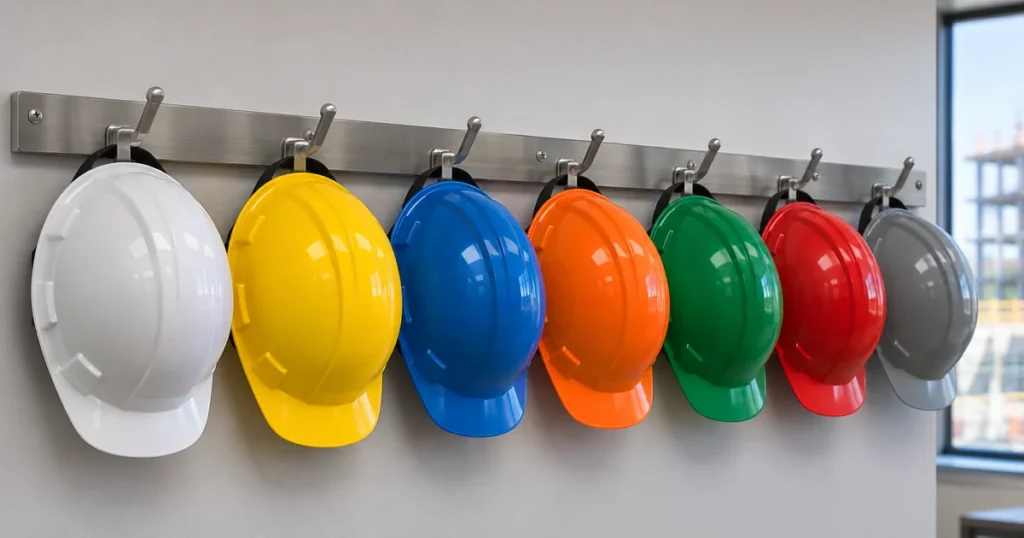
You’ve just walked onto a site where the supervisors wear white, the crane crew wears orange and someone in green is shadowing a crew lead. This guide covers hard hat colors meaning on U.S. sites: what each color usually signals, what the rules actually require, and how to set a color code for your own site.
Hard hat colors usually signal a role: white for managers and supervisors, yellow for general labor, blue for technical trades, orange for road and lifting crews, and green for safety staff or new workers. These are conventions, not law. OSHA doesn’t set hard hat colors, so each employer’s site policy decides.
What You Need to Know
- No federal color code exists. OSHA’s head protection rules set performance, not color, and ANSI/ISEA Z89.1 only adds an optional high-visibility marking.
- Green means two different things. Many sites use it for safety officers, but oil and gas operators use it to flag workers with less than six months on the job.
- The UK does have a written standard. Build UK’s scheme uses black for supervisors, white for managers, orange for slingers and signallers, and blue for everyone else.
- Color changes heat, not protection. In Honeywell’s tests, white shells ran coolest and orange ran hottest.
- Order the color from the maker. Painting a shell can break its certification unless the manufacturer allows it.
What Do Hard Hat Colors Mean?
On most U.S. sites, white means management, yellow means general labor, blue means skilled trades, orange means road or lifting crews, green means safety staff or new hires, brown means hot work, red means emergency roles and gray means visitors. These meanings come from industry habit, so your site’s policy overrides them.
The table below compiles the most common meanings from three widely read guides (DOZR, HSE Blog and Hard Head Veterans). Where they disagree, both meanings are shown.
| Color | Usually worn by (U.S. practice) | Watch out for |
|---|---|---|
| White | Site managers, supervisors, foremen, engineers, architects | Some companies also give white to workers who finish a new-hire program |
| Yellow | General laborers, earthmoving operators | The three guides agree on this one |
| Blue | Carpenters, electricians and other technical trades | Some companies use blue for new hires instead |
| Orange | Road crews, traffic marshals, slingers and signalers | Chosen for visibility near traffic and lifting |
| Green | Safety officers and inspectors, or new workers | The most dangerous mix-up on this list (see below) |
| Brown | Welders and others doing high-heat work | The color signals the role; it doesn’t add heat resistance |
| Red | Fire marshals, emergency response team | Hard Head Veterans adds inspectors |
| Gray | Site visitors, clients, consultants | Visitors should still get a properly sized, certified hat |
| Black | Supervisors (UK standard); management on some U.S. sites | Less common in the U.S.; meaning varies most |
| Pink | Some sites issue it to anyone who forgot their own hat | A site custom, not a role |
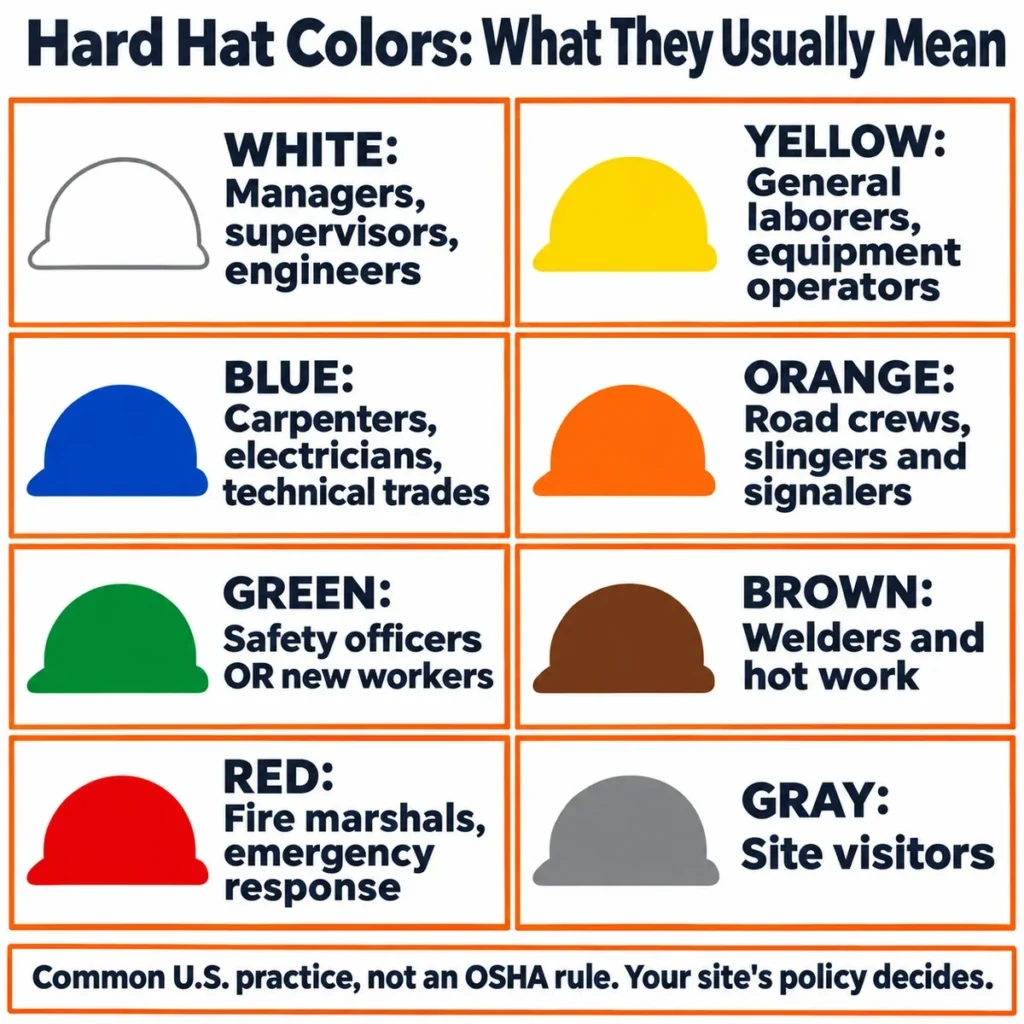
Brown is a good example of why color is only a label. A brown hat tells others the wearer does hot work, but heat resistance comes from the shell material and, where tested, the optional higher-temperature (HT) marking, which 3M lists as a separate rating on its hard hats.
Does OSHA Require Hard Hat Colors?
No. OSHA’s head protection rules, 29 CFR 1910.135 and 1926.100, require head protection built to ANSI Z89.1 or shown to be equally effective, but say nothing about color. OSHA’s only color code, 29 CFR 1910.144, covers marking hazards and equipment, such as red for danger signs and stop bars and yellow for caution.
ANSI/ISEA Z89.1 doesn’t assign colors to roles either. Since its 2009 edition, it has offered an optional high-visibility test and marking for head protection. The 2026 edition renamed that mark from High Visibility (HV) to Enhanced Visibility (EV) without changing the visibility performance.
So a hard hat in any color is compliant if it carries the right Type and Class for your hazards. For when hard hats are required in the first place, see OSHA hard hat requirements, and for what the HV or EV mark on the label means, see the ANSI Z89.1 hard hat standard.
Green Hard Hat Meaning: Safety Officer or New Worker?
A green hard hat can mean opposite things. On many construction sites it marks safety officers and inspectors, the people you go to with a hazard. In oil and gas it often marks a short-service employee, a worker with less than six months’ experience who shouldn’t be left to work alone. Check which system your site uses before assuming.
The oil and gas meaning is formal. In Safety Alert No. 440 (April 28, 2022), the U.S. Bureau of Safety and Environmental Enforcement (BSEE) says “green hard hats and SSE stickers can be used to identify Short Service Employees.” It defines them as workers with less than six months at the facility or in the industry, or who recently changed positions.
Operators write it into contracts. Chevron’s short-service program summary says SSE personnel “must be visibly identifiable e.g. green hard hat,” and Occidental’s contractor rules default to a green hard hat when a contractor’s own program names no other marker.
The danger is a visitor or new worker asking a green-hatted trainee whether something is safe, thinking they’re asking a safety officer. If your site uses green for both, add a second marker, such as a large “SSE” sticker on each side of the shell.
How the U.S., UK and Oil and Gas Color Systems Compare
Three systems are in use. U.S. construction follows custom, the UK has a written industry standard from Build UK, and oil and gas operators use color mainly to flag inexperienced workers. If you work across these sectors or countries, the same color can mean different things.
| Role | Common U.S. practice | Build UK standard (2016, reviewed 2023) | Oil and gas short-service programs |
|---|---|---|---|
| Managers | White | White (site manager, competent operative) | Company color |
| Supervisors | White | Black | Company color |
| Slingers and signalers | Orange | Orange | Company color |
| Vehicle marshals | Orange | White, with a different-colored hi-vis vest | Company color |
| General workers | Yellow | Blue (everyone not in another role) | Company color |
| Visitors | Gray | Blue | Company color |
| New workers | Varies | No separate color | Green, or SSE stickers |
| First aiders and fire marshals | Varies (red for fire roles) | Helmet stickers, not a color | Varies |
Build UK’s standard also says all helmets must meet BS EN 397, BS EN 12492 or BS EN 14052. It notes that Network Rail only permits white and blue helmets on its infrastructure, so even the UK system has exceptions.
Does Hard Hat Color Affect Heat or Protection?
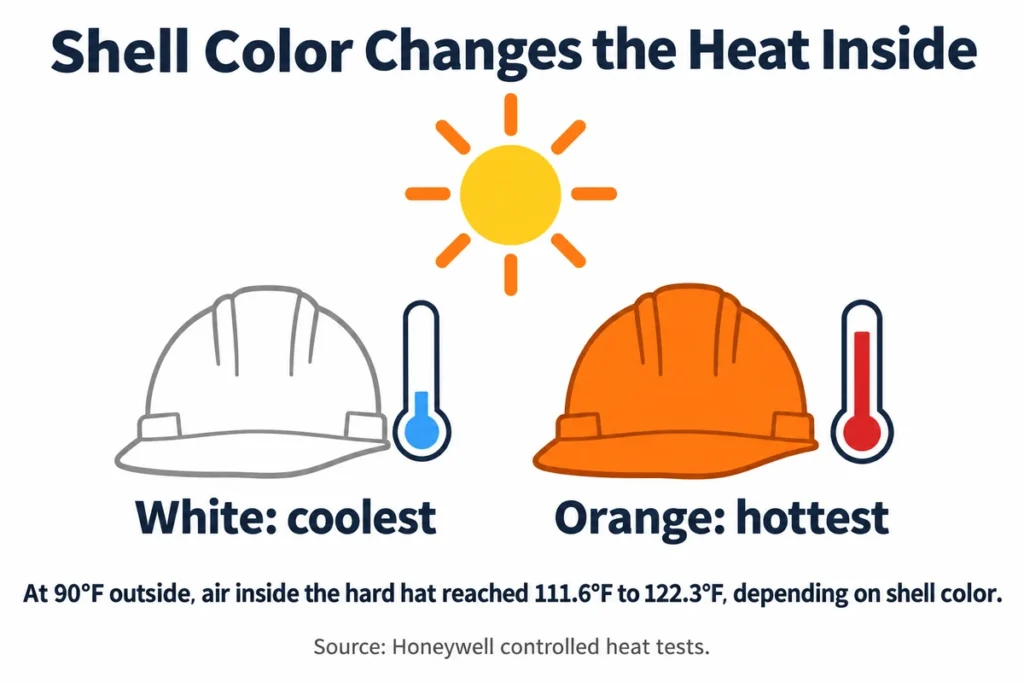
Color doesn’t change a certified hard hat’s impact or electrical rating, but it does change how hot it gets. In Honeywell’s controlled tests, white shells kept the air around the head coolest and orange ran hottest. Lighter colors are the simple fix for hot-weather work.
Honeywell placed identical hard hats in different colors on head forms under an infrared lamp that simulated the sun. At a 90°F ambient temperature, the air gap above the head ranged from 111.6°F to 122.3°F depending on color. It also found the outer shell can get 60 degrees warmer than the surrounding air, and the air inside more than 30 degrees warmer.
A separate outdoor test, published on the American Society of Concrete Contractors (ASCC) website, found white helmets had about a 3% lower inside air temperature than blue ones, both with foam liners. In that test, the foam liner made a bigger difference than the color: 8–12% lower inside temperature.
That puts color policy and comfort in tension. Orange and yellow are often picked for visibility, yet they run hotter. If your crew works in sun near traffic, a white hard hat with a high-visibility vest may be the better trade-off.
How to Set a Hard Hat Color Code for Your Site
Write a short color policy, issue hats in those colors from the manufacturer, and brief everyone on day one, including visitors and subcontractors. Keep it to five or six colors, give each a single meaning, and add stickers for roles like first aider rather than more colors.
- List your roles. Start with management, supervisors, general workers, lifting crews, safety staff, visitors and new hires.
- Assign one color per role. Use the common U.S. meanings in the table above unless a client or sector rule says otherwise.
- Decide what green means, and only one thing. If new hires wear green, give safety staff a different color, or add a visible “SSE” sticker.
- Use stickers for extra roles. Build UK uses helmet stickers for first aiders and fire marshals instead of more colors.
- Write it down and brief it. Put the chart in the site induction and on the gate, and tell subcontractors that your colors apply on your site.
Whatever colors you choose, buy them that way. Don’t paint or wrap a hard hat to change its color; OSHA’s 2009 letter on painting says it must follow the manufacturer’s instructions unless the employer can show the hat stays equally protective. Our how to wear a hard hat guide covers what’s allowed with stickers and paint.
Common Mistakes With Hard Hat Colors
Most color mistakes come from treating a site custom as a universal rule. A color tells you what someone’s job probably is on that site, not what they’re qualified for anywhere else, and not how well the hat protects them.
- Assuming green means “safety officer.” On an oil and gas site, it may mean the least experienced person there.
- Assuming a color makes a hat compliant. Compliance comes from the ANSI Z89.1 label inside the shell, not the color outside.
- Painting old hats to match a new color code. Order the color from the manufacturer instead.
- Choosing dark colors for hot-weather crews. Darker and orange shells ran hotter in Honeywell’s tests.
- Using too many colors. Every added color is one more thing new workers must learn; stickers carry extra roles more clearly.
- Ignoring fading. A faded shell isn’t a new color; MSA says fading shows sunlight or UV has started weakening the shell, which is a replacement sign.
Frequently Asked Questions
White hard hat meaning: who wears white?
A white hard hat usually means management or supervision: site managers, foremen, engineers, architects and supervisors. On U.S. sites this is custom, not a rule, so your site’s color policy decides. Under the UK’s Build UK standard, white marks site managers, competent operatives and vehicle marshals, while supervisors wear black. White is also the coolest color in hot sun, according to Honeywell’s heat tests.
What does a green hard hat mean?
It depends on the site. On many construction sites, green marks safety officers and inspectors. In oil and gas, green often marks a short-service employee, a worker with less than six months’ experience. BSEE’s Safety Alert No. 440 names green hard hats as one way to identify them, and Chevron’s program uses them. If you’re unsure, ask before treating a green hat as the safety contact.
What does a blue hard hat mean?
On most U.S. sites, blue marks technical trades such as carpenters and electricians. Some companies use blue for new employees instead; Faith Technologies, for example, swaps a new hire’s blue hard hat for a white one when they finish its six-month program. Under the UK’s Build UK standard, blue is the default for everyone on site who isn’t a manager, supervisor, slinger or signaller, including visitors.
What does a black hard hat mean?
Black is the supervisor color under the UK’s Build UK standard. In the U.S. it’s less common, and its meaning varies more than any other color: some sites use it for management or foremen, while others don’t use black at all. If you see black hard hats on a U.S. site, check the site’s color chart rather than assuming a role.
Does OSHA require hard hats to be color coded?
No. OSHA’s head protection standards, 29 CFR 1910.135 and 1926.100, require head protection that meets ANSI Z89.1 for the hazards present, but they don’t assign colors to roles. Training quizzes sometimes imply a federal color code; there isn’t one. OSHA’s color rule, 1910.144, covers hazard and equipment marking. Color codes for hard hats are set by employers, clients or industry bodies.
What color hard hat should a visitor wear?
Gray is the most common visitor color on U.S. sites, but your site policy decides. Under the UK’s Build UK standard, visitors wear blue with other general site personnel. Whatever the color, a visitor’s hard hat must still be certified to ANSI Z89.1 for the site’s hazards, correctly sized and adjusted. Visitor hats are shared, so inspect them before each issue.
Can I paint my hard hat a different color?
Only if the manufacturer’s instructions allow it. OSHA’s 2009 letter says painting a hard hat must follow the manufacturer’s guidance unless the employer can show the hat stays equally protective. Some paints and solvents can weaken the shell without visible damage. The safer route is to order hats in the color you need from the manufacturer.
Where to Go Next
- Head Protection guide: color tells you the role, not the protection; this compares hard hats, safety helmets and bump caps by hazard, with a full label chart.
- How to wear a hard hat: before you add stickers or paint for a color code, check what’s allowed, plus fit, date codes and a pre-shift checklist.
- ANSI Z89.1 hard hat standard explained: what the HV/EV visibility mark and the other markings inside the shell actually certify.
- OSHA hard hat requirements: OSHA sets no colors, but it does decide when a hard hat is required and that the employer pays for it.
Sources: 29 CFR 1910.144 (Cornell LII); OSHA letter of interpretation, October 27, 2009 (painting and stickers); BSEE Safety Alert No. 440 (April 28, 2022); Chevron, Summary of SSE Program; Occidental contractor SSE requirements; Faith Technologies SSE program; Build UK, Safety Helmet Colours Standard (2016, reviewed 2023); Honeywell, Beat the Heat hard hat e-guide (2019); ASCC, Heat Effects on Helmets; ISHN on ANSI/ISEA Z89.1-2009; Construction Dive on ANSI/ISEA Z89.1-2026; 3M guide to ANSI hard hats; MSA, “Signs You May Need a New Hard Hat”; DOZR, HSE Blog and Hard Head Veterans color guides.