
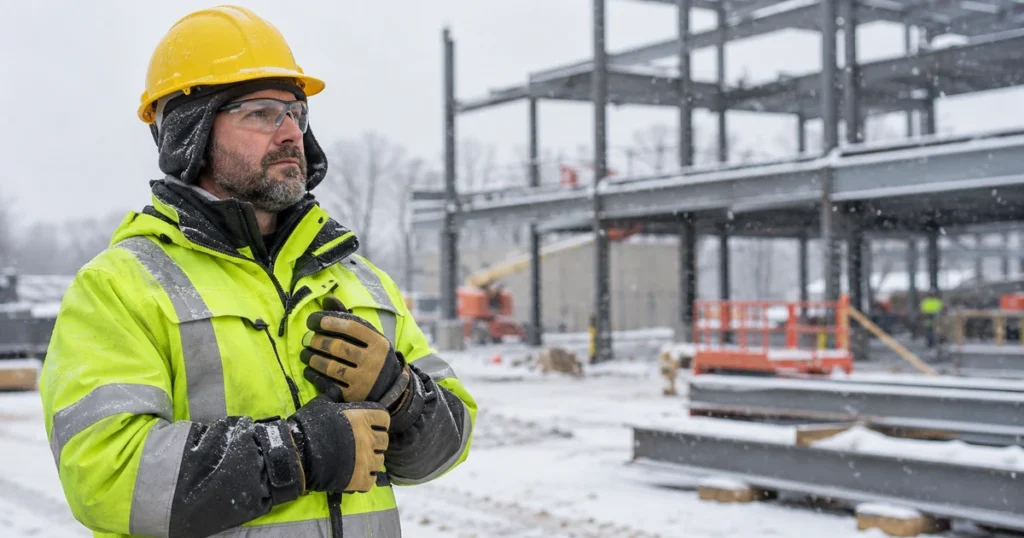
It’s the first freezing morning on site, and the cold is coming straight through your hard hat. Here’s what OSHA says about wearing a hard hat winter liner or a beanie underneath, what the LT mark on your hat means, and how to stay warm without weakening your head protection at U.S. workplaces.
Wear a winter liner made for hard hats, and preferably approved by your hard hat’s maker. OSHA’s 2006 letter says liners designed to be compatible with the hat are not prohibited, and recommends employers permit only those. A regular beanie or hoodie isn’t designed for the hat. For extreme cold, choose a hard hat marked LT.
What You Need to Know
- OSHA allows designed winter liners. Its 2006 letter says a liner “specifically designed to be compatible with the hard hat’s protective properties is not prohibited.”
- Your own beanie is a gray area. OSHA says an employer “typically would not be able to ascertain” whether a regular garment compromises the hat.
- Every certified hard hat is tested cold. The standard cold test is at 0°F; the optional LT mark means it also passed at -22°F.
- Refit the hat after adding a liner. Loosen the headband first, then tighten it until snug over the liner.
- Electrical and arc flash work need the right liner. Some liners have no metal parts or flame-resistant fabric; check the spec sheet.
Can You Wear a Beanie Under a Hard Hat?
Not a regular one, unless your hard hat’s maker approves it. OSHA’s rules don’t specifically ban cold-weather headwear, but OSHA recommends employers “permit only liners that are specifically designed” for the hard hat. A beanie, hoodie or scarf you bought yourself isn’t designed for the hat, so the safe choice is a hard hat winter liner.
There’s a twist. MSA sells beanie-style knit cap liners as part of its own V-Gard winter liner range, so a “beanie” made as a liner for your hard hat is a different thing from a beanie off the shelf. The question isn’t the shape; it’s whether the maker designed it for your hat.
The reason this matters is the gap between your head and the shell. The suspension holds the shell clear of your head, and that space is part of how the hat absorbs a blow. Bullard, quoted in OSHA’s letter, says “hard hat users should never… wear anything inside a hard hat” that could reduce that clearance.
What Does OSHA Say About Winter Liners?
OSHA answered this in an April 17, 2006 letter about wearing caps or other apparel under a hard hat for cold weather. It found that neither 29 CFR 1926.100 nor the ANSI standards it incorporates specifically prohibit cold-weather head garments, and that liners designed for hard hats are permitted.
Here’s what each point of the letter means for you:
| What OSHA’s 2006 letter says | What it means for you |
|---|---|
| The regulations and ANSI standards don’t contain provisions “specifically prohibiting the use of cold weather head garments under hard hats” | There’s no flat ban on wearing something under your hard hat |
| The ANSI standards’ use of “winter liners” indicates they permit liners “specifically designed to be compatible with the protective properties of the helmets” | A liner made for hard hats is allowed |
| If a garment were “to detract from the hard hat’s protective properties,” it could violate the standard | A garment that changes the fit or clearance can be a violation |
| An employer “typically would not be able to ascertain” whether a regular garment’s use violates §1926.100 | That’s why beanies and hoodies are a gray area |
| “We recommend that employers permit only liners that are specifically designed” | Your site can, and often should, ban non-liner headwear |
| OSHA recommends the employer “contact the hard hat manufacturer” about compatibility | Check your hat maker’s list of approved liners |
The letter was written for construction, but the same logic applies in general industry, where 29 CFR 1910.135 also requires ANSI-compliant head protection. For the full OSHA rules, see our OSHA hard hat requirements guide.
Are Hard Hats Safe in the Cold? What the LT Mark Means
Yes, every ANSI-certified hard hat is already tested after cold conditioning. Published test guidance for ANSI/ISEA Z89.1-2009 conditions hats at 0°F before impact and penetration testing. Hats that also pass after conditioning at -22°F (-30°C) can carry the optional LT (lower temperature) mark.
Here’s how the cold tests compare, from published Z89.1 test guidance:
| Test | Temperature | Applies to | Marking |
|---|---|---|---|
| Standard cold conditioning | 0°F (-18°C), in the 2009 edition’s guidance | Every certified hard hat | None needed |
| Lower temperature (optional) | -22°F (-30°C), for at least four hours in the 2009 edition’s guidance | Hats the maker chooses to test | LT on the label |
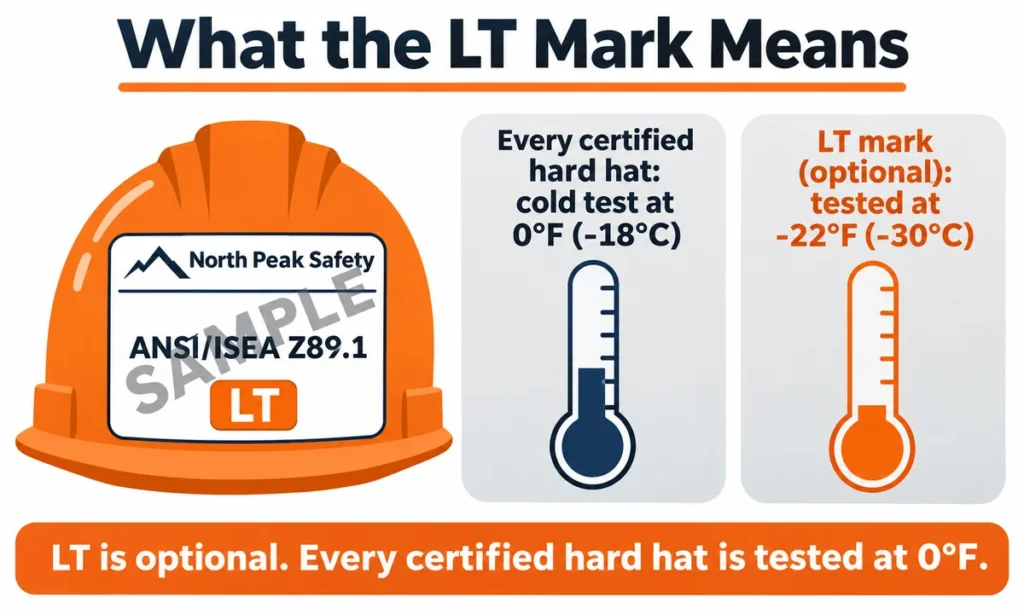
Airgas’s hard hat guide describes the traditional low-temperature test as 0°F, with LT for hats meeting the requirements at -22°F. A published summary of the ANSI/ISEA Z89.1-2009 test guidelines gives the same two temperatures. OSHA’s current rules reference the 2009, 2003 and 1997 editions of Z89.1 and accept later editions shown to be equally effective.
If your site regularly drops toward or below 0°F, look for the LT mark. For what every other marking means, see our ANSI Z89.1 hard hat standard guide.
Which Winter Liner Should You Choose?
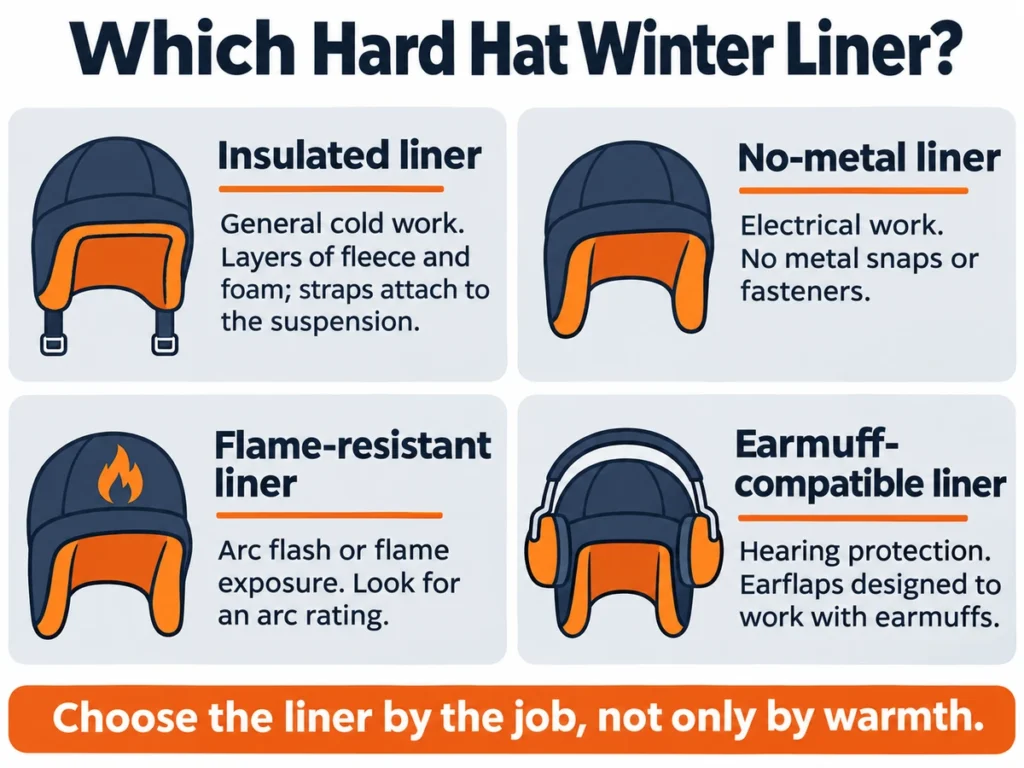
Choose by your job, not only by warmth. For general cold, an insulated liner that straps to the suspension works. For electrical work, choose one with no metal parts. For arc flash exposure, choose a flame-resistant liner with an arc rating. If you wear earmuffs, choose one designed not to reduce hearing protection.
What maker spec sheets list for each need:
| Your need | Liner feature to look for | Example from maker specs |
|---|---|---|
| General cold | Two or three insulated layers; straps that attach to the suspension | Ergodyne N-Ferno 6867: quilted shell, foam mid-layer, fleece lining, four hook-and-loop straps |
| Electrical work | No metal parts | MSA V-Gard Supreme 2-piece: “no metal parts”; Klein Tools 60015: non-metallic touch fasteners; a Honeywell liner listed as dielectric |
| Arc flash or flame exposure | Flame-resistant fabric with an arc rating | MSA V-Gard Supreme: fabric tested to an ATPV of 8 cal/cm² |
| Earmuffs | Earflaps designed for earmuffs | MSA: quilted flaps “allow uncompromised hearing protection levels when using earmuffs” |
| Very low temperatures, face exposed | Extended or face-covering liner | MSA’s knit cap cover tube covers ears, mouth, cheeks and neck |
Flame “retardant” and flame “resistant” aren’t the same thing on spec sheets. MSA says its Select liners keep flame retardancy for up to 50 launderings, while its Supreme liners use flame-resistant fibers in every layer. If your employer’s arc flash assessment requires an arc rating, check the liner’s ATPV against it.
For the electrical rating of the hat itself, see Class E vs G vs C hard hats.
How to Winterize Your Hard Hat in Five Steps
Switching to winter gear takes five minutes, but each step matters. The liner must sit outside the suspension’s working space, the headband must be refitted over the liner, and the hat must still sit level and snug. Here’s the routine to follow at the start of the cold season.
- Check the hat first. Inspect the shell and suspension for cracks, dents or chalky, faded plastic, and replace a damaged hat before winter.
- Choose a liner made for hard hats. Ideally one your hat’s maker approves, with the features your job needs.
- Loosen the headband fully. Turn the ratchet to its largest size before putting the hat on over the liner.
- Attach the liner as the maker says. Many, such as Ergodyne’s N-Ferno liners, use hook-and-loop straps that attach to the suspension.
- Refit and test. Tighten until snug, then look down and turn your head; the hat shouldn’t shift.
For fit, crown height and replacement timelines, see how to wear a hard hat.
How Do You Spot Cold Stress?
Watch for shivering, numbness, and pale or gray skin. OSHA says hypothermia starts when body temperature drops to 95°F or less: mild symptoms are being alert but shivering, and severe symptoms include shivering stopping, confusion, slurred speech and loss of consciousness. Frostbite can happen above freezing because of wind chill.
OSHA has no specific cold-weather standard, but it says employers have a duty under the OSH Act to protect workers from recognized hazards, including cold stress. Its guidance includes:
- Knowing the wind chill temperature and planning the work around it.
- Scheduling breaks in warm areas and gradually introducing new or returning workers to the cold.
- Watching for wetness and dampness, which OSHA lists as a cold stress risk factor; hypothermia can occur even above 40°F if a person is chilled by rain or sweat.
A dry liner matters for the same reason. Swap a sweat-soaked liner for a dry one at breaks if you can.
Common Mistakes With Hard Hats in Winter
Most winter mistakes come from improvising warmth: stuffing a hat under the shell, leaving the headband at its summer size, or picking any liner off the shelf. A liner made for hard hats, a refitted headband and a quick inspection solve most of them.
- Wearing a regular beanie or hoodie under the shell. OSHA recommends only liners designed for the hard hat.
- Not refitting the headband. A headband set for a bare head may be too tight over a liner, and one loosened without retightening lets the hat slide.
- Choosing a liner with metal snaps for electrical work. Pick one listed with no metal parts.
- Assuming “flame retardant” means arc-rated. Check the ATPV if your arc flash assessment requires one.
- Ignoring the LT mark in extreme cold. Below 0°F, look for a hat certified at -22°F.
- Working in a damp liner. Wetness speeds heat loss; carry a spare.
Frequently Asked Questions
Can you wear a beanie under a hard hat?
Not a regular one. OSHA’s 2006 letter says the rules don’t specifically ban cold-weather garments, but an employer “typically would not be able to ascertain” whether one compromises the hat, so OSHA recommends permitting only liners designed for it. Some makers, such as MSA, sell knit cap liners made for their hard hats; those are a different matter from a store-bought beanie.
Does OSHA allow hard hat winter liners?
Yes. OSHA’s April 17, 2006 letter says the ANSI standards’ use of the term “winter liners” indicates they permit liners specifically designed to be compatible with the hard hat’s protective properties, and that using one “is not prohibited.” OSHA also recommends employers contact the hard hat manufacturer to confirm which liners are compatible with the hat they use.
What does LT mean on a hard hat?
LT stands for lower temperature. It’s an optional ANSI/ISEA Z89.1 marking showing the hard hat passed the standard’s tests after conditioning at -22°F (-30°C). Every certified hard hat is already tested after conditioning at 0°F, so LT adds protection for colder work. Look for it if your site regularly drops toward or below 0°F.
Do hard hats crack in the cold?
A certified hard hat in good condition is tested to perform after cold conditioning at 0°F, and LT-marked hats at -22°F. But those tests are on new hats, so inspect yours before winter. Replace any hat with cracks, dents or a chalky, faded surface, and any hat that has taken an impact.
Does a winter liner affect electrical protection?
It can if it has metal parts. Liners made for electrical work list “no metal parts” or non-metallic fasteners, such as MSA’s V-Gard Supreme 2-piece liner and Klein Tools’ 60015 liner. The hat’s electrical Class still comes from the shell’s certification, so check both the hat’s Class and the liner’s spec sheet before electrical work.
Do I need a flame-resistant winter liner?
If your work involves arc flash or open flame, yes, and it should match your employer’s hazard assessment. MSA’s V-Gard Supreme liners use flame-resistant fabric tested to an ATPV of 8 cal/cm², while its Select liners are flame retardant for up to 50 launderings. “Flame retardant” alone doesn’t tell you the arc rating.
Can you wear earmuffs with a winter liner?
Yes, with a liner designed for it. MSA says many of its winter liner models have quilted earflaps designed to allow “uncompromised hearing protection levels when using earmuffs.” Check that your liner is listed as compatible with earmuffs before relying on both together, and ask your hearing protection supplier if you’re unsure.
Where to Go Next
- How to wear a hard hat: refit the headband and check the crown height after adding a liner.
- ANSI Z89.1 hard hat standard: what LT and every other marking on the label certifies.
- Class E vs G vs C hard hats: check the hat’s electrical rating before winter electrical work.
- OSHA hard hat requirements: when OSHA requires head protection and which ANSI editions it references.
- Head Protection guide: hard hats, safety helmets and bump caps compared by hazard, with a full label chart.
Sources: OSHA letter of interpretation, April 17, 2006 (caps or other apparel under a hard hat for cold weather); OSHA Winter Weather and Cold Stress pages; OSHA Cold Stress Quick Card (OSHA 3156); Airgas hard hat safety guide (cold test and LT); published ANSI/ISEA Z89.1-2009 test guidelines (Cobra Carbide); MSA V-Gard winter liner pages and data sheet; Ergodyne N-Ferno 6867 product page; Klein Tools 60015 liner; Honeywell winter liner listing (Avantor); Northern Safety liner article.