
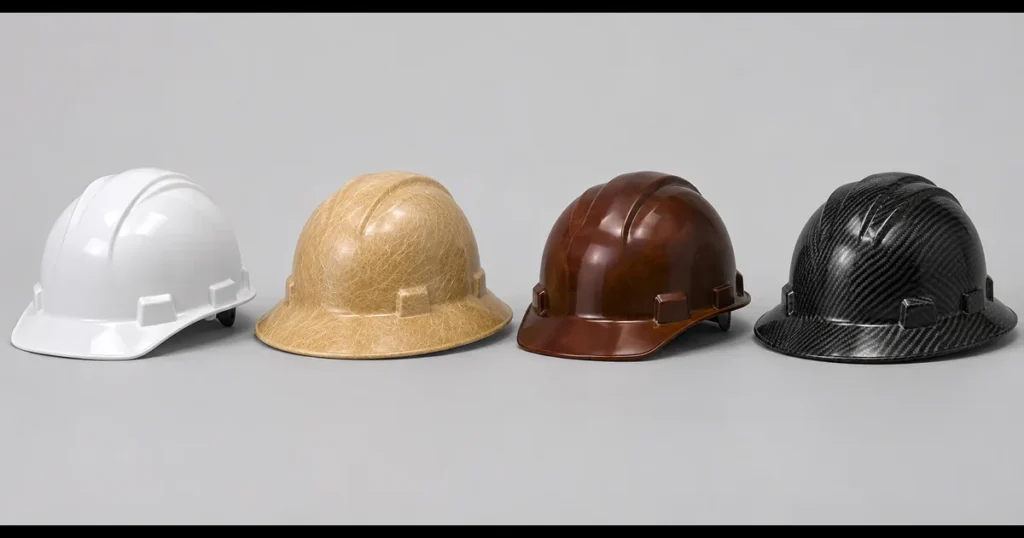
You’re choosing between a $20 plastic hard hat and a $200 carbon fiber one, and the listings all claim to be the toughest. Here’s what the main hard hat materials actually change, checked against the manufacturers’ own spec sheets, so you can match the shell to your hazards for U.S. workplaces.
Most hard hats are HDPE plastic, which is light, cheap and can be Class E for electrical work. Fiberglass and phenolic shells handle more heat but are usually Class G. Carbon fiber is the lightest premium option, but most carbon fiber hard hats are Class C, with no electrical protection. Choose by hazard, then check the label.
What You Need to Know
- Material decides which Class is possible. MSA’s polyethylene V-Gard is Class E; its phenolic Skullgard and Honeywell’s fiberglass Roughneck are Class G; the carbon fiber hats checked here are Class C.
- Carbon fiber isn’t for electrical work. LIFT Safety’s and Klein Tools’ carbon fiber hard hats are rated Class C, which means no electrical protection.
- “350°F” isn’t an ANSI rating. It’s a manufacturer’s radiant-heat claim; the ANSI “HT” mark means the hat passed its tests at 140°F.
- Every certified material meets the same impact test. A cheap HDPE hat and a carbon fiber hat with the same Type passed the same ANSI Z89.1 impact requirements.
- Thermoplastics show UV damage. A chalky, faded or stiff shell means replace it.
What Are Hard Hats Made Of?
Hard hat shells are made from two families of material: thermoplastics such as high-density polyethylene (HDPE), polycarbonate and ABS, and thermoset or composite materials such as fiberglass, phenolic resin and carbon fiber. HDPE is by far the most common; the composites are used mainly for heat or weight.
A University of Kentucky hard hat guide sums up the split: thermoplastics (polyethylene, polycarbonate and others) and thermoset materials (fiberglass and phenolic-impregnated textiles) are commonly used to mold industrial hard hat shells.
- Thermoplastics are molded by melting and cooling. They’re light and cheap, and HDPE is non-conductive, but standard grades handle less heat than composites and degrade in sunlight over time.
- Thermosets and composites are cured with resin, often reinforced with glass or carbon fibers. They resist heat better and hold their shape, but cost more.
The shell is only half the system. The suspension inside does much of the impact work, and the shell and suspension are certified together.
Hard Hat Materials Compared
The best way to compare materials is by what the manufacturers certify: the electrical Class and any heat claims. Here’s what the spec sheets say for real models in each material. Prices vary widely, from HDPE at the low end to carbon fiber at several times the cost.
| Material | Example (maker spec) | Electrical Class | Heat | Best for |
|---|---|---|---|---|
| HDPE (polyethylene) | MSA V-Gard cap | Class E | V-Gard H1 helmet offers the optional ANSI HT mark (tested at 140°F) | General construction, electrical work, most jobs |
| High-heat thermoplastic | Bullard 911 series | Class E and G | Marketed for higher heat resistance than polyethylene | Utilities, welding, foundries |
| Fiberglass | Honeywell Fibre-Metal Roughneck P2 | Class G (and C) | Maker says it meets ANSI impact tests at up to 370°F (P2A) and 500°F (P2HN) | Steel mills, foundries, hot work |
| Phenolic resin | MSA Skullgard | Class G | Tested to radiant heat loads up to 350°F | Steel mills, welding, smelting |
| Fiber-reinforced polymer | Klein Tools Konstruct | Class G | Radiant heat up to 350°F; ANSI LT and HT marks | Hot work with limited electrical risk |
| Carbon fiber | LIFT Safety DAX; Klein Tools carbon fiber | Class C (no electrical protection) | DAX: radiant heat up to 350°F; Klein: ANSI LT and HT marks | Lightweight all-day wear, no electrical hazard |
| ABS / polycarbonate | Common in climbing-style safety helmets | Depends on model | Depends on model | Safety helmets; check the label |
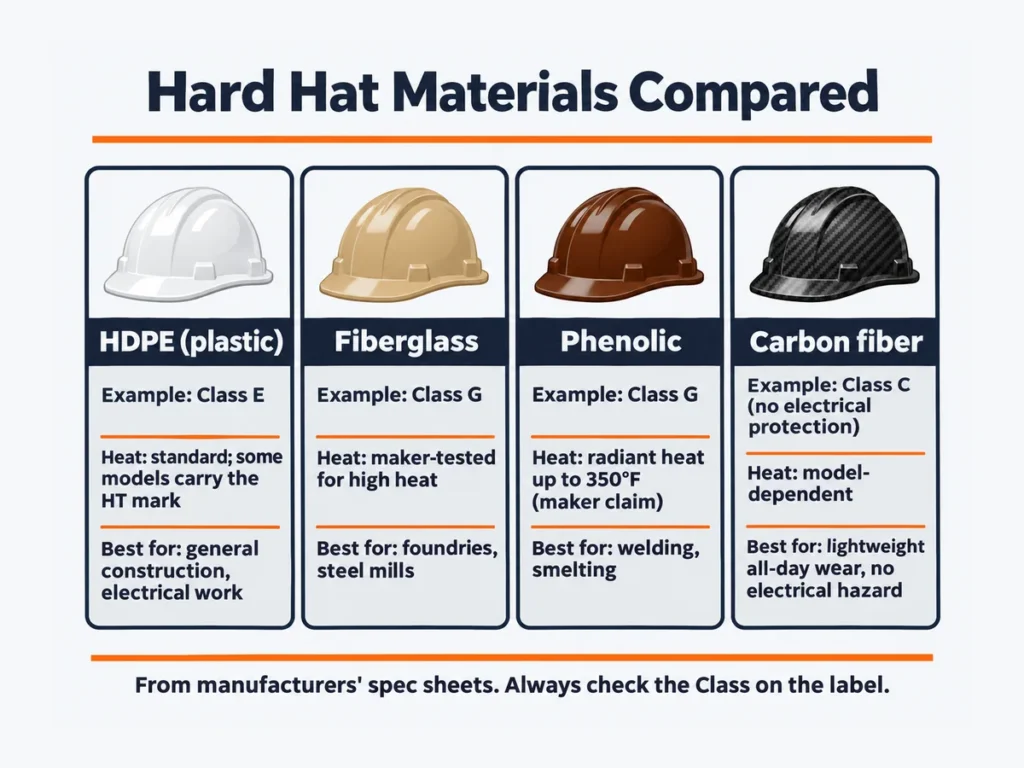
Two patterns stand out. In the spec sheets checked, the Class E hats were HDPE or thermoplastic. The heat-resistant materials (fiberglass, phenolic and fiber-reinforced polymer) were Class G, rated for lower voltages. For what each Class covers, see Class E vs G vs C hard hats.
Are Carbon Fiber Hard Hats Better?
Better for weight and looks, not for every job. Carbon fiber shells are light and stiff, and some carry high radiant-heat claims. But the carbon fiber hard hats checked here are rated Class C, with no electrical protection, and they cost several times more than HDPE. For electrical work, they’re the wrong choice.
What the spec sheets show:
- LIFT Safety DAX carbon fiber: “carbon fiber reinforced resin shell,” ANSI Z89.1 Type I, Class C. LIFT states the shell has been tested to radiant heat loads up to 350°F. LIFT’s product description, as published by distributor NAFECO, gives the carbon fiber shell’s average weight as 315 g without the suspension and 460 g with it.
- Klein Tools carbon fiber hard hats: “True carbon fiber multi layered construction,” Class C, Type 1, with the optional LT and HT marks.
Class C means the hat “is not intended to provide protection against contact with electrical conductors.” So a carbon fiber hat can be a good choice for a site manager or inspector who wears a hard hat all day away from live electrical parts, but not for an electrician.
Carbon fiber is also Type I on most models checked, meaning top impact only. If your hazard assessment calls for side-impact protection, see Type 1 vs Type 2 hard hats.
Which Hard Hat Material Is Best for Heat?
For high heat, choose fiberglass, phenolic or another heat-rated composite. Honeywell’s fiberglass Roughneck P2HN claims impact performance at up to 500°F, and MSA’s phenolic Skullgard is tested to radiant heat loads up to 350°F. Standard HDPE hats like MSA’s V-Gard are rated for general purpose use, not for foundries or steel mills.
But read the heat claims carefully. There are two different things:
| What you see | What it means | Who sets it |
|---|---|---|
| HT mark on the label | Passed the standard’s tests after conditioning at 140°F ± 3.6°F (60°C) | ANSI/ISEA Z89.1 (optional test) |
| LT mark on the label | Passed the tests after conditioning at -22°F (-30°C) | ANSI/ISEA Z89.1 (optional test) |
| “Radiant heat up to 350°F” | The maker’s own radiant-heat test | Manufacturer claim, not an ANSI rating |
| “Meets impact tests at up to 500°F” | The maker ran the ANSI impact test at that temperature | Manufacturer claim, not an ANSI rating |
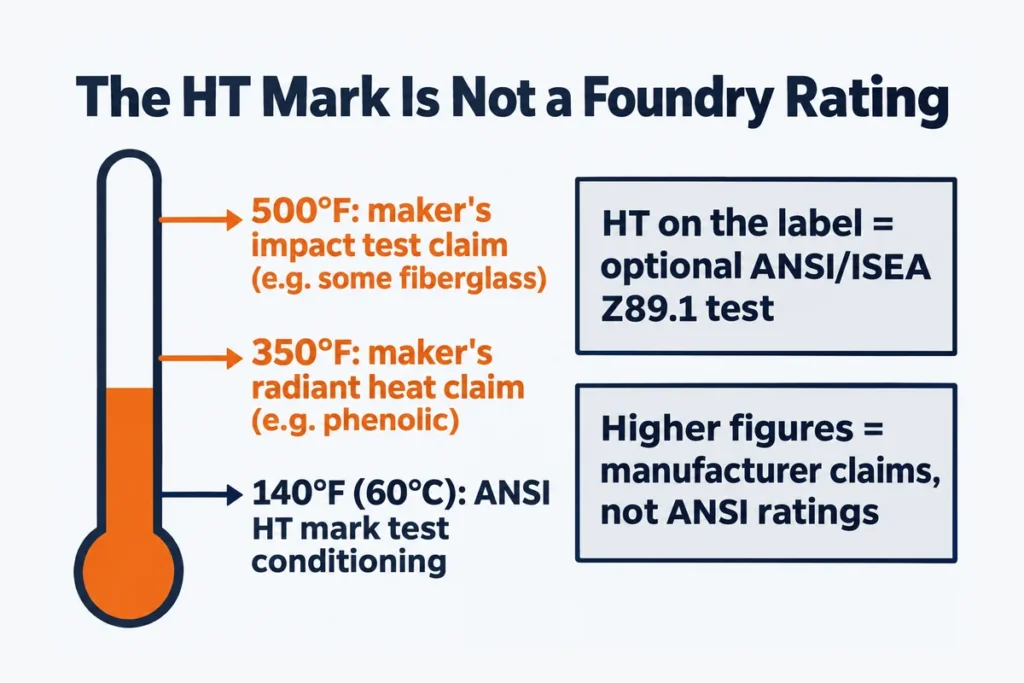
The surprise is the gap between them. The ANSI HT mark, which many buyers assume means “for hot work,” only certifies performance at 140°F. MSA’s own V-Gard H1 spec sheet lists the higher-temperature test as 140°F ± 3.6°F. For foundry or steel-mill heat, look for the manufacturer’s radiant-heat rating as well, and ask the maker what test it used. For the cold end, LT and winter liners are covered in hard hat winter liner.
Shell color also matters in sun. Our hard hat colors meaning guide covers Honeywell’s tests showing white shells run coolest.
Which Material Should You Choose?
Start with your hazards, not the material. If there’s any chance of electrical contact, you need Class E, which in practice usually means HDPE. If there’s high heat with little electrical risk, choose fiberglass or phenolic. If neither applies and weight matters, carbon fiber is an option.
| Your work | Material to look for | Class to check | Why |
|---|---|---|---|
| Electrical work, overhead lines | HDPE or high-heat thermoplastic | Class E | Rated for high-voltage protection |
| General construction | HDPE | Class E or G | Light, cheap, widely available |
| Welding, foundries, steel mills | Fiberglass, phenolic or fiber-reinforced polymer | Class G | Higher heat resistance |
| Hot work near electrical equipment | High-heat thermoplastic (for example Bullard 911) | Class E | Heat resistance and E rating together |
| All-day wear, no electrical hazard | Carbon fiber or HDPE | Class C acceptable | Lighter on the neck; carbon fiber costs more |
| Cold climates | Any material with the LT mark | As needed | Tested at -22°F |
Check three things on the label before you buy: ANSI/ISEA Z89.1, the Type (I or II) and the Class (E, G or C). The material on the listing tells you about weight and heat; the label tells you what the hat is certified for. Our ANSI Z89.1 hard hat standard guide explains every marking. If a premium-material listing makes claims the label doesn’t back up, see how to spot a fake hard hat.
How Long Do Different Hard Hat Materials Last?
Every material wears out, and manufacturers set the service life, not the material type. Thermoplastics such as HDPE show their age through UV damage: a stiff, brittle, faded, dull or chalky shell. Composites are often marketed as more durable, but the maker’s replacement schedule still applies.
The University of Kentucky guide lists the signs of thermoplastic degradation: a shell that becomes stiff, brittle, faded, dull in color or chalky. Any of those means replace the shell. MSA lists its V-Gard shells as HDPE with a UV inhibitor, but Bullard notes that all hard hats are susceptible to ultraviolet damage, even with an inhibitor added.
For composites, LIFT Safety says its suggested replacement is based on service life from when the hat was placed into service, not the manufacture date. Whatever the material, follow your maker’s schedule and inspect before each use. Our how to wear a hard hat guide covers the inspection checklist and each maker’s replacement timeline.
Common Mistakes When Choosing a Hard Hat Material
Most material mistakes come from choosing on looks, price or a heat number without checking the Class and the source of the claim. A premium shell can be the wrong hat for the job, and a basic HDPE hat is often the right one.
- Buying carbon fiber for electrical work. The carbon fiber hats checked here are Class C, with no electrical protection.
- Reading “HT” as “hot work rated.” The ANSI HT test is at 140°F; foundry heat needs the manufacturer’s radiant-heat rating.
- Assuming fiberglass is Class E. The fiberglass and phenolic models checked here are Class G, rated for lower voltages.
- Paying for a premium material you don’t need. If your hazards are falling objects and electrical contact, a Class E HDPE hat is the standard choice.
- Ignoring UV damage on HDPE. A chalky or faded shell is past its life, whatever the date code says.
- Trusting strength claims without context. “Eight times stronger than HDPE” is a maker’s claim; the ANSI impact test is the same pass mark for every certified material.
Frequently Asked Questions
What are hard hats made of?
Most hard hats are made of high-density polyethylene (HDPE), a light, cheap plastic that can be certified Class E for electrical work. Others use fiberglass, phenolic resin or fiber-reinforced polymers for heat resistance, and carbon fiber for low weight. Safety helmets often use ABS or polycarbonate. Inside every shell is a suspension, and the shell and suspension are certified together.
Are carbon fiber hard hats better than HDPE?
Not for every job. Carbon fiber is lighter and stiffer, and some models carry high radiant-heat claims, but the carbon fiber hard hats checked here are Class C, with no electrical protection, and cost several times more. A certified HDPE hat with the same Type passed the same ANSI Z89.1 impact test. Choose carbon fiber for comfort away from electrical hazards.
Can a carbon fiber hard hat be used for electrical work?
Usually not. The carbon fiber hard hats from LIFT Safety and Klein Tools checked for this guide are rated Class C, which isn’t intended to protect against contact with electrical conductors. For work near energized lines or equipment, you need a Class E hard hat, which is most often HDPE or a high-heat thermoplastic. Always check the Class on the label.
Is fiberglass stronger than HDPE?
Honeywell says its fiberglass Roughneck compound is eight times stronger than common HDPE cap shells, but that’s a manufacturer claim. For certification, both materials must pass the same ANSI Z89.1 impact test for their Type. Fiberglass’s real advantage is heat resistance. Its trade-off is electrical rating: the Roughneck P2 is Class G, not Class E.
What does HT mean on a hard hat?
HT is an optional ANSI/ISEA Z89.1 marking meaning the hard hat passed the standard’s tests after conditioning at a higher temperature: 140°F ± 3.6°F (60°C), according to MSA’s V-Gard H1 spec sheet. It isn’t a foundry or welding rating. For extreme heat, look for the manufacturer’s radiant-heat rating, such as MSA Skullgard’s 350°F.
What is the best hard hat material for welding?
A heat-resistant material such as phenolic, fiberglass or a fiber-reinforced polymer. MSA lists welding among the markets for its phenolic Skullgard, which is tested to radiant heat loads up to 350°F, and Honeywell’s fiberglass Roughneck and Bullard’s high-heat 911 series are also aimed at hot work. Check the Class too: if there’s electrical risk, you’ll need a Class E model.
Do hard hat materials affect how long the hat lasts?
Somewhat, but the manufacturer sets the replacement schedule, not the material. HDPE and other thermoplastics degrade in sunlight and show it as a chalky, faded or brittle shell. Composites resist heat and UV better but still have a service life. Follow your manufacturer’s guidance, count from the in-service date where the maker says to, and replace any shell that’s damaged or has taken an impact.
Where to Go Next
- Class E vs G vs C hard hats: the material often decides the Class, so check what each one protects against.
- ANSI Z89.1 hard hat standard explained: what HT, LT and every other marking on the label certifies.
- Hard hat colors meaning: the shell’s color changes heat in sun as much as its material does.
- Hard hat winter liner: for the cold end of the scale, what the LT mark means and which liners keep the hat’s ratings.
- Fake hard hat: how to check that a premium shell’s label and listing claims are genuine.
- How to wear a hard hat: spot UV damage early and follow each maker’s replacement schedule.
- Head Protection guide: hard hats, safety helmets and bump caps compared by hazard, with a full label chart.
Sources: Bullard industrial head protection user information guide (UV damage); MSA V-Gard cap specification sheets (polyethylene, Class E, UV inhibitor); MSA V-Gard H1 specification (LT -22°F, HT 140°F); MSA Skullgard specification (phenolic, Class G, 350°F radiant heat); Honeywell Fibre-Metal Roughneck P2 product page (fiberglass, Class G, 370°F and 500°F); Bullard 911 series listing (thermoplastic, Class E and G); LIFT Safety DAX carbon fiber spec sheets and listings (Class C, 350°F radiant heat, weight); Klein Tools carbon fiber and Konstruct hard hats (Class C and G, LT and HT); University of Kentucky hard hat guide; WC Safety, US Made Supply and Best Reviews material guides.